Skip to main content Scroll Top

Entries

16 Apr: Education, School of

Education, School of

The School of Education traces its origins back to 1877, when the university established a Summer Normal School to provide training for teachers in North Carolina. Teacher training was offered only during the summer until 1885, when the Department of Normal Instruction was established. A graduate program was established in 1896. The name was changed to the Department of Education in 1903 and became the School of Education in 1913. That same year the school moved into Peabody Hall, a new building constructed with support from the Peabody Education Fund, which had long provided resources for teacher training at UNC and other schools.

Education was a popular major at the university in the post—World War II era, with school enrollment increasing around the state. In 1962 the university awarded more graduate degrees in education than in any other major. By the 1990s the school was consistently ranked among the top twenty-five education programs in the country.

The School of Education has often led the way at the university in hiring women faculty. Women began teaching at the Summer Normal School as early as 1878. In 1927 Sallie Marks became the first woman to join the faculty at UNC, and in 1970 Roberta Jackson joined the School of Education, becoming the first tenure-track African American woman at the university.
16 Apr: Eddie Smith Field House

Eddie Smith Field House

Completed in 2001, the Field House was built to serve as the indoor home for UNC—Chapel Hill's track and field teams. It was also used an indoor practice facility for the Tar Heel football team for many years before the team decided to build a dedicated indoor practice field. The Field House is named in honor of Eddie Smith Sr., whose son, Eddie Smith Jr., a 1965 graduate of Carolina, made a significant contribution to support its construction. The building houses the Dick Taylor Track, named in honor of one of the university's great track athletes. Taylor, class of 1950, was a star hurdler at Carolina. He was a native of Lumberton, North Carolina, and UNC-Pembroke, located in his hometown, also has a track named for Taylor.

Date Established: 2001

Date Range: 2001 – Present

EagleHotel_973

16 Apr: Eagle Hotel

Eagle Hotel

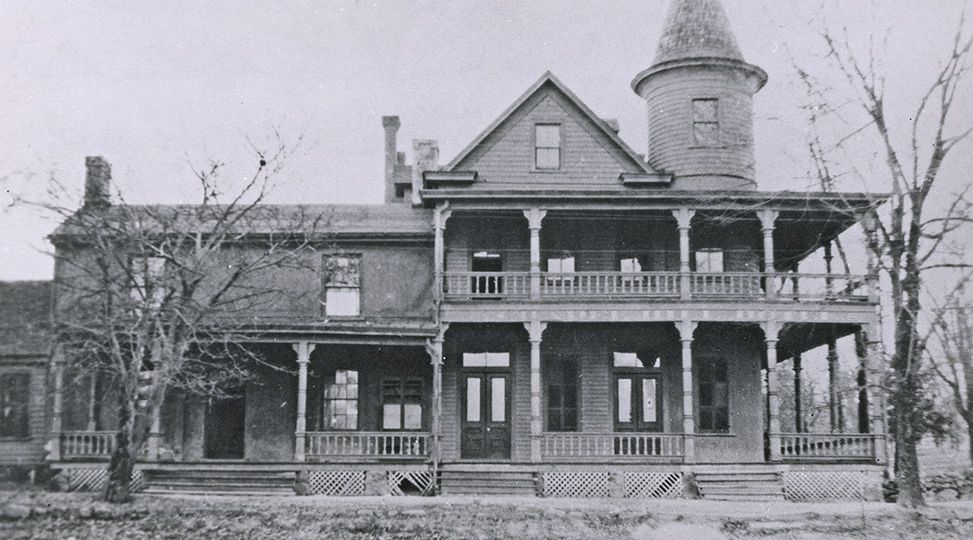
Eagle Hotel once stood on the present site of Graham Memorial Hall on the east side of McCorkle Place. The university's first steward, John "Buck" Taylor, opened a tavern on the site in 1796, which he and his son operated until the 1820s. It was known simply as the Tavern House and, like most such places at the time, was also an inn and gathering place. The property became a hotel in 1823. Sometime in the 1830s Ann Segur Hilliard, known as Miss Nancy, became the proprietor. The establishment was called first the Hilliard Hotel and then the Eagle Hotel. Hilliard added more space and boarded students there, reaching around ninety boarders by 1850. Hilliard ran the establishment with her sister and brother-in-law, Martha and Benton Utley, who enslaved forty-two people. The university paid for trustees to stay there, including their enslaved servants and their horses. As the only place to stay in Chapel Hill, the Eagle was popular with travelers, especially at commencement time. In 1847 Miss Hilliard built an addition to her hotel to welcome U.S. president and alumnus James K. Polk to that year's graduation.

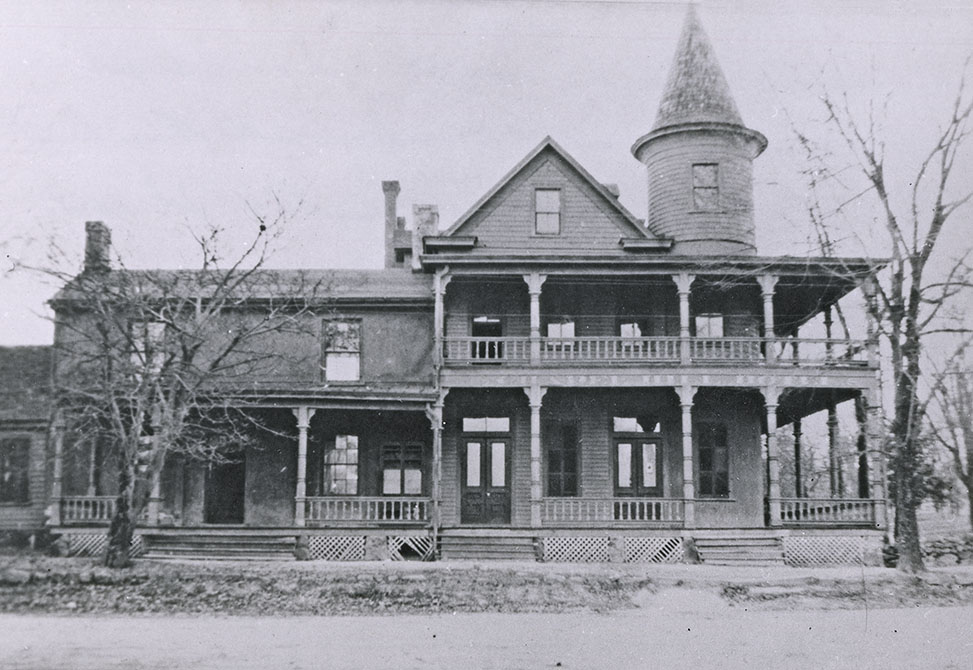
After the Civil War the Eagle Hotel struggled financially. In the 1890s the owners tore down the original tavern building, replacing it with a large Queen Anne—style structure with a large porch. Known as the University Inn, the property did not thrive. The university bought the site in 1908 and used it as a dormitory until it was destroyed by fire in 1921.

In 1993—94 the faculty and students of the UNC Research Laboratories of Archaeology selected the site to conduct an archaeological field school to celebrate the university's bicentennial. The project demonstrated how the labs train undergraduate students in field and laboratory methods in historical archaeology and showcased the work for the public. Several thousand people visited the site during open houses, including hundreds of school children who participated in the excavations. This work provided new evidence and information about the early history of the town and campus.

Date Established: 1796

Date Range: 1796 –
1921

The University Inn (formerly the Eagle Hotel), ca. 1890s. The building was located on the current site of Graham Memorial. North Carolina County Collection, North Carolina Collection Photo Archives, Wilson Library.


16 Apr: Dunce Cap

Dunce Cap

When viewing Wilson Library from South Building, the top of the bell tower is visible, aligned with the center of the dome and looking like an old-fashioned dunce cap atop a student's head. One of the persistent rumors around campus is that this was done deliberately by John Motley Morehead, who was angry when Louis Round Wilson wouldn't let him put the bell tower on top of the library. In fact, Morehead's first suggestion was to put a bell tower on top of South Building. When the trustees rejected this plan, the library was suggested, but Wilson pointed out that loud bells reverberating over a quiet reading room would not make for the best study environment. Morehead was eventually persuaded that a freestanding bell tower would be best and the current site was chosen.

Date Established: 1931

Date Range: 1931 – Present

16 Apr: Dormitories

Dormitories

The university's first dorm was its first building. When Hinton James arrived on campus in 1795, Old East was the only building on campus. It was not long before the number of students outgrew the available space, even with six people in each room. Many of the earliest buildings have housed students at some point in their history, including South Building, Old West, New East, and New West. With the rapid growth of the university in the early twentieth century, there was a significant increase in the construction of dormitories. Vance, Battle, and Pettigrew Halls were completed in 1912 to house students. An additional ten residence halls were built in the 1920s, including Spencer Residence Hall, the first dorm built to house women students. The university continued to use land on the east side of campus for student housing through the 1940s. The post—World War II boom in enrollment saw the most serious housing crisis yet. With thousands of veterans returning to school, the dorms were filled to capacity and the university installed twenty-six Quonset huts as temporary housing. Even with the extra space, a few students were relegated to trailers and even tents on campus.

In the 1950s the university began to look toward South Campus as a growth area for student housing. In 1958 Avery, Parker, and Teague dorms were completed near Kenan Stadium. The most significant change in student housing came a few years later, in 1962, when the high-rise Ehringhaus and Craige dorms opened. The six-floor dorms were followed in 1965 and 1967 by Morrison and Hinton James dorms, both ten stories tall. Located far from north campus, the high-rises were an attempt to make the most economical and efficient use of the dwindling land available to the university. The push to build even bigger and higher dorms did not last long. There was discussion of building a twenty-one-story dorm on campus, but it was canceled. When the university built new dorms in early 2002, they were smaller and designed to bring more of a traditional campus feel to South Campus.

16 Apr: Dixie Classic

Dixie Classic

Dixie Classic was a popular basketball tournament held from 1949 to 1960 in Reynolds Coliseum in Raleigh. Started by N.C. State basketball coach Everett Case, the tournament featured North Carolina's "Big Four" teams (UNC, Duke, N.C. State, and Wake Forest) against top teams from around the country. It was popular with students and alumni and attracted a wide following statewide. The tournament ended in scandal when multiple players —including a couple from UNC —were caught fixing games in exchange for payment from gamblers. The charges cast a pall on basketball for several years. UNC System president William C. Friday limited the number of basketball scholarships and games. The scandal and subsequent reforms contributed to the resignation of UNC coach Frank McGuire and the hiring of his assistant coach, Dean Smith.

Date Established: 1949

Date Range: 1949 –
1960

16 Apr: Dining

Dining

Campus dining halls have been a part of campus life —and students have complained about them —since the earliest days of the university. The second building built on campus, after Old East, was Steward's Hall, which opened in 1795. From the beginning students were unhappy with the food. In petitions to the faculty in 1809, students complained about the quality of food at Steward's Hall, citing "an insufficiency of butter," and beef that is "sometimes tainted, and impregnated with fly-blows." Steward's Hall was eventually leased to a local resident and run as a private business. Many UNC students in the nineteenth and early twentieth centuries got their meals from local boarding houses.

In 1898 the university converted an old gymnasium building into a new dining hall known as Commons Hall. Built on the current site of Phillips Hall, Commons served student meals until 1914, when the much more modern Swain Hall opened. Swain was the main campus dining hall for the next twenty-five years. The opinion of the students about the food offered there can be inferred by the nickname then in regular use, "Swine Hall."

Students never warmed to Swain Hall, and the campus soon outgrew the facility. In 1939 the university opened Lenoir Hall, a large, modern space that could seat up to 1,300 students at a time. Following World War II, students began to have multiple options for eating on campus, including the Pine Room, a snack bar in Lenoir, and the Monogram Club. When campus housing expanded to South Campus in the 1960s, student dining followed. The immediately unpopular Chase Hall cafeteria opened in 1965, and some dorms housed dining facilities.

Campus dining facilities were operated by the university until 1969. Almost immediately following a strike of cafeteria workers who were protesting low pay and poor working conditions, the university outsourced campus dining to Saga Corporation, a company that managed campus dining operations at schools around the country. Saga was soon replaced by Servo-O-Mation, then by ARA, which later changed its named to Aramark and has managed dining at UNC for several decades.

One of the strangest periods in campus dining came in 1997, when privately operated food stands were placed around Polk Place to serve hungry students during a major renovation of Lenoir. The booths, which included one dedicated to corn on the cob, made the campus look like a county fair. When Lenoir reopened it was fully modernized and gave students a wide variety of dining options.

16 Apr: Dialectic and Philanthropic Societies

Dialectic and Philanthropic Societies

Commonly known as the "Di" and "Phi," the Dialectic and Philanthropic Societies are the oldest student organizations at Carolina and were at the heart of student life throughout the university's early history. Students founded a debating society in 1795, less than a year after the university opened. A rival society was founded shortly after, and the groups soon changed their names to the Dialectic Society and Philanthropic Society. They competed for students for several years before agreeing to divide incoming students geographically: those from west of Raleigh would join the Dialectic Society, while those east of Raleigh would join the Philanthropic.

In an era before the university provided any support for student social and nonacademic life, the societies helped with entertainment (participating in and attending formal debates counted as entertainment) and enforced student discipline with a series of fines for bad behavior. They also purchased books, building libraries that, by 1850, would be three times the size of the university's own library. Realizing the importance of the societies in promoting student self-governance, the UNC Board of Trustees in 1885 passed a resolution requiring all students to join one of the two groups. The requirement was in place for only ten years, but the majority of students still joined one of the societies even after they were no longer required to. The popularity of the societies began to wane following World War I, as more student activities (including athletics) became available and the Campus Y emerged as the new center of student life.

In their debates, the societies often took on controversial issues. An 1834 debate on the topic, "Ought slavery to be abolished?" was in favor of abolition. However, when they debated in 1837 on whether "slavery was an evil morally or politically," the answer was no. In 1945 the Di Society resolved that the system of racial segregation known as Jim Crow should be abolished and that African Americans should be admitted to UNC.

As the campus changed in the twentieth century, so did the societies. In 1930 they began to admit women. In 1959 they voted to merge into a single organization, the Dialectic and Philanthropic Societies, or DiPhi. Membership dwindled, but never to the point of dissolution; there has always been a group of new UNC—Chapel Hill students interested in debate and in being part of the university's oldest tradition.

Date Established: 1795

Date Range: 1795 – Present

»


16 Apr: Dey Hall

Dey Hall

Dey Hall was completed in 1962 for the use of the university's foreign language departments. The building was praised for being fully air conditioned and for its language lab, which had 200 stations in which students could study languages using tape-recorded lessons and conversations. It is named for faculty member William Morton Dey, who led the department for more than forty years. He joined the faculty in 1909 and was named a Kenan Professor in 1934. He retired in 1950. Dey's specialty was French literature, and his knowledge and contributions were acknowledged by the French government, which made him Chevalier of the Legion of Honor in 1949.

Date Established: 1962

Date Range: 1962 – Present

DeanSmithCenter_973

16 Apr: Dean Smith Center

Dean Smith Center

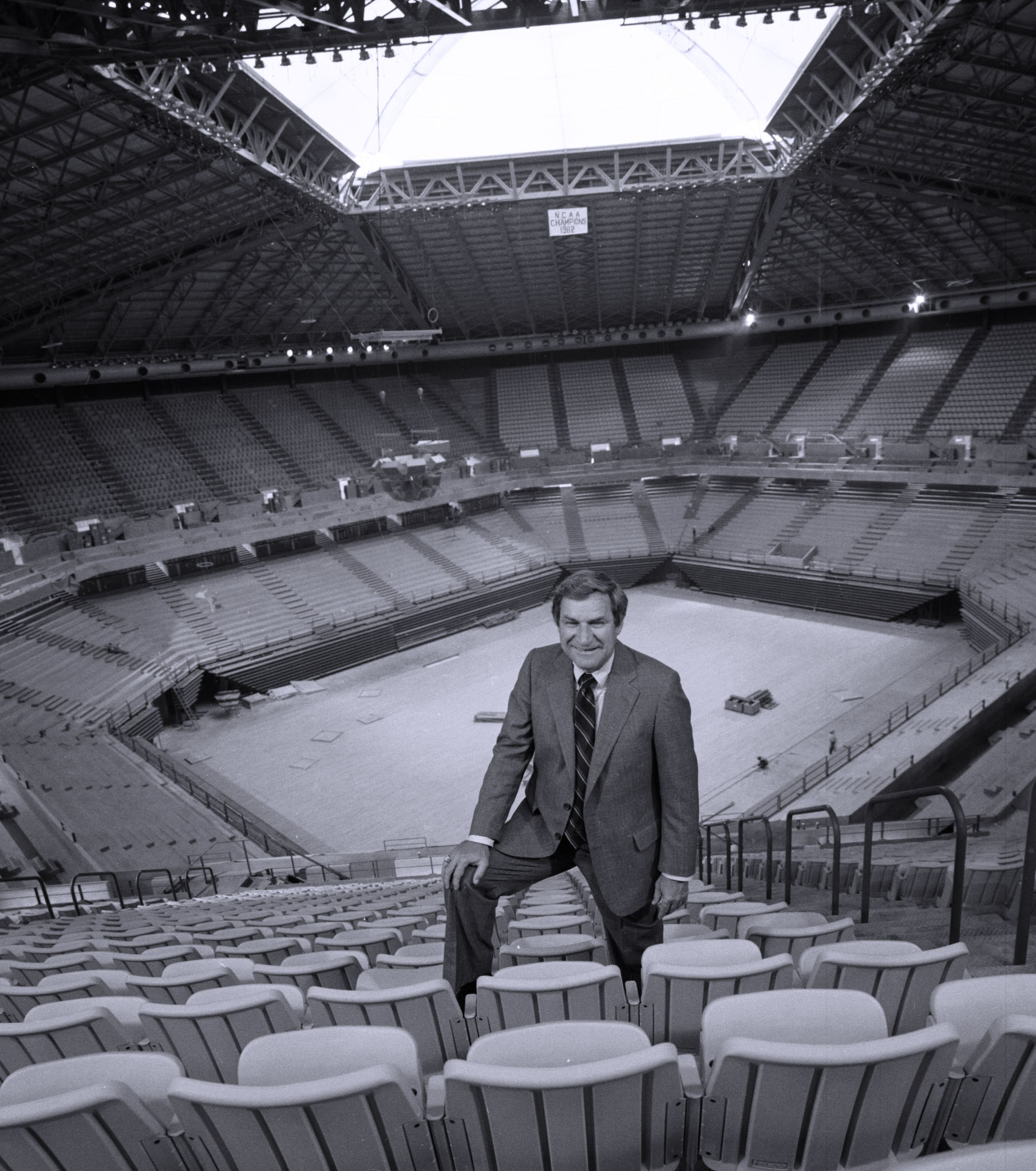
As Carolina basketball continued its long run of success in the 1970s, many fans and alumni clamored for a new venue that would seat more people than Carmichael Arena. Fund-raising began as early as 1980 and would result in more than $34 million in private contributions. The building was to be named for coach Dean Smith, who initially resisted the idea until he was convinced that having his name on the arena would help with fund-raising.

The Dean E. Smith Student Activities Center opened on January 18, 1986. The first game was a 95—92 victory for UNC—Chapel Hill over Duke. The state-of-the-art building held more than 21,000 fans, more than double the capacity of Carmichael. Students and alumni quickly took to referring to the domed structure as the "Dean Dome."

It its early years the Dean Dome also hosted a wide variety of popular concerts. University administrators initially began booking concerts to defray operating losses from the expensive new venue. Many of the largest touring acts in the late 1980s and early 1990s performed in the Dean Smith Center, including Pink Floyd, Bruce Springsteen, Tina Turner, and the Grateful Dead.

With the fans spread out in the more spacious Dean Smith Center, the building received some criticism that the game environment was quieter than students and fans had been accustomed to in Carmichael. Some players and fans compared it unfavorably with the notoriously raucous atmosphere in Duke's Cameron Indoor Stadium. One of the more stinging criticisms came from Florida State University basketball player Sam Cassell, who said, after a 1991 game, "This is not a Duke kind of crowd. It's more like a cheese-and-wine crowd, kind of laid back."

In 2018 the Dean Smith Center court was named for men's basketball coach Roy Williams.

Date Established: 1986

Date Range: 1986 – Present

Basketball coach Dean Smith in the nearly completed Dean E. Smith Student Activities Center at UNC, 1985. Photograph by Hugh Morton. Hugh Morton Photo Collection, North Carolina Collection Photo Archives, Wilson Library.


Privacy Preferences
When you visit our website, it may store information through your browser from specific services, usually in form of cookies. Here you can change your privacy preferences. Please note that blocking some types of cookies may impact your experience on our website and the services we offer.