Skip to main content Scroll Top

Entries

16 Apr: Davis Library

Davis Library

Following decades of rapid growth at the university, by the 1970s it became clear that the library collections and services were outgrowing the iconic Wilson Library building. In October 1975 the board of trustees approved the construction of a new central library on campus, using funds available from the sale of campus utilities. Built on the site of a former parking lot next to the Graham Student Union, construction began in 1979, and the new Walter Royal Davis Library opened in February 1984. It was designed by Italian architect Aldo Guirgola, also known for his work on the Wright Brothers National Memorial in Kitty Hawk, North Carolina, and the Australian Parliament House in Canberra.

The library is named for Walter Royal Davis, a donor and member of the UNC Board of Trustees. Davis is credited with persuading the state legislature to allow the university to use the proceeds of its recent sale of campus utilities for the construction of the new library. Davis was a Pasquotank County native who made a fortune in the oil industry in Texas. Despite never having attended college, he often made significant gifts to support higher education in North Carolina. He is possibly the only person to have served on the board of trustees for both UNC—Chapel Hill and Duke at the same time.

Date Established: 1978

Date Range: 1978 – Present
DaviePoplar_973

16 Apr: Davie Poplar

Davie Poplar

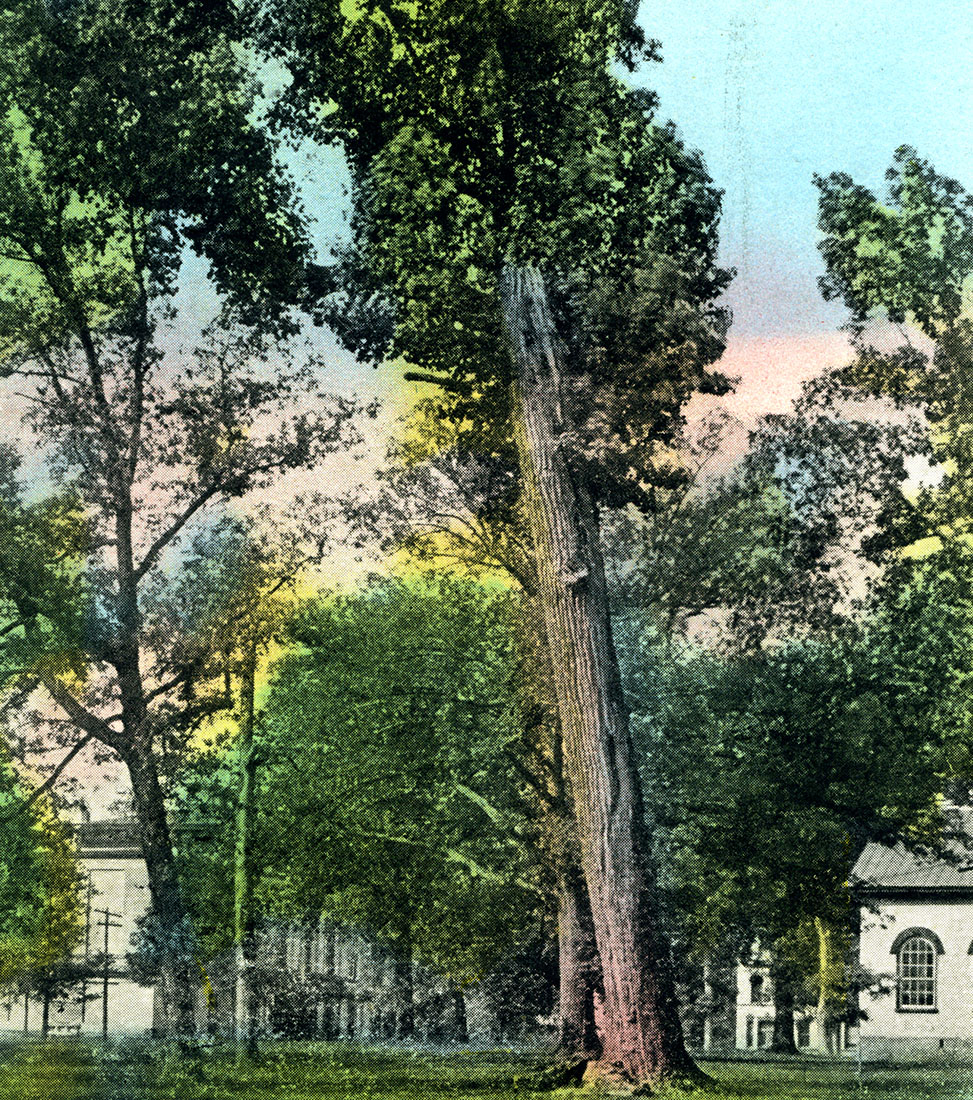
The legendary tulip poplar at the heart of the UNC—Chapel Hill campus is older than the university. The earliest known reference to it is in the reminiscences of a member of the class of 1818. In his recollections of campus, he talks about the "old poplar," which shows that even in the university's first decades the tree was a landmark (and already considered old). The name Davie Poplar first began to be used in the 1890s, in honor of William Richardson Davie, whose early support has led many to call him the "father of the university." Cornelia Phillips Spencer is believed to be the one who named the tree for Davie.

The Davie Poplar used to be a popular gathering spot for students and a place to hold formal events, like the annual Class Day ceremony. The tree has seen some hard times. In 1902 a severe storm hit the campus and several large branches broke off. To the dismay of many alums, early newspaper reports said that the tree had fallen down in the storm. In 1918, fearing that the tree wouldn't last much longer, the Davie Poplar Jr., grafted from a branch of the original, was planted nearby. Throughout the years, there were continued concerns about the tree —both for its health and for the safety of the people passing underneath. In the 1950s a steel cable was put in place to attach the aging tree to stronger trees nearby, and concrete was used to reinforce the hollow interior of the Davie Poplar. In 1961 seven and a half tons of wood were trimmed from the tree.

The Davie Poplar was one of the focal points of UNC—Chapel Hill's 1993 bicentennial celebration. Public school students from each of North Carolina's 100 counties were invited to campus, each receiving a seedling from the Davie Poplar to plant in their home counties, symbolizing the statewide reach of the university and its ties to the public school system.

Postcard image of the “Old Davie Poplar,” 1910. Durwood Barbour Postcard Collection, North Carolina Collection Photo Archives, Wilson Library.


16 Apr: Davie Hall

Davie Hall

Davie Hall was completed in 1908 to house the Departments of Botany and Zoology. Located at what was then the eastern edge of the campus, it was said to have all necessary modern conveniences, including elevators, a dark room, and rooms suitable for plants and animals. A new wing for botany was built in 1925, and underground lab space was added in 1940. The building did not age well and received a major renovation and addition in the 1960s: parts of the old building were torn away, and a new addition was built around the old one. The new addition added a distinctly modern style to the campus. It was designed by the architectural firm of Holloway-Reeves, which was also responsible for the State Legislative Building in Raleigh. When the new addition was completed in 1967, the Department of Psychology moved in.

Davie Hall is named for William Richardson Davie, the former Revolutionary War officer who is often called the father of the university. Davie graduated from the College of New Jersey (now Princeton) in 1776 and joined the military to serve in the Revolutionary War. After the war he was active in politics in North Carolina, serving as a delegate to the Constitutional Convention, in which he advocated for the interests of slaveholders and helped introduce and pass the Three-Fifths Compromise. At a ratification convention held in Fayetteville in 1789, in which Davie introduced the bill to ratify the federal constitution, he also successfully introduced a bill to establish the University of North Carolina. Davie was active in early university governance helping to establish a curriculum and hire its first faculty. As grand master of the North Carolina Masonic Order, Davie led the Masonic ceremony held at the laying of the cornerstone of Old East in 1793.

In the early 1800s, after an unexpected loss in a race for Congress and following a contentious argument about funding for the university, Davie retired from political life to his growing plantation in South Carolina. At the time of his death in 1820, Davie held 116 enslaved people.

Date Established: 1967

Date Range: 1967 – Present

16 Apr: Danziger's

Danziger's

Danziger's was a legendary Franklin Street candy shop and restaurant. It was opened in 1939 by Edward G. Danziger, a confectioner from Vienna who a few years earlier had fled his native Austria ahead of the Nazi occupation. The candy shop and cafe at 153 East Franklin Street soon became a popular date spot with students. The success of the candy shop enabled Danziger and his family to open several other restaurants in town, including the Zoom Zoom Room and the Ram's Head Rathskeller.

Date Established: 1939

Date Range: 1939 – Present

16 Apr: Daniels Building

Daniels Building

In 1963 the UNC Board of Trustees approved construction of a new building to house the campus bookstore, a relief to students who had complained about crowded conditions in the Book Exchange, located in the basement of Steele Building. The new bookstore was one of three new student services buildings built on the former site of Emerson Field. It was flanked on either side by the new House Undergraduate Library and Graham Student Union and faced the newly built sunken brick pit created during the construction of the new buildings. When it opened in time for the fall 1968 school year, the new Josephus Daniels Building housed the Book Exchange, which sold textbooks and school supplies, the Bull's Head Bookshop, and other offices and services. In addition to many other modern features, the Daniels Building was an early adopter of cameras and closed circuit television to guard against theft (and also, bookstore administrators argued, to analyze traffic patterns in the store). With the new building, the Book Exchange name was retired and it was commonly referred to as Student Stores. In addition to selling books and supplies, Student Stores also offered a popular check-cashing service in the 1970s and 1980s. A 1973 Daily Tar Heel article reported that the store regularly cashed more than 1,000 checks a day for students.

In 2016, after more than a century of operating a textbook store on campus, the university outsourced the bookstore to Barnes and Noble, which renovated the interior of the building but retained the Student Stores and Bull's Head Bookshop names.

The building is named for Josephus Daniels, who had a long career in journalism and public service. Daniels attended law school at UNC in the 1880s and was an ardent supporter of the university throughout his life, serving on the board of trustees for more than forty years. In 1894, with support from Julian Carr, Daniels purchased the Raleigh News and Observer and turned it into a leading paper in the state, as well as one of the primary political tools of the North Carolina Democratic Party. The News and Observer was active during the 1898 statewide campaign and was an ardent supporter of the Democrats' white supremacy platform. Throughout the campaign, the paper repeatedly ran viciously racist political cartoons on the front page, many warning of the evils of "Negro domination" that would come if voters failed to elect Democrats. Following the successful campaign and the election two years later of his friend Charles B. Aycock as governor, Daniels was instrumental in developing the legislation that would effectively disenfranchise North Carolina's African American voters for the next half century. Daniels's political connections reached far beyond North Carolina and led to prominent posts in the federal government. He served as secretary of the navy during the administration of Woodrow Wilson, and then later as U.S. ambassador to Mexico under Franklin D. Roosevelt. Daniels returned to Raleigh in 1941 to resume his work on the News and Observer and work on his multivolume autobiography.

Date Established: 1964

Date Range: 1964 – Present

16 Apr: Dance Marathon

Dance Marathon

In February 1999 a group of around seventy-five UNC—Chapel Hill students danced for twenty-four hours to raise money for the North Carolina Children's Hospital. The Dance Marathon, inspired by a long-running student fund-raiser at Penn State, became an annual tradition. The number of student participants steadily increased, as did the amount of money raised. In 2014 the name of the program was officially changed to "Carolina for the Kids" and began to include other fund-raising activities.

Date Established: 1999

Date Range: 1999 – Present

DailyTarHeel_973

16 Apr: Daily Tar Heel

Daily Tar Heel

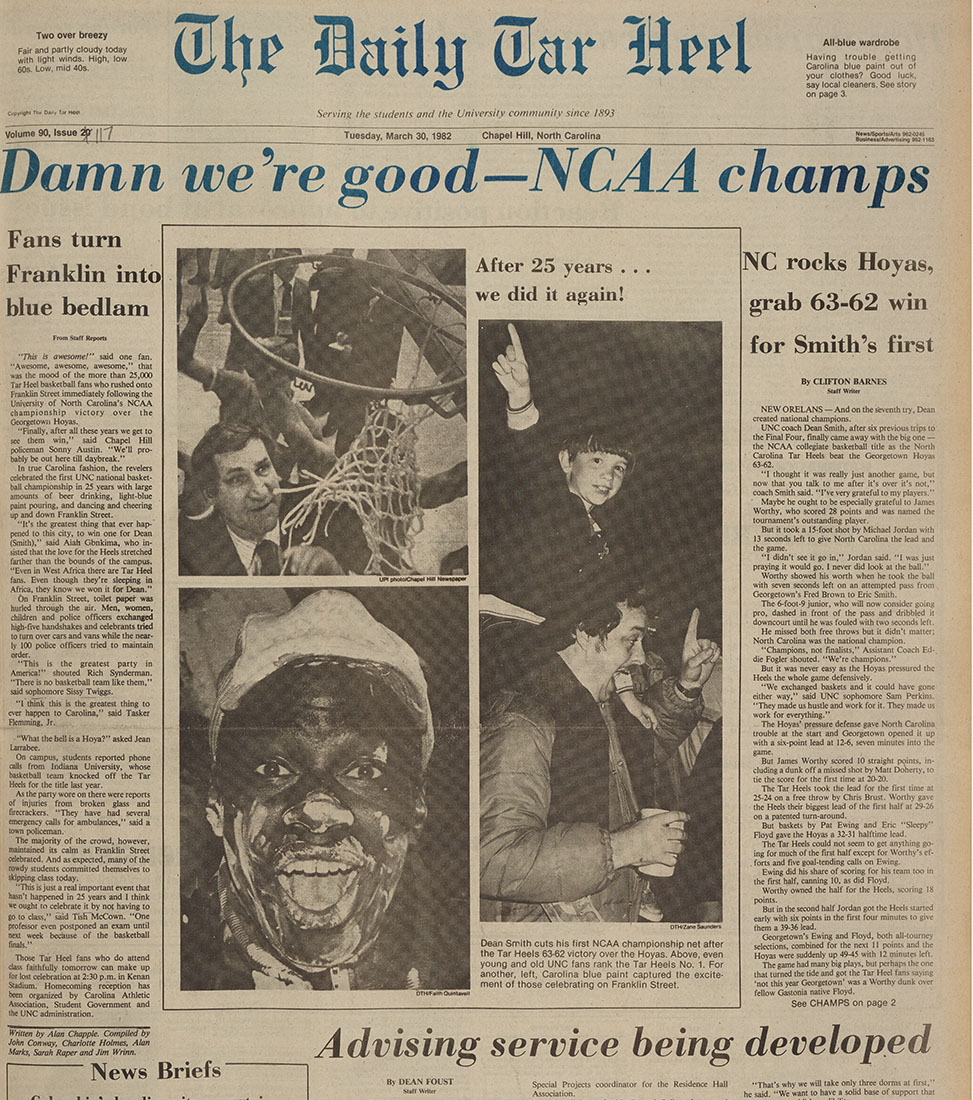
First published in 1893 as the Tar Heel, the Daily Tar Heel has been a vital part of the Carolina student experience for more than a century. It was first published by the Athletic Association, a fact that drew criticism and an early competitor, the White and Blue. The White and Blue did not last long and the Tar Heel expanded its coverage on other aspects of student and university life. In 1923 the paper separated from the Athletic Association and became an official student publication, which included accepting money from student fees. By 1929 it was thriving, and began publishing six days a week, changing its name to the Daily Tar Heel. Though it has never been formally associated with the journalism school, the paper has drawn heavily from journalism students for its staff.

In the 1940s and 1950s the Daily Tar Heel was at the center of the anti-Communist furor that swirled around the campus. The university had been accused of being too liberal since the leadership of Frank Porter Graham in the 1930s. The claim of liberal bias was soon applied to the student paper. It ran a few columns from a student who was a Communist Party member, and it drew the attention of the FBI in 1954 by publishing an April Fool's Day issue called the Daily Witch Hunt, which featured a photo of J. Edgar Hoover examining the rear end of a horse. The accusations of favoring left-leaning stories and opinions would continue to follow the paper into the 1960s as it covered the North Carolina Speaker Ban Law and student involvement in civil rights protests. The Daily Tar Heel increased its coverage of national issues during this period, even sending reporters to cover protests in Mississippi and Alabama.

The continuing criticism of the paper's coverage by conservative students and state residents often focused on the paper's acceptance of mandatory student fees. The paper's critics charged that students should not have to pay for coverage that they disagreed with. By the 1980s the paper began a move toward financial independence by setting up a nonprofit. In 1993, 100 years after it was started, the Daily Tar Heel became an independent publication. By the 2000s the newspaper was facing challenges similar to newspapers everywhere: declining ad revenues and a readership that was increasingly looking to newer, online resources for news and information.

Many Daily Tar Heel alumni have gone on to prominent careers in journalism, several winning Pulitzer Prizes. Some of the university's best-known alumni were editors of the paper, including university presidents Edward Kidder Graham and Frank Porter Graham, novelist Thomas Wolfe, and journalist Charles Kuralt.

Date Established: 1893

Date Range: 1893 – Present

Front page of the Daily Tar Heel published March 30, 1982, the day after the men??s basketball team won the NCAA championship. North Carolina Collection, Wilson Library.


16 Apr: Cyprett's Bridge

Cyprett's Bridge

After the University of North Carolina received its charter, the board of trustees had to find a location for the university. Wanting a site near the center of the state, they considered several locations before settling on an area within a fifteen-mile radius of Cyprett's Bridge in northern Chatham County, a few miles south of Chapel Hill. Cyprett's Bridge crossed New Hope Creek and was located on the road between Raleigh and Pittsboro. The location of Cyprett's Bridge is now believed to be underneath Jordan Lake, near the area where Highway 64 crosses the lake.

16 Apr: Creative writing

Creative writing

Carolina students were writing and publishing creative works long before creative writing became part of the curriculum. Beginning in the late nineteenth century with the Carolina Magazine, students published poetry and short stories in campus publications. Dramatic writing became a focal point at Carolina when Frederick Koch started the Carolina Playmakers in 1918 and his students —including future novelist Thomas Wolfe —wrote original "folk plays." In the 1940s Jesse Rehder, a faculty member in English, taught creative writing. Her classes were popular enough that by 1966 a creative writing program was established within the English department. Novelist Max Steele was the first director of the program and led it for more than twenty years. Many well-known authors have since taught in the department, including Doris Betts, Jill McCorkle, Bland Simpson, Randall Kenan, and Daniel Wallace.

Date Established: 1966

Date Range: 1966 – Present

16 Apr: Craige Residence Hall

Craige Residence Hall

One of the new high-rise dorms built on South Campus in the 1960s, Craige was completed in 1962. The six-story building was designed to house around 700 students —all men when it first opened. Nicknamed "Maverick House" by early residents, Craige was home to the "Victory Gong," which was apparently given to the dorm by a former marine who got it in Japan. In 1965 the gong was stolen by students from Morrison dorm, an event that attracted significant coverage in the Daily Tar Heel and led to many years' worth of animosity between the two dorms.

Craige is named for Francis Burton Craige, an 1829 graduate of the university. Craige was a lawyer and politician, serving in both the state legislature and U.S. Congress. As the Civil War approached, Craige was an outspoken advocate for secession. He was a member of the state secession convention in 1861 and introduced the ordinance that led to North Carolina's joining the Confederacy. He later served in the Confederate Congress.

Date Established: 1962

Date Range: 1962 – Present

Privacy Preferences
When you visit our website, it may store information through your browser from specific services, usually in form of cookies. Here you can change your privacy preferences. Please note that blocking some types of cookies may impact your experience on our website and the services we offer.