Skip to main content Scroll Top

Entries

16 Apr: Stacy Residence Hall

Stacy Residence Hall

Stacy Residence Hall was completed as a men's dormitory in 1938, one of several new dorms built at the time using funds from the Public Works Administration. It is named for Marvin Hendrix Stacy, a math professor at Carolina who served briefly as acting president of the school after the death of Edward Kidder Graham in 1918, until he too succumbed to the flu epidemic.

Date Established: 1937

Date Range: 1937 – Present
16 Apr: St. Anthony Hall

St. Anthony Hall

The Xi Chapter of Delta Psi, known as St. Anthony Hall, was active for a few years before the Civil War and then returned in the 1920s. Like the other chapters around the country, St. Anthony Hall at Carolina has a distinctive literary focus. The chapter has long hosted readings and a regular "Pancakes and Poetry" event. St. Anthony Hall has been a trailblazer among campus fraternities: in 1967 it was the first social fraternity to accept an African American member, when basketball star Charles Scott joined, and in 1971 it became the first to go coed, admitting women as members on an equal basis.

Date Established: 1854

Date Range: 1854 – Present

16 Apr: Springfest

Springfest

Following the cancellation of the annual Jubilee concerts, UNC—Chapel Hill students started a new tradition in 1974 known as Springfest. Originally envisioned as a multiday arts and music festival, Springfest turned into a day-long concert by local bands on "Connor Beach," the lawn in front of Connor dorm. By the mid-1980s Springfest crowds ranged from 3,000 to 5,000 people. Students brought kegs and coolers to the increasingly alcohol-fueled event. The size of the crowds and the amount of beer consumed began to concern campus officials, especially after the legal drinking age was raised to twenty-one in 1986. In 1990 alcohol was banned from the event, and in 1991 the campus housing department denied a permit for the concert, citing concerns over liability.

16 Apr: Spencer Residence Hall

Spencer Residence Hall

Located at the southwest corner of East Franklin Street and Raleigh Street, Spencer opened in 1924 as the first residence hall for women at Carolina. The building included parlors and a dining room and kitchen facilities. In 1930 the third floor was finished, adding nine rooms. In 1958 an addition provided room for an additional seventy students. In the 1960s the kitchen and dining room were replaced with a study room and an apartment for the residence director. Spencer is now a residence hall for women and men and, because of its prime location on Franklin Street, a popular choice for Carolina students.

The building was named in 1927 for Cornelia Phillips Spencer, the first woman to receive an honorary degree from the university, in 1895. Spencer was a writer and journalist and the daughter and sister of UNC professors. She is best known for chronicling university and village life during the Civil War and Reconstruction. During Reconstruction, Spencer sided with the Democratic Party, composed mainly of former Confederates, against Republicans on the question of racial equality. Spencer was best known in Carolina history for being the "woman who rang the bell." This was a reference to the legislature announcing that the university would reopen in 1876, after Democrats had regained control of state government. Reportedly, when news of the reopening reached Chapel Hill, Spencer led a small group to campus, where they rang the bell in South Building to mark the occasion. Even though as a woman Spencer did not have an official role at Carolina, she was very much part of the community. She wrote hymns for special occasions, organized events, and helped keep alumni records. Despite her conservative stance on race, Spencer supported public education and increased opportunities —if not coeducation —for white women.

When the university created an award to honor women in the 1990s, they named it the Cornelia Phillips Spencer Bell Award, in homage to the popular story. In 2002, galvanized by graduate student and activist Yonni Chapman, scholars began to talk about Spencer's outspoken support of white supremacy. After a campus seminar on the subject, then-chancellor James Moeser abolished the award in 2005. It has been replaced by the University Award for the Advancement of Women.

Date Established: 1921

Date Range: 1921 – Present

SpeakerBanLaw_973

16 Apr: Speaker Ban Law

Speaker Ban Law

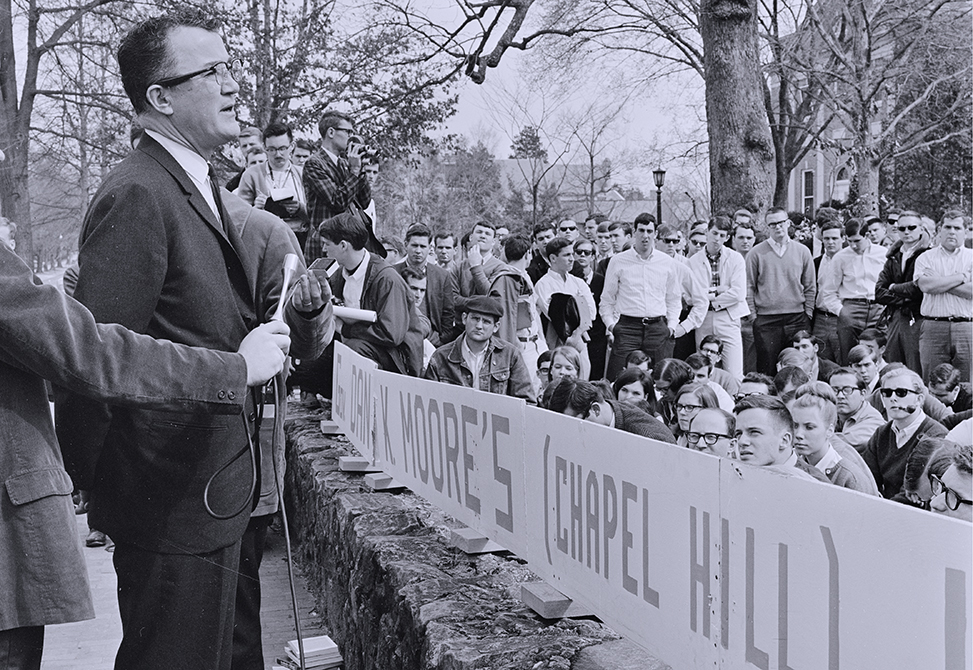
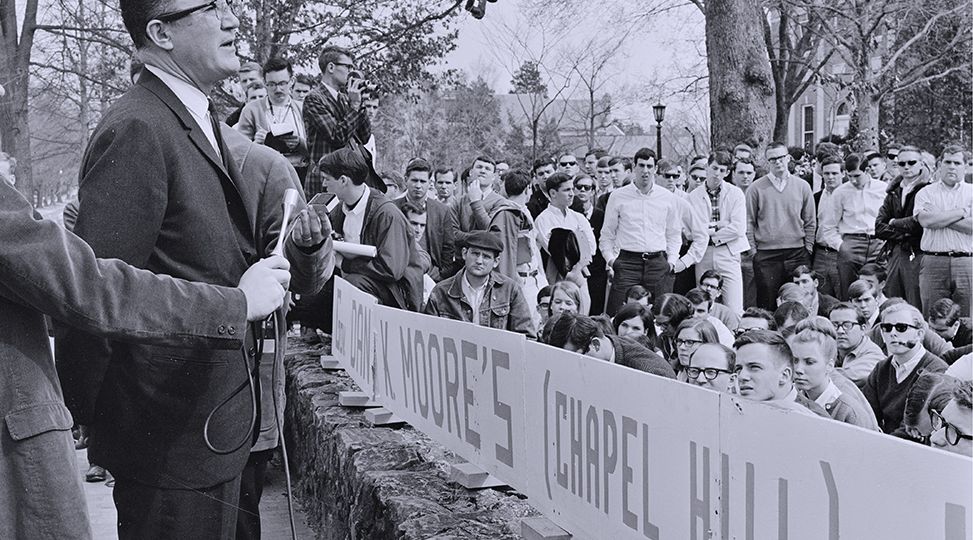
In 1963 the North Carolina General Assembly passed the Act to Regulate Visiting Speakers, which prohibited from speaking at a state-supported college campus anyone who was a known member of the Communist Party, had advocated the overthrow of the state or federal constitution, or had ever invoked the Fifth Amendment before any judicial tribunal with respect to subversive activities. Passed without warning in the last hours of the legislative session in June, the bill seemed to be about anticommunism but was in fact a sharp rebuke to student activists for their participation racial integration and civil rights protests. It quickly became known as the Speaker Ban Law, and administrators, faculty, and students organized to oppose it.

Administrators and trustees worked within the system to challenge it. This resulted in a compromise in 1965, in which the General Assembly amended the law to give college boards of trustees power over the approval of campus speakers. This occurred primarily because the Southern Association of Colleges and Schools declared that the Speaker Ban Law, a violation of academic freedom and free speech, threatened university accreditation.

Students undertook a series of protests, which coalesced with the election of student body president Paul Dickson III (UNC—Chapel Hill class of 1966), who won election on a platform of defense of free speech. In March 1966 Dickson and other student leaders invited Frank Wilkinson (who had invoked the Fifth Amendment before a congressional committee) and Herbert Aptheker (a Communist) to appear on campus. Prevented from speaking by Chancellor J. Carlyle Sitterson, both of them spoke from the sidewalk on the town side of the stone wall on McCorkle Place. Wilkinson and Aptheker's appearances formed the basis for a lawsuit brought by the student leaders, Dickson v. Sitterson, which overturned the law in 1968.

In 2011, encouraged by former UNC System president William C. Friday, the university installed a plaque on one of the stone walls commemorating the students who advocated for the repeal of the Speaker Ban Law.

Date Established: 1963

Date Range: 1963 –
1968

Frank Wilkinson (left) speaks to UNC students gathered on Franklin Street. Photo by Charles Cooper. Durham Herald Co. Newspaper Photograph Collection, North Carolina Collection Photo Archives, Wilson Library.


16 Apr: Southern Historical Collection

Southern Historical Collection

In the early twentieth century, led by faculty and students in history and social sciences, UNC began to emerge as a center for research on the American South. To support and encourage this work, history professor Joseph Grégoire de Roulhac Hamilton created the Southern Historical Collection in 1930. Hamilton's legendary collecting trips took him around the Southeast as he gathered family papers, plantation records, and more, bringing it all back to Chapel Hill. His work earned him the nickname "Ransack" Hamilton from people who were both amused and angered by his relentless collecting. The work of Hamilton and his successors helped build the collection into the largest repository of manuscript materials about the American South. As part of the Wilson Special Collections Library, the Southern Historical Collection has provided research materials for generations of historians, helping inform many popular and influential works on southern history.

Date Established: 1844

Date Range: 1844 – Present

16 Apr: Southen Oral History Program

Southen Oral History Program

Founded in 1973, the Southern Oral History Program (SOHP) conducts oral histories and provides training for future oral historians. Under the leadership of history professor Jacquelyn Down Hall, it grew into a nationally recognized program. While the program interviewed some prominent and well-known people, a major focus was on capturing voices that would otherwise be marginalized or simply absent from the historical record. In 1987 Hall and several of her colleagues published Like a Family: The Making of a Southern Cotton Mill World, an influential work that drew on oral histories to explore the lives of mill workers in the early twentieth-century South.

The SOHP has been recognized as a national leader in oral history practice and education. In 1999 Hall was awarded a National Humanities Medal by President Bill Clinton in recognition of her work and that of the SOHP. After Hall's retirement from the program in 2011, subsequent directors have continued to expand the work, engaging undergraduate and graduate students in the active practice of oral history. Its collection of more than 6,000 interviews is housed in the Southern Historical Collection at Wilson Library and available online. Originally based in the Department of History, the program is now part of the Center for the Study of the American South.

16 Apr: South Campus

South Campus

While there is no official definition of the area known familiarly as South Campus, students and alumni generally know it as the section of the campus south of Kenan Stadium. The name most often refers to the high-rise dorms that were first constructed in the 1960s. However, as the campus has expanded, the definition of South Campus has shifted. In the 1920s, newspaper reports referred to the area now known as Polk Place as the south campus.

013419_CampusScenes0066

16 Apr: South Building

South Building

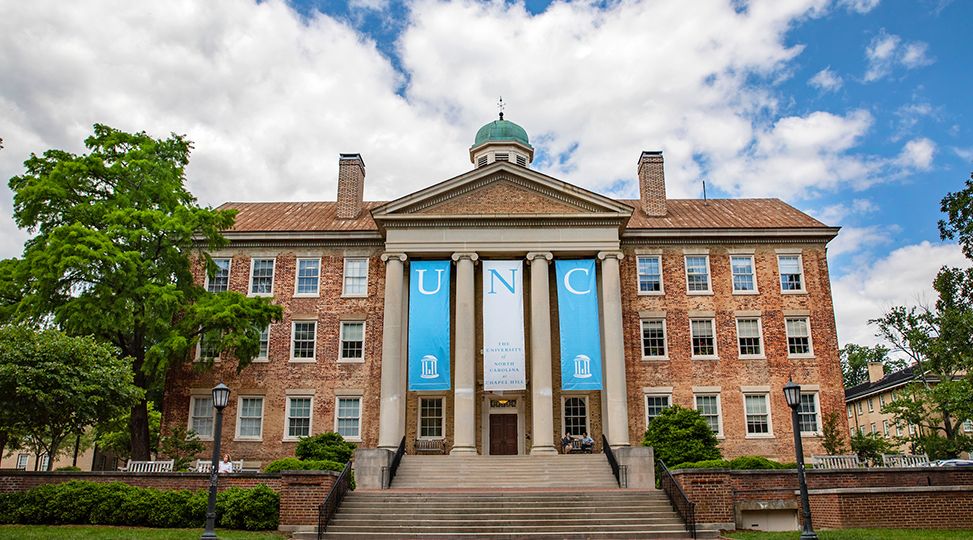
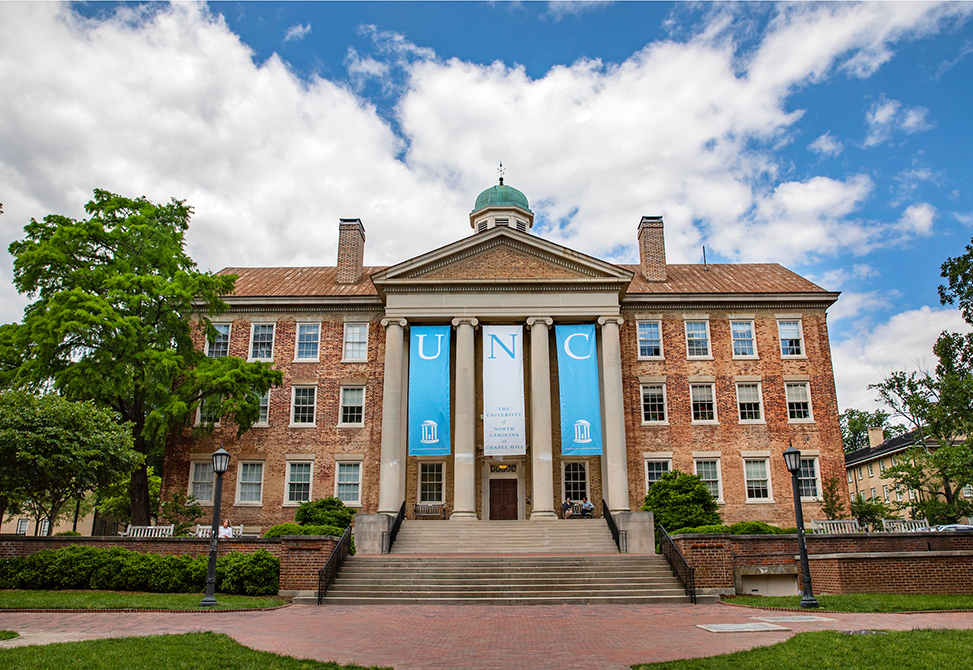
Construction on South Building, known originally as Main Building, began in 1798, but lack of funds delayed its completion until 1814. Students reportedly built rough cabins inside the unfinished structure to escape crowded conditions in Old East. When it finally opened, South contained dormitory rooms for eighty students, halls for the debating societies, a library space, and a public hall. Unlike Old East, which has remained a dormitory space throughout its history, South Building's configuration changed on a regular basis to fit the university's needs.

In 1926 university leaders committed to a full renovation to house administrative offices. The interior was completely removed, the basement dug out to create another floor, and the large south portico facing Polk Place was added. The northeast corner of the first floor became the president's office and remained so until William Friday moved the Consolidated University offices to the Coates Building on Franklin Street. The South Building office then became the chancellor's office, which it remains today.

South Building still has a bell, which was first installed in the early 1800s and automated in the 1930s. Before that, the building's custodian (known then as a janitor) rang the bell for class changes. It is now rung only for special occasions.

Date Established: 1799

Date Range: 1799 – Present

South Building decorated with banners for the 2019 spring commencement. Photo by Johnny Andrews, UNC-Chapel Hill.


16 Apr: Social Work, School of

Social Work, School of

The School of Social Work was founded in 1920 as a professional graduate school, offering master's and doctoral degrees and educating social workers for research and advanced practice. The school, known first as the School of Public Welfare, was created to train professionals for a newly formed state agency to oversee county-level welfare offices. The school's mission also included research on social problems, which led to the creation of the Institute for Social Sciences in 1924. It was the first program of its kind in the country. The school, led by sociologist Howard Odum, adopted a regional approach to its work, looking at the social and economic problems facing the American South, including poverty and race relations. The school has always stressed field research and works closely with public and nonprofit agencies.

The School of Social Work was the first on campus to have an African American faculty member when it hired Hortense McClinton in 1966. The Tate-Turner-Kuralt Building, completed in 1995, is the home of the School of Social Work.

Privacy Preferences
When you visit our website, it may store information through your browser from specific services, usually in form of cookies. Here you can change your privacy preferences. Please note that blocking some types of cookies may impact your experience on our website and the services we offer.