Skip to main content Scroll Top

Entries

16 Apr: Soccer

Soccer

Carolina students began playing soccer after World War I. The first references to it in the Tar Heel were in 1917, with the first intramural games played in 1919. The first intercollegiate game was played in 1937, when a group of students organized a scrimmage against Duke (the UNC team lost, 2—1). Soccer became a varsity sport in 1947 and was soon successful, winning the Southern Conference championship in 1948. In 1963 Edwin Okoroma, from Nigeria, became the first black varsity athlete at UNC when he joined the soccer team. The men's soccer team won its first Atlantic Coast Conference championship in 1987 and won national championships in 2001 and 2011.

Carolina soccer began a new era in 1977, when Anson Dorrance was hired as coach. Initially hired to coach the men's team, Dorrance also took over as coach of the women's soccer team in 1979, when women's soccer became a varsity sport at Carolina. He would coach both the women and the men through 1988. Women's soccer quickly developed into a successful program. The Tar Heel women won a national championship in 1981, beginning an unparalleled record of success. The team has won twenty-two national championships (as of 2018), including nine in a row between 1986 and 1994. They have had several undefeated seasons, and Dorrance has won national and ACC Soccer Coach of the Year awards multiple times. Many alumnae of the program, including Mia Hamm and Heather O'Reilly, have gone on to successful international careers, leading Olympic and World Cup champion teams. Soccer is without question the most successful athletic program at UNC and is often mentioned as one of the most dominant programs in all of college athletics. The prominence of the program was acknowledged by Dean Smith, who once said of UNC, "This is a women's soccer school. We're just trying to keep up with them."

Date Established: 1917

Date Range: 1917 – Present
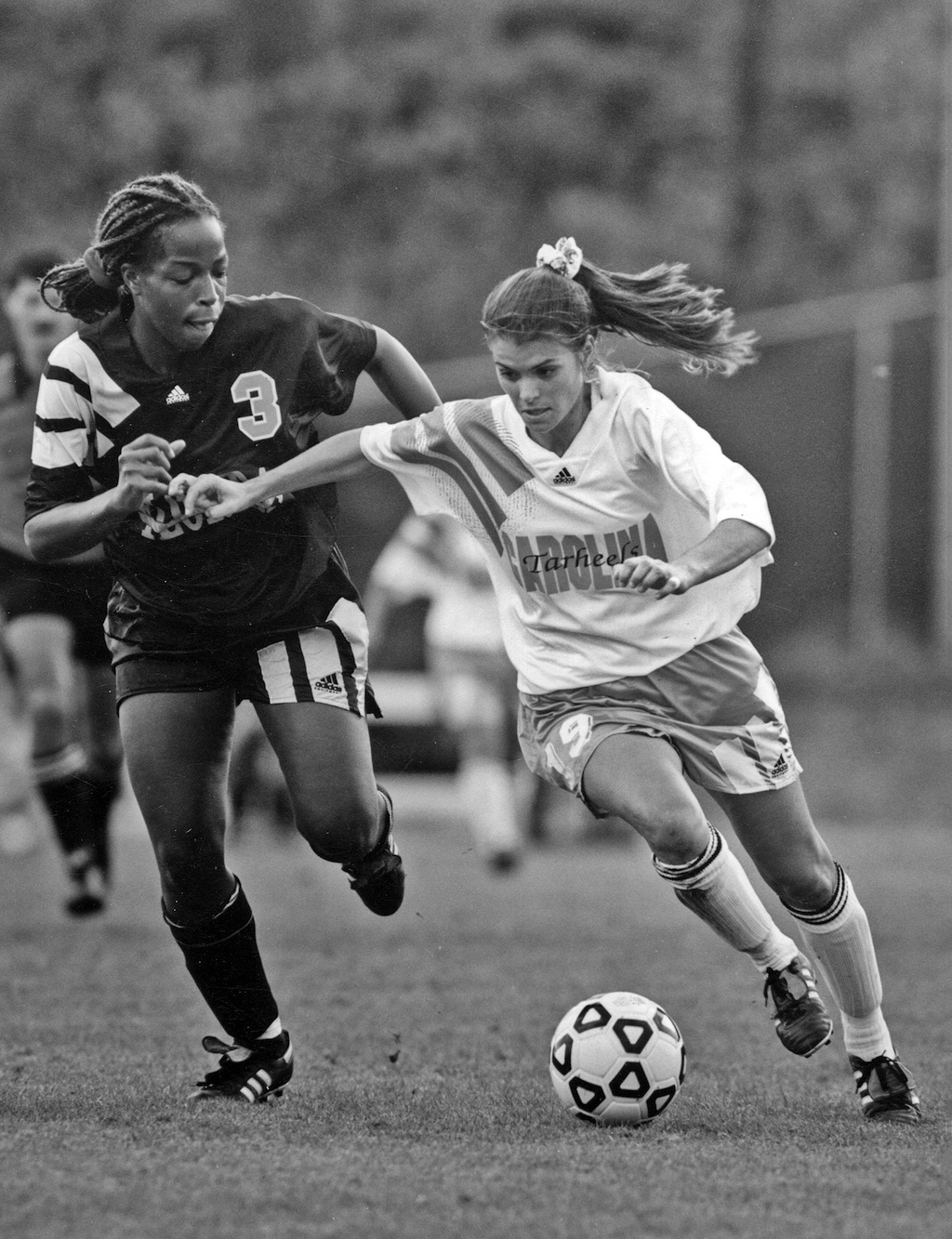
UNC’s Mia Hamm (right) races down the field ahead of a player from Florida International University during a game in the 1987 NCAA tournament. Durham Herald Co. Newspaper Photograph Collection, North Carolina Collection Photo Archives, Wilson Library.


16 Apr: Smith Building

Smith Building

Built in 1901 as a men's dormitory with space for sixty-five students, the Mary Ann Smith Building was one of the first to be equipped with heat, lighting, and indoor plumbing. It was designed by architect Frank Milburn, who designed all of the campus buildings from 1901 to 1915, and has a Flemish influence to its style, including rounded gables. It has the distinction of being the first building named for a woman at the university. Smith Building became a men's graduate student residence in 1927 and a women's dormitory from 1945 into the 1960s. Then it became an office and classroom building, which is what it is today, home now for the Department of Women's and Gender Studies.

Mary Ann Smith made a bequest to the university to support a professorship and scholarships in chemistry. The daughter of a wealthy Raleigh merchant, she married James T. Morehead in 1861. The marriage was not a success, and the couple separated. However, Smith retained the rights to her property through a marriage contract and disposed of that property in her will. In the 1870s she was committed to an insane asylum and eventually died still confined to an institution. She left two wills, and by the time legal issues were settled the university desperately needed new student housing, so the trustees committed a portion of it for that purpose.

Date Established: 1900

Date Range: 1900 – Present

«
»


16 Apr: Slavery

Slavery

The early history of the university is inseparable from the history of slavery in the United States. Many of the early faculty and most of the members of the UNC Board of Trustees profited directly from enslaved labor. Enslaved people helped build the first buildings and were present all over campus and town as laborers and servants through the end of the Civil War. Students came from elite slaveholding families in North Carolina and elsewhere. They brought enslaved personal servants with them until 1845, when the university banned the practice. Instead, students paid a fee to the university, which leased enslaved laborers from faculty and townspeople. Students relied on the enslaved women and men who cleaned their rooms, tended fires in the winter, did their laundry, and cooked their meals. The university also received income from the sale of enslaved people: because of the state law that awarded unclaimed property (escheats) to UNC, on multiple occasions the university inherited enslaved women, men, and children, who were subsequently sold, with the proceeds going to the university.

Most published histories of the university have failed to fully acknowledge the presence and impact of slavery on the university campus. In 2003 the University Archives put on an exhibit in Wilson Library called Slavery and the Making of the University, which helped spark a discussion about early university history. In 2005 the university dedicated the Unsung Founders Memorial, a public commemoration of the enslaved people who, along with free African Americans, helped build and maintain the university. In 2007 the university named a new residence hall for George Moses Horton, an enslaved man from nearby Chatham County who worked on campus and sold poetry to students. The work to understand and explain the university's history with slavery continues. On University Day 2018 Chancellor Carol L. Folt apologized on behalf of the university for its participation in the practice of slavery and called for more work to reconcile its past with its present and future.

16 Apr: Sitterson Hall

Sitterson Hall

Sitterson Hall opened in 1987 to house the Department of Computer Science. In contrast to computer science buildings at other universities, many of which featured a distinctly modern design, Sitterson was built in a more traditional style. A staff member in the department explained to the Daily Tar Heel that they didn't want a "Darth Vader building" because "computers are already intimidating." The building is named for former chancellor J. Carlyle Sitterson, who had a long career at Carolina. Beginning as an instructor in 1935, Sitterson was later named a Kenan Professor and served as dean of the College of Arts and Sciences. He was chancellor from 1966 to 1971, a period that spanned a tumultuous time on campus, including the cafeteria workers' strikes, antiracist activism from the Black Student Movement, and large-scale Vietnam protests. Sitterson and other campus administrators were often the focus of the student protests and struggled at times to respond to student demands and activism unlike any that had occurred previously in the university's history.

Date Established: 1986

Date Range: 1986 – Present

16 Apr: Sexuality and Gender Alliance

Sexuality and Gender Alliance

Founded in 1974 (initially called the Gay Awareness Rap Group), the Carolina Gay Association was the first recognized student organization for gay and lesbian students on campus. The group was active in its early years, helping host the Southeastern Gay Conference in 1976 and beginning publication of Lambda, believed to have been the first LGBTQ student publication in the country. In 1975 the Carolina Gay Association protested local bar He's Not Here after the manager asked two gay men to stop dancing. The organization was at the center of a campus-wide debate in 1991 when the summer student legislature passed a resolution to end funding for the Carolina Gay and Lesbian Association, as it was then called. The attempt to defund the group was ultimately unsuccessful, but that effort, supported by many students, demonstrated that UNC still presented a hostile environment for many LGBTQ students. The organization has changed names multiple times and has been known as the Sexuality and Gender Alliance since 2012. Its members work to foster a strong and supportive LGBTQ community at Carolina.

16 Apr: Senior Walk

Senior Walk

The path that runs on the north side of the Coker Arboretum behind Spencer Residence Hall and Chapel of the Cross, the Episcopal church on Franklin Street, is what remains of Senior Walk, a popular campus landmark well into the 1960s. It began as an informal path some time in the 1890s and became a formal designation with the Senior Class Gift of 1928, which placed a sandstone tablet designating the path and flowering cherry trees on each side of it. Students for many years lined up on Senior Walk to process to commencement in Memorial Hall. It was also a favorite path for male students to walk their dates home to Spencer and other women's residence halls.

Senior Walk originally extended west from Hillsborough Street to the south end of Graham Memorial Hall. Construction of the Morehead Planetarium in the 1940s shifted the path to the north, and with the building expansion in the 1970s, the senior class tablet disappeared from campus. In 2017 the tablet returned to campus from a backyard somewhere in Chatham County, just south of Chapel Hill, and has been reinstalled at the Hillsborough Street entrance.

16 Apr: Seal

Seal

The UNC Board of Trustees first adopted a school seal in 1791. The seal featured the face of the god Apollo and his symbol of the rising sun as being "expressive of the dawn of higher education in our State." It also included the Latin words "Sigal Universitat Carol Septent," translated as "Seal of the University of North Carolina." The Apollo seal was used on official documents for the next century. It was changed slightly in 1895, showing Apollo's face in profile, before being changed more dramatically in 1897. Under the direction of University President Edwin Alderman, the new seal included a shield with a diagonal band and the words "Lux Libertas," Latin for light and liberty, which became the university's motto. This apparently simple design was the subject of controversy due to the direction of the diagonal band on the seal. In what was probably a simple accident, the band crossing the shield was placed in a different direction than those that appear on most standard family crests. This alternate band, known as a "bend sinister," was believed by many to signify illegitimacy. The outcry over the incorrect band was persistent enough that the university formally changed the design of the seal in 1944.

16 Apr: Scuttlebutt

Scuttlebutt

The Scuttlebutt was a popular snack bar located at the corner of Cameron and Columbia Streets, near Swain Hall. The small white building was built as a canteen for U.S. Navy cadets on campus while attending pre-flight school. Given to the university after the war, it was later operated by Student Stores. It was a popular stop for many students on campus, especially for fraternity members living nearby at the houses on Fraternity Court. By the early 1970s the manager said the building was "about to fall down" and the university considered demolition. It lasted a couple of decades longer before being razed in 1996.

Date Established: 1943

Date Range: 1943 –
1997

«
»


16 Apr: Sangam

Sangam

UNC—Chapel Hill's South Asian student organization was founded in 1987 with twelve members. The name comes from the Hindi word for togetherness. In 1992 Sangam hosted the first ever National Indian-American Students Conference. The organization has grown significantly, with well over 100 members by the 2010s.

Date Established: 1987

Date Range: 1987 – Present

16 Apr: Ruffin Residence Hall

Ruffin Residence Hall

Ruffin Residence Hall was opened in 1922, at the same time as nearby Grimes, Mangum, and Manly dorms. Originally housing only men, Ruffin was converted to a women's dorm by 1976. It is named for two members of the Ruffin family: Thomas Ruffin and Thomas Ruffin Jr. Both were lawyers, served on the state supreme court, and were members of the UNC Board of Trustees. Ruffin Sr. enslaved many people on his plantations in Alamance and Orange Counties and was a partner in a slave-trading business that frequently led to children being taken from their parents and sold. He is probably best remembered for his 1829 ruling in the case State v. Mann, which held that people who enslaved African Americans could not be indicted for injuring people they held in bondage. In the opinion he wrote, "The power of the master must be absolute to render the submission of the slave perfect." Ruffin Jr. had a long legal career, interrupted by service in the Confederate army and a stint on the North Carolina Supreme Court.

Date Established: 1921

Date Range: 1921 – Present

«
»


Privacy Preferences
When you visit our website, it may store information through your browser from specific services, usually in form of cookies. Here you can change your privacy preferences. Please note that blocking some types of cookies may impact your experience on our website and the services we offer.