Skip to main content Scroll Top

Entries

16 Apr: ROTC

ROTC

The university began a Reserve Officer Training Program on campus in fall 1940, when the U.S. Navy placed a ROTC unit on campus. The new unit came at a time when, faced with the possibility of the United States entering World War II, the university took a more direct role in military preparation, including the establishment of compulsory physical education. The Navy ROTC began with 100 students enrolled and was active through the war. Initially housed in Woollen Gym, the ROTC program moved into the Naval Armory in 1943. ROTC training on campus expanded in 1947, with Air Force ROTC. During Vietnam War protests in the late 1960s and early 1970s, many Carolina students questioned the presence of the military programs on campus, especially after Harvard ended its ROTC programs in 1969. The protests ended after a few years. By 1978 a Daily Tar Heel headline proclaimed, "ROTC No Longer Draws Campus Contempt." In 1995 UNC—Chapel Hill added an Army ROTC program, known as the Tar Heel Battalion.

Date Established: 1926

Date Range: 1926 – Present
16 Apr: Rosenau Hall

Rosenau Hall

Rosenau Hall opened in 1962 to serve as the home of the School of Public Health. The additional space was much needed: at the time it opened, public health classes had been offered in fourteen different buildings around campus. In 1965 it was named for Milton Rosenau, founder of the school and a public health pioneer. Rosenau worked in public health positions in the federal government and then went to Harvard, where he established the nation's first school of public health. After retiring from Harvard he to came to Chapel Hill and founded the School of Public Health, serving as its dean for several years.

16 Apr: Robertson Scholars

Robertson Scholars

In 2000 alumnus Julian Robertson and his wife, Josephine, gave $24 million to establish an unusual scholarship program that would enable students to enroll jointly at UNC—Chapel Hill and Duke. The Robertson Scholars take classes and participate in extracurricular activities at both schools. One of the most visible elements of the program is the Robertson Express Bus, which runs regularly between the two campuses.

More information about Robertson Scholars

Date Established: 2000

Date Range: 2000 – Present

16 Apr: Research Labs in Archaeology

Research Labs in Archaeology

The university began offering courses in archaeology as early as the 1920s. These were primarily lecture classes focused on historical archaeology, with an emphasis on ancient Greece and Rome. In the mid-1930s, following an increased interest in the archaeology of North Carolina, the university began supporting efforts to study early civilizations in the state. Using funding from the WPA (Works Progress Administration), the university started the Laboratory of Archaeology in 1939. Work at the lab was halted during World War II and then revived in 1948 under a new name, Research Laboratories of Anthropology, and with a new director, faculty member Joffre Coe. Lauded as the "Father of Archaeology" in North Carolina, Coe served as director until 1982 and helped build the laboratory into a program of national significance.

In 1997 the name was changed to Research Laboratories of Archaeology. The focus of the department was, and remains, the study of Native American cultures in the Southeast. The North Carolina Archaeology Collection, compiled by students and staff since the founding of the lab, now contains millions of artifacts spanning more than 12,000 years of history and is one of the preeminent resources for the study of Native American life in the region. The collection has had many homes on and off campus —it moved between Alumni and Person Halls in its early years and was housed for many years in Wilson Library. In 2004 the university renovated space in Hamilton Hall to house the collection.

Date Established: 1939

Date Range: 1939 – Present

16 Apr: Religion

Religion

Despite its status as a public university, the university had a close relationship with Christianity for much of its first 100 years. Students had to attend daily chapel or Sunday church service, and the distribution of Bibles to graduating seniors was a commencement tradition until the mid-1970s. In 1859 the Young Men's Christian Association (YMCA) opened a chapter on campus and students held their own religious services and Bible study groups. The YMCA Building opened in 1907, funded by private donations. The Young Women's Christian Association arrived in 1935 and then merged with the YMCA in 1963 to form what is now known as the Campus Y. Today more than forty student organizations have a faith or religious affiliation, which reflects the variety of religious traditions among the student body.

Religion has also been the focus of controversy in university history. In the early decades President Joseph Caldwell and later President David Lowry Swain had to refute religious leaders who argued that the state university was a threat to the growth of church-affiliated schools. Other critics claimed at various times that the campus was dominated by Presbyterians, or Episcopalians, although the facts never supported this charge.

UNC had a small number of Jewish students and even faculty members before the twentieth century. That number began to grow in the 1920s. UNC never imposed a quota for Jewish students at the undergraduate level, as many American colleges and universities did around this time. In 1933, however, Isaac Manning, dean of the medical school, denied admission to an applicant because he was Jewish. Manning maintained a quota because, he claimed, it was difficult to place Jewish students in further study at other schools. Morris Krasny, the applicant, appealed to UNC president Frank Porter Graham, and Graham ordered the medical school to accept him. Manning resigned rather than change his decision.

In 2002 the book selection committee for the annual Summer Reading Program for new students chose Approaching the Qur'an: The Early Revelations, by Michael Sells. Committee members saw a need for Americans to better understand Islam after the attacks of September 11, 2001. After criticism from conservative journalists about the selection, the Family Policy Network (FPN) filed suit against the university (Yacovelli v. Moeser) on behalf of several students. FPN claimed that the university had violated the Establishment Clause of the First Amendment, but the network lost in court and on appeal. Meanwhile, for students who did not wish to take part in discussions, the university offered the option of writing a paper.

The university has had a Department of Religious Studies since 1946, which has bachelor's, master's, and doctoral degree programs. Faculty teach and conduct research in historical and contemporary topics across an array of religious traditions, including Christianity, Judaism, Islam, Buddhism, and Hinduism.

16 Apr: Reconstruction and closing

Reconstruction and closing

The defeat of the Confederacy and the emancipation of one-third of the people of North Carolina in 1865 brought change at every level to the university and Chapel Hill. Fewer than 100 students remained enrolled, and the university's finances were ruined by investments that were now worthless. Potential new students would have come from families likewise impacted by the economic collapse. Political divisions played out over control of the campus. A provisional state government led by Republicans was hostile to a university that they identified with the elite wealthy people who had led the state into secession and defeat. UNC president David Lowry Swain eventually persuaded the legislature to appropriate funds to pay faculty salaries. He also gained access to the state's share of the Morrill Act, passed in 1862 by the U.S. Congress to create land-grant colleges.

When Congress took over Reconstruction in 1867, it imposed new requirements on the former Confederate states. Under a new state government and a new state constitution ratified in 1868 by a multiracial assembly, control of the state university shifted to the State Board of Education. The Republican state government replaced Swain and the faculty with new appointments, making professor Solomon Pool president. Democrats, comprised largely of the former slaveholding elite who had lost the war, imposed a virtual boycott on the university. In Chapel Hill the opposition included Cornelia Phillips Spencer, who excoriated Republicans and Pool's administration in weekly newspaper columns. Students stayed away, while the Republican legislature, mired in its own financial troubles, offered no support.

At the 1869 commencement, Republican governor William Woods Holden called for a more egalitarian approach to higher education and for UNC to truly be a "people's university." He proposed opening a school elsewhere for African Americans that would be part of UNC, a plan that led conservative opponents to make untrue claims about the integration of the university. Terrorist activity by the Ku Klux Klan in Orange County targeted university faculty and Republicans, adding to social turmoil and uncertainty. Holden's attempt to fight the Klan with state militia helped mobilize Democratic voters, who in 1870 elected a majority in the state house and senate. The legislature impeached and convicted Holden, removing him from office.

President Pool still tried to keep the university open, but the threat of Klan violence and the lack of financial resources ensured that no new students enrolled. By the beginning of 1871 the university was closed, and faculty and students were gone. Four years would pass before the university's allies could muster the political support under Democrats to reopen the campus.

Date Established: 1863

Date Range: 1863 –
1877

16 Apr: Rathskellar

Rathskellar

The Ram's Head Rathskeller, opened in Amber Alley off of Franklin Street in 1948, was beloved by generations of Carolina students. It was run by the Danziger family, owner of several successful restaurants in Chapel Hill. It was a combination of a formal restaurant and beer hall but turned into a college town classic, with dishes that remained on the menu for decades and carved initials from students over many years in the walls. "The Rat" was the first restaurant to serve imported beer in Chapel Hill. Some of the best-known menu items were the lasagna, known informally as the "bowl of cheese," and a sizzling steak called The Gambler. The "Rat" was also notable for its beloved and long-serving staff, with some waiters staying at the restaurants for decades, providing a sense of continuity for generations of Carolina students. The Rathskeller closed in 2007, though a few of the classic menu items have been revived at S&T's Soda Shoppe, a Pittsboro restaurant owned by longtime fans of the Rathskellar.

Date Established: 1948

Date Range: 1948 –
2007

16 Apr: Rameses

Rameses

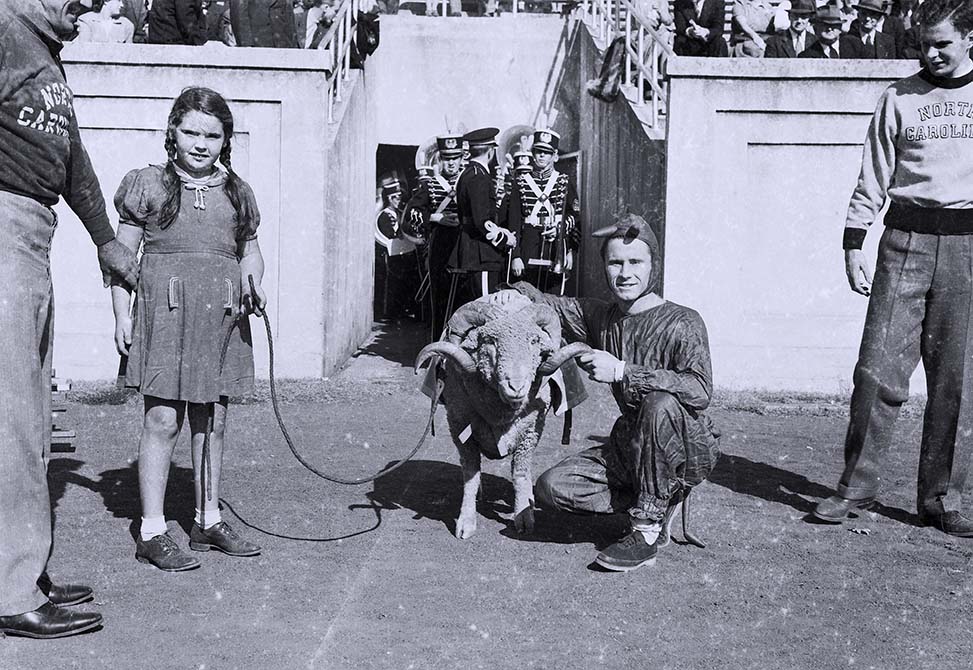
The tradition of having a live ram at home football games began in 1924. Cheerleader Vic Huggins, looking for inspiration during a lackluster season, wanted to find a live animal mascot for the team. Inspired by star fullback Jack Merritt, known as the Battering Ram, Huggins decided to use a ram. He paid $25 for a live ram from a farm in Texas. Dubbed Rameses, the ram made its debut at a game on November 8, 1924. A live ram, often with its horns painted Carolina blue, has been a fixture at Tar Heel home football games ever since. When not at football games, Rameses lives at a farm near campus in the care of the Hogan family, who have cared for at least twenty generations of the Rameses line.

The university included Rameses as one of its trademarks when it began its licensing program in the early 1980s. The first Rameses costume was introduced during the 1987—88 basketball season. The ram costume, worn by a student, was more popular than the short-lived "Tar Heel Tim" in the 1970s, a student dressed as a large foot. The Rameses costume design went through a couple of changes over the years but quickly became a regular part of the Carolina athletics experience and a visible symbol of the university at events around campus. In 2015, to handle increasing demands for Rameses at events and to try to connect more with kids, the university introduced Rameses Jr., another costumed ram, this one with Carolina blue horns and a more friendly expression on its face.

Date Established: 1924

Date Range: 1924 – Present

In this photo from the early 1940s, Rameses is posing with the Duke Blue Devil mascot before a football game. Photograph by Hugh Morton. Hugh Morton Photo Collection, North Carolina Collection Photo Archives, Wilson Library.


RadioTelevisionAndMotionPicturesDepartmentOf_973

16 Apr: Radio, Television, and Motion Pictures, Department of

Radio, Television, and Motion Pictures, Department of

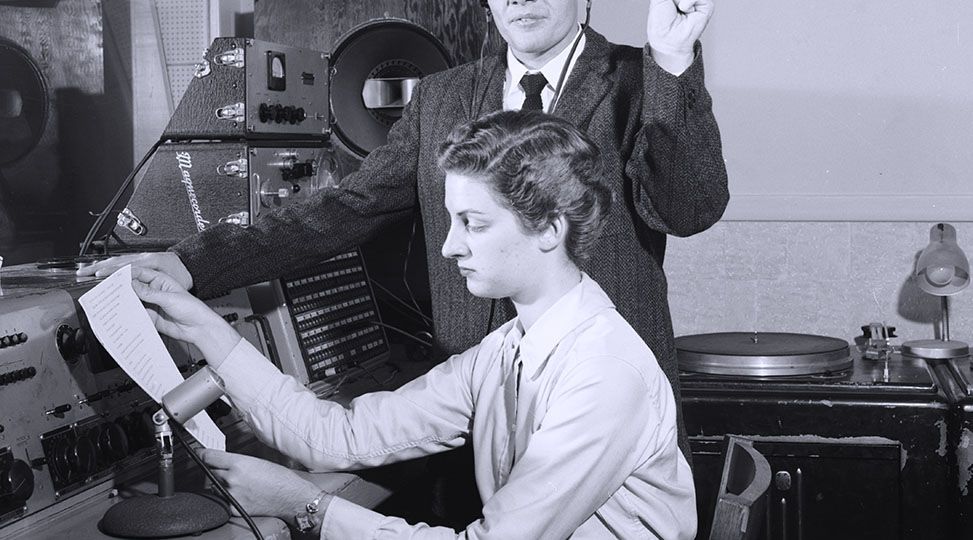
This department, popularly known by its acronym, RTVMP, existed from 1954 to 1993. It was the brainchild of Earl Wynn, a faculty member in drama and speech, who developed the first courses in broadcasting at Carolina. Wynn also led the closely allied Communication Center based in Swain Hall to centralize all of the equipment needed for radio, television, motion picture, photographic, and record production.

Wynn produced the university's first radio program, which occurred on May 26, 1940, through the Extension Division, and taught the first course in radio in 1942. After he returned from service in World War II, Wynn set up a department of radio, which became RTVMP in 1954. The department offered undergraduate and master's degrees, in addition to developing the radio station that became WUNC-FM and the television station that became UNC-TV.

The College of Arts and Sciences abolished the RTVMP department in 1993. Parts of its curriculum moved into the School of Journalism and Mass Communication (now the School of Media and Journalism), and other parts merged with the Department of Speech Communication (now Department of Communication). The latter continues to operate studio facilities in Swain Hall.

Date Established: 1954

Date Range: 1954 –
1993

RTVMP students in a campus recording studio, ca. 1959. UNC Photo Lab Collection, North Carolina Collection Photo Archives, Wilson Library.


16 Apr: Pulpit Hill

Pulpit Hill

Pulpit Hill is the name of a fictionalized version of Chapel Hill that appeared in Thomas Wolfe's 1929 novel, Look Homeward, Angel. Wolfe's heavily autobiographical first novel has his protagonist, Eugene Gant, attending the state university there. He describes the campus as a "charming" place where "a young man was able to loaf comfortably and delightfully through four luxurious and indolent years." The novel also includes fictional versions of several of Wolfe's professors, most notably philosophy professor Horace Williams. The university appeared in Wolfe's fiction again in his posthumous novel The Web and the Rock as Pine Rock College. Although he called it an "old, impoverished backwoods college," the references to the university were clear when he wrote about "its unfinished spareness, its old brick and its campus well." Despite these sometimes harsh descriptions, Wolfe (class of 1920) retained fond memories of his alma mater. In a letter to a classmate in 1929 he wrote, "So far from forgetting the blessed place, I think my picture of it grows clearer every year: it was as close to magic as I've ever been."

Privacy Preferences
When you visit our website, it may store information through your browser from specific services, usually in form of cookies. Here you can change your privacy preferences. Please note that blocking some types of cookies may impact your experience on our website and the services we offer.