Skip to main content Scroll Top

Entries

16 Apr: Prisoners of war

Prisoners of war

A small group of prisoners of war worked briefly at the university during World War II. Camp Butner, located in Granville County about thirty miles northeast of Chapel Hill, began receiving German prisoners of war in the spring of 1944. By the summer some of the prisoners were working as dining hall attendants on campus. They worked in Lenoir Hall, which was used exclusively by the U.S. Navy cadets for the navy pre-flight school located on campus. It is not clear how long the prisoners were on campus or how many there were, but occasional mentions of them in the Daily Tar Heel from August 1944 show that students were aware of the prisoners and were in occasional contact with them.
16 Apr: Presidents of UNC

Presidents of UNC

Carolina's early history is marked by long presidential tenures. The campus leader was at first designated as presiding professor. Four men served under that title, from 1794 to 1804, when the trustees opted to promote Joseph Caldwell to president. He served until 1812 and stepped in again four years later to serve another twenty-three years. Caldwell was followed by David Lowry Swain, whose thirty-three-year tenure remains a record. In the political turmoil of Reconstruction, mathematics professor Solomon Pool attempted to keep the university open for three years in the face of virulent Democratic opposition. After reopening in 1875 the university gained new prominence and stability under the twenty-year tenure of Kemp Plummer Battle. Presidents Francis Preston Venable and Harry Woodburn Chase began to build a research enterprise, while the brief tenure of Edward Kidder Graham saw the creation of an extension program to serve the state. Although Frank Porter Graham's nineteen years as president spanned the change from a single university to a consolidated system, his influence on Carolina as a progressive dedicated to academic freedom shaped the university's reputation for the remainder of the twentieth century.

Presiding Professors
David Ker: 1794—96
Charles W. Harris: 1796 (July—December)
Joseph Caldwell: 1796—97
James S. Gillespie: 1797—99
Joseph Caldwell: 1799—1804

University Presidents
Joseph Caldwell: 1804—12
Robert Hett Chapman: 1812—16
Joseph Caldwell: 1816—35
Elisha Mitchell (acting): 1835 (February—December)
David Lowry Swain: 1835—68
Solomon Pool: 1869—72
Charles Phillips: 1875—76
Kemp Plummer Battle: 1876—91
George Tayloe Winston: 1891—96
Edwin Anderson Alderman: 1896—1900
Francis Preston Venable: 1900—1913
Edward Kidder Graham (acting): 1913—14, (president): 1914—18
Marvin Hendrix Stacy (acting): 1918—19
Harry Woodburn Chase: 1919—30
Frank Porter Graham: 1930—34

PolkPlace_973

16 Apr: Polk Place

Polk Place

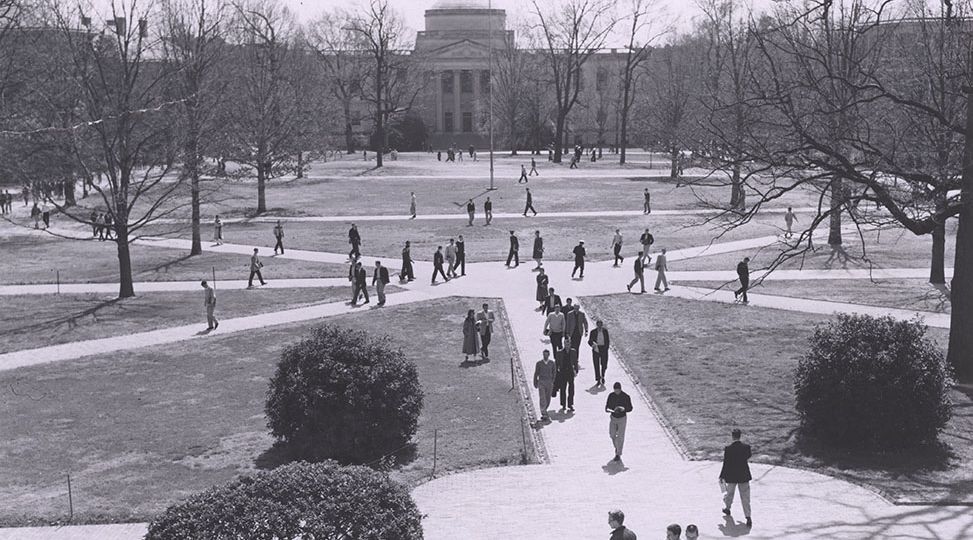
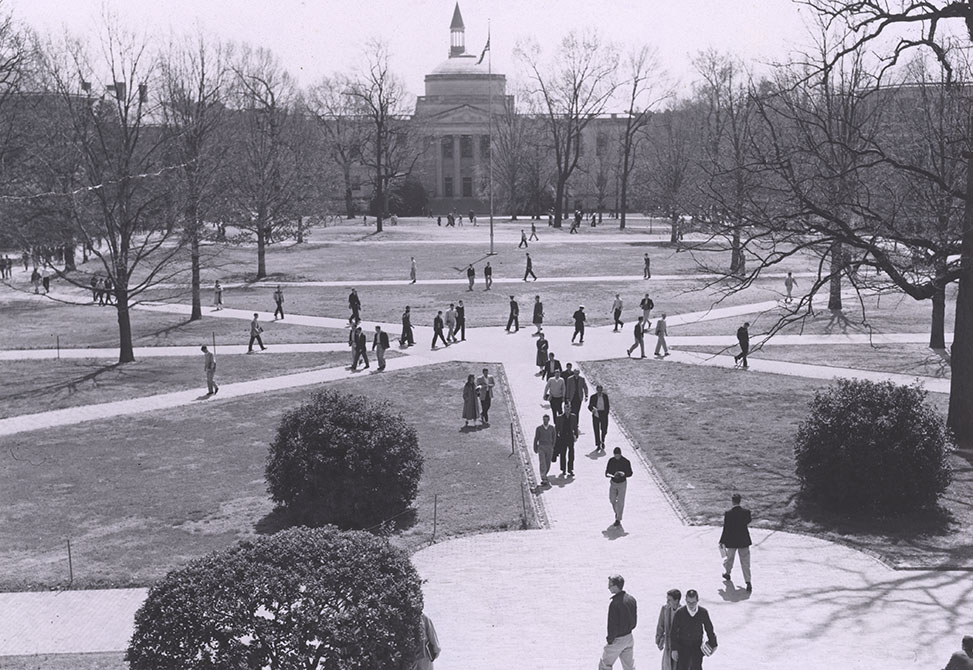
The quad that stretches from South Building to Wilson Library is named for James K. Polk, the only university alumnus to date to become president of the United States. If McCorkle Place, to the north of South Building, represents the nineteenth-century campus, then Polk Place represents the early twentieth century and the beginning of the modern research university. The quad was planned to accommodate dramatic growth in the student body. Most of its classroom buildings, along with Wilson Library, were built over about ten years. The architect firm of McKim, Mead and White designed the quad, and architect Arthur C. Nash oversaw its development and construction. To accommodate the construction pace, a railroad spur was extended temporarily into the center of the quad so that materials could be delivered to the site.

View of Polk Place, ca. 1960s, probably taken from one of the upstairs windows in South Building. UNC Image Collection, North Carolina Collection Photo Archives, Wilson Library.


PlaymakersTheaterSmithHall_973

16 Apr: Playmakers Theater (Smith Hall)

Playmakers Theater (Smith Hall)

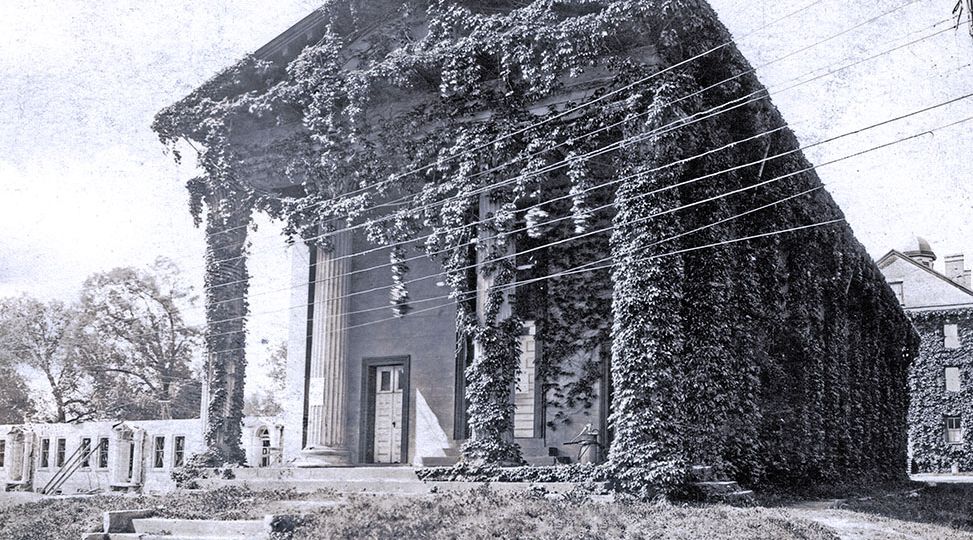
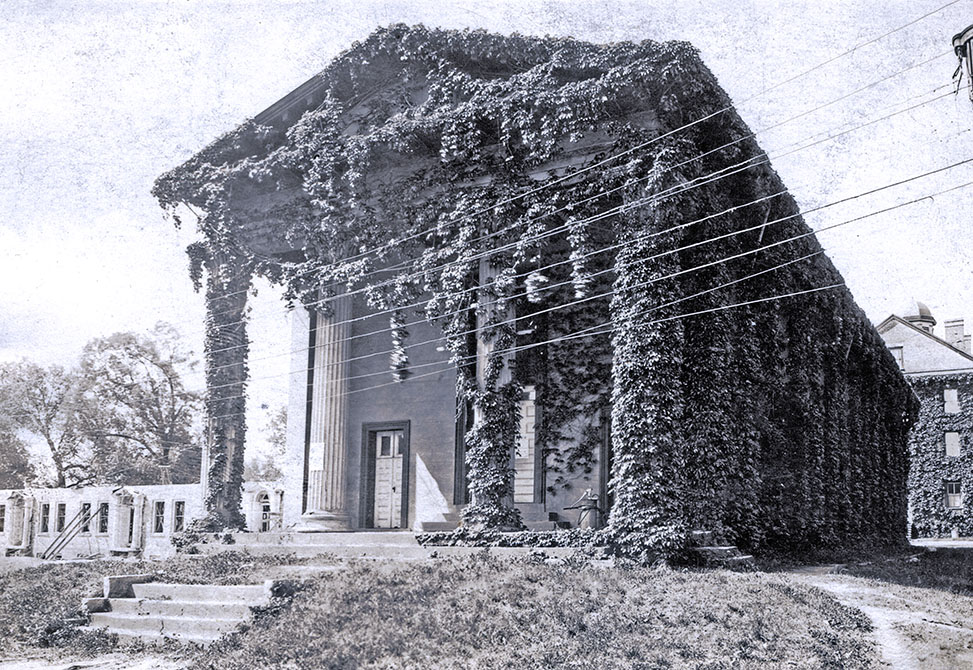
Designed by architect Alexander Jackson Davis, Playmakers Theatre is a National Historic Landmark and one of the most significant architectural works on campus. Built in 1850 as a combination library and ballroom, the building was named for its benefactor, Benjamin Smith. A significant architectural feature is the use of wheat and corn decorations on the column capitals instead of the traditional acanthus leaves. Over the years the building housed a chemistry laboratory, and in 1893 it became the university bath house, with six tubs installed for 500 students. The law school occupied the building until 1925, when the university turned it into a theater for the Carolina Playmakers, with the help of a grant from the Carnegie Corporation. It was the main indoor performing space for the Carolina Playmakers until the Paul Green Theatre opened in 1978. Playmakers Theatre continues to be used as a performance space, despite its lack of accessible restrooms and air conditioning.

Date Established: 1850

Date Range: 1850 – Present

Playmakers Theatre, then known as Smith Hall, was the home of the UNC School of Law at the time of this 1915 photo. Durwood Barbour Postcard Collection, North Carolina Collection Photo Archives, Wilson Library.


16 Apr: Playmakers Repertory Company

Playmakers Repertory Company

PlayMakers Repertory Company is a professional regional theater company in residence at UNC—Chapel Hill. Resident and visiting professional artists work in conjunction with graduate students in acting, costume production, and technical production from the Department of Dramatic Art. It is a member of the League of Resident Theatres in the United States and one of the oldest professional theater companies in North Carolina. The company produces a full season of classical and regional plays, staged in the Paul Green Theatre and the Kenan Theatre in the Joan H. Gillings Center for Dramatic Art. PlayMakers' first official production was The Crucible in January 1977, held in the Playmakers Theatre.

Date Established: 1976

Date Range: 1976 – Present

16 Apr: Pit preachers

Pit preachers

The promise of a ready audience and a tolerance for free speech on campus has long made the Pit a popular location for preaching. The "pit preachers" are usually evangelical Christians seeking to educate, chastise, or convert passing students. Many are noted for their fiery rhetoric, not to mention their powerful voices. Arguing with the preacher is a favorite pastime of students, and a crowd often gathers to mock, dispute, or simply listen. While there have been many different preachers on campus, the best known and most persistent is Gary Birdsong, an itinerant preacher who travels to schools around North Carolina (at North Carolina State he is known as the Brickyard Preacher). A fixture in the Pit since the early 1980s, Birdsong's deep voice resonates across campus, and his inflammatory descriptions of the sinful lives of college students ("Homo Hill" is his nickname for Chapel Hill) are a fixture of his confrontational style. He was banned from the Pit by campus police for two years in 2007 after refusing to leave when the space was reserved by a student group. He spoke elsewhere on campus and promptly returned to the Pit as soon as the ban expired.

Date Established: 1980

Date Range: 1980 –
2020

16 Apr: Piney Prospect

Piney Prospect

Piney Prospect is a promontory on the east edge of campus and the site of Gimghoul Castle. In his first description of the site, William Richardson Davie called it Prospect Point, a place from which one could view the land to the east, including the high points near the Eno, Little, and Flat Rivers. According to Kemp Plummer Battle, the name became "Piney" through the common practice of pronouncing "point" as "pi'nt," which eventually just became "piney." Battle grew up exploring the woods in this area, eventually making trails and naming many of its features. When the Order of the Gimghoul purchased the land in the 1920s, a seat was placed at the point using rocks Battle had gathered there, in his memory. The Piney Prospect overlook is on the Lover's Loop Trail, part of Battle Park.

16 Apr: Physical education

Physical education

While early Carolina students often participated in outdoor games, the university did not require physical education until 1891. To encourage physical fitness among the student body, students were required to take part in exercises at the gymnasium (then located in Commons Hall) three times a week. These early classes were organized by the campus YMCA. The requirements have changed many times over the years. In 1896 all students had to exercise at the gym for thirty minutes a day. By the early twentieth century this was reduced to a varying number of hours a week, with different requirements by class. World War I brought about an increased focus on physical training, and a Department of Physical Education was established soon after, with a separate physical education department for women created in 1933. In 1938 the two were combined into the Department of Physical Education and Athletics.

In the 1930s and 1940s the physical education department was closely aligned with the athletic department and recreational sports. By the 1950s the different functions separated and the Department of Physical Education focused exclusively on teaching. The curriculum received a full revision in the 1980s, reflected in the change of the name to the Department of Physical Education, Exercise, and Sport Science. In 1999 it was shortened to the Department of Exercise and Sport Science.

16 Apr: Phillips Hall

Phillips Hall

Phillips Hall opened in 1919 to house many of the university's science departments, which had been scattered around the campus. The Departments of Math, Physics, and Engineering were the first occupants. As Phillips was being built, the Tar Heel boasted that the new building would be the "best equipped of its kind in the South" and that it would "equal those at Harvard and Yale." In addition to modern scientific facilities (including a "dynamo room"), it contained reinforced steel and concrete that were supposed to make it fireproof. It has been expanded several times since 1919, including the addition of the Phillips Annex, built in 1960 to house the university's Computation Center.

The distinctive style of Phillips Hall, called English Collegiate at the time it was built, has led to one of the most unlikely, although persistent, myths about the campus. Students have suggested that it was not designed for UNC—Chapel Hill at all, that the campus architect received plans meant for another campus. The design of Phillips Hall, however, was intentional, with the building style specified in the construction contract. It was built during a period of architectural experimentation on campus, with buildings such as the Smith Building, Campus Y, and Battle-Vance-Pettigrew departing from the style of the older buildings. It has not been one of the more popular buildings on campus. Historian Archibald Henderson wrote that "the general effect was that of an industrial plant, suggesting automobiles or sewing machines."

The building is named for three members of the Phillips family, all of whom taught at UNC in the nineteenth century: James Phillips, an early math instructor; Charles Phillips, who taught math and engineering and briefly served as acting president of the university; and William Battle Phillips, who earned the university's first doctorate when he received a Ph.D. in chemistry in 1883.

Date Established: 1918

Date Range: 1918 – Present

PettigrewHall_973

16 Apr: Pettigrew Hall

Pettigrew Hall

Pettigrew Hall, part of the three-part Battle-Vance-Pettigrew building, opened in 1912 as a dormitory. Built on northwest corner of McCorkle Place on Franklin Street, the modern dorm featured steam heat, water, and shower baths on every floor. The building served as a dorm until the late 1960s, when it was converted to office space, used most recently by the Office of Scholarships and Student Aid. The building is named for alumnus and Civil War general James Johnston Pettigrew. Valedictorian of the class of 1847, Pettigrew was one of the most acclaimed students of his generation. After graduation he traveled, wrote, and practiced law in South Carolina. Initially a reluctant secessionist, he eventually joined the South Carolina militia and was appointed to lead a North Carolina regiment in the Civil War. He rose to the rank of brigadier general, was wounded in battle multiple times, and eventually died from wounds suffered while leading his regiment in the ill-fated Pickett's Charge at the Battle of Gettysburg.

Date Established: 1912

Date Range: 1912 – Present

Battle-Vance-Pettigrew building, ca. 1920s. Pettigrew Hall is on the left. UNC Image Collection, North Carolina Collection Photo Archives, Wilson Library.


Privacy Preferences
When you visit our website, it may store information through your browser from specific services, usually in form of cookies. Here you can change your privacy preferences. Please note that blocking some types of cookies may impact your experience on our website and the services we offer.