Skip to main content Scroll Top

Entries

16 Apr: Person Hall

Person Hall

Person Hall was the third building completed after Old East and Steward's Hall. Completed in 1797, Person served as the College Chapel and village church for almost forty years. In 1877 the building was renovated to house the Departments of Physics and Chemistry. Shortly after they moved in, the building caught fire and the interior was destroyed. Trustee Julian Carr paid for its rebuilding, and in 1886 and 1892 the building was enlarged to better accommodate chemistry labs and instruction. The School of Medicine later occupied Person Hall, followed by the School of Pharmacy, and then the Department of Music.

In 1936, using New Deal funds, the university turned Person Hall into an art gallery and home to the art department. The distinctive gargoyles and statue of Archbishop of Canterbury Stephen Langton were added to the exterior at this time. The music department returned to the building in the mid-1970s and has occupied it since then.

Person Hall is named in honor of Brigadier General Thomas Person, a Revolutionary War officer and wealthy planter who used and profited from enslaved labor. He was also a founding UNC trustee. It is the first university building named for a donor. When the university needed funds to complete its construction, Person gave 1,050 silver dollars for the project.

Date Established: 1798

Date Range: 1798 – Present
16 Apr: Peabody Hall

Peabody Hall

Peabody Hall has always served as the home for the School of Education. It opened in 1913 and received a major renovation and expansion in 1960. It is named for philanthropist George Peabody, who established the Peabody Education Fund, after the Civil War to support teacher training, primarily in the South. The fund provided support for the university's first Summer Normal School for teachers in 1877 and in 1911 contributed $40,000 toward the construction of a new building for the School of Education.

Date Established: 1912

Date Range: 1912 – Present

16 Apr: Patch Adams

Patch Adams

In the summer of 1998 the UNC—Chapel Hill campus was transformed into the fictional Virginia Medical University for the filming of the movie Patch Adams. Based on the true story of an unorthodox doctor who used humor to help his patients, the movie starred Robin Williams, who was in Chapel Hill for several weeks for filming. Many Carolina students, staff, and local residents had roles as extras in the movie. Alumni will recognize many campus locations in the movie, including Polk Place, Gerrard Hall, Wilson Library, and Carroll Hall. While it was exciting to see the campus on the big screen, it received many poor reviews, and film critic Gene Siskel picked it as the worst movie of the year.

Date Established: 1998

Date Range: 1998 –
1998

16 Apr: Parker Residence Hall

Parker Residence Hall

Parker Residence Hall opened 1958, at the same time as nearby Avery and Teague dorms. Originally all male, Parker became a women's dorm starting in 1968. It is named for John J. Parker, a lawyer and judge. Parker graduated from UNC in 1907 and went on to a long and successful legal career. In 1930 Parker was nominated by President Herbert Hoover to fill an empty Supreme Court seat. His nomination was narrowly defeated, due in large part to opposition from organized labor and the NAACP. Labor unions opposed Parker due to some of his decisions on the U.S. Court of Appeals, and the NAACP campaigned against his nomination due to remarks he had made during an unsuccessful gubernatorial campaign in 1920 when he referred to the participation of African Americans in politics as a "source of evil and danger to both parties." Parker was a member of the UNC Board of Trustees for several decades and a strong supporter of university president Frank Porter Graham.

Date Established: 1957

Date Range: 1957 – Present

16 Apr: Olympics

Olympics

The university has several interesting connections to the Olympic games. Faculty member Eben Alexander was serving as ambassador to Greece in 1896 during the revival of the modern Olympics and was instrumental in recruiting American athletes to participate. UNC's first Olympian was Harry Williamson, who competed in track in the 1936 games in Berlin. The first medalist from Carolina was Floyd "Chunk" Simmons, who won the bronze medal in the decathlon in 1948. UNC gold medalists include several in men's basketball and women's soccer. In 1987 UNC hosted several events during the 1987 Olympic Festival, an Olympic-style competition held in non-Olympic years. In 1996 the Olympic torch passed through campus on its way to the Atlanta games.

16 Apr: Old West

Old West

Completed in 1823 as a companion to Old East, located to the west of the Old Well. Construction was under the direction of architect William Nichols, who also designed a third floor for Old East at the same time to make the buildings match. Nichols and architect Alexander Jackson Davis, who oversaw an addition and renovation in 1848, used enslaved laborers on this construction. In the 1880s Old West was home to the North Carolina Historical Society for a brief period. It also housed faculty offices and lecture rooms for the early medical school faculty, making it the first building used exclusively for medical instruction in Chapel Hill.

Old East and Old West have undergone multiple repairs and renovations over the years. A major restoration project in the mid-1990s removed virtually all of the interiors and restored the exteriors to resemble their 1848 appearance.

Date Established: 1822

Date Range: 1822 – Present


OldWell_973

16 Apr: Old Well

Old Well

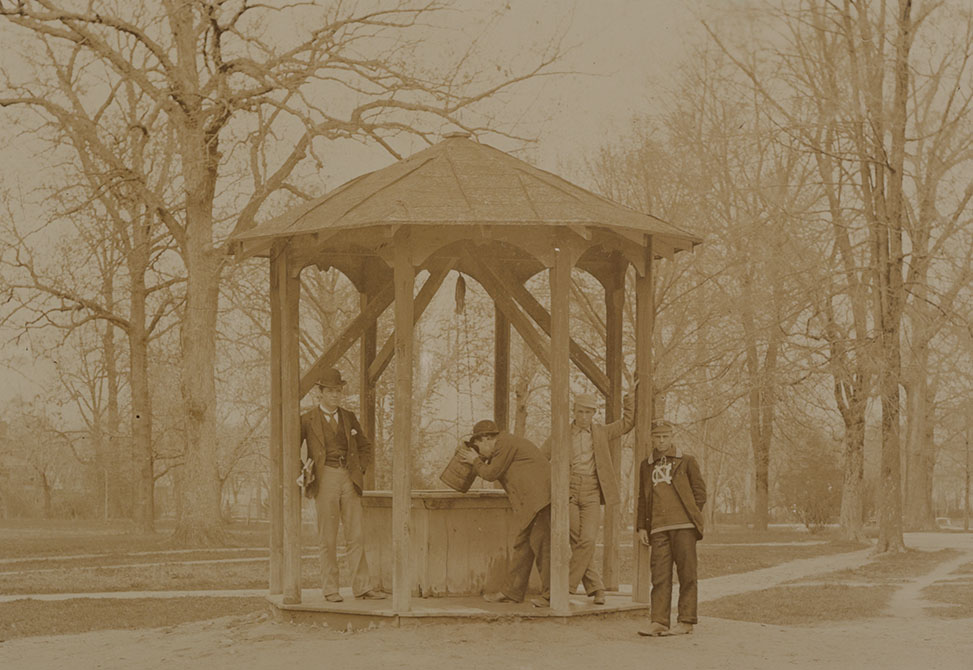
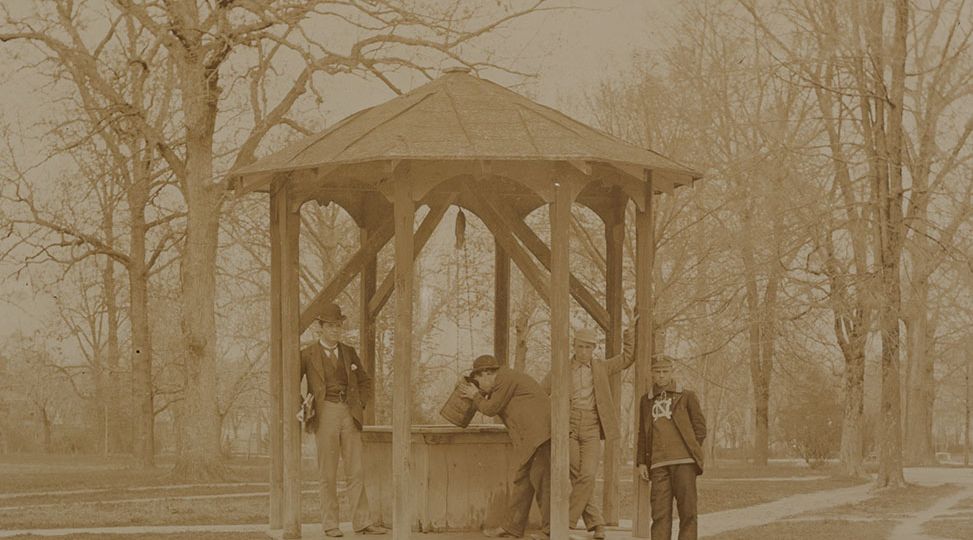
Early UNC students and faculty relied on wells and nearby springs and creeks for water. The Old Well is probably one of the original wells dug in the 1790s. Located near Old East, the well was at the center of the small campus following the construction of South Building and Old West. Photos from the 1890s show the well surrounded by a rough wooden structure that would have been built to cover the open well and provide shelter for students. Students and others retrieved water from the well using a wooden bucket and a chain. In 1897 university president Edwin Anderson Alderman, whose office in South Building looked out on the well, wanted to "add a little beauty to the grim, austere dignity of the old Campus at Chapel Hill." He was inspired by the small temples he had seen in English gardens and at Versailles. Using some of these as models, campus builders constructed a domed structure with white columns, which is the design of the Old Well we know today. A pump was installed in 1900, replaced by a water fountain in 1925, at which point it ceased to operate as a well: the fountain was connected to the university's water system.

By the 1950s the Old Well was showing signs of decay, and university officials decided that it needed to be completely rebuilt. The original structure was demolished in the summer of 1954, and a replica was built in its place, containing sturdier pillars, marble bases, and a copper dome. The Old Well has become one of the most recognizable symbols of the university. It is a registered trademark of UNC—Chapel Hill and is used on everything from clothing to institutional letterhead.

Date Established: 1800

Date Range: 1800 – Present

“The Well,” ca. 1892. This photo shows the well a few years before it was renovated to its now iconic design in 1897. Kemp Battle Photograph Album, North Carolina Collection Photo Archives, Wilson Library.


16 Apr: Old Students Club

Old Students Club

Founded in 1936, the Old Students Club is a section of the General Alumni Association for people who were students more than fifty years ago. In the 1950s the group considered changing the name. "That word Old is the point of criticism," the club president wrote. "We just don't like to be called Old." But after discussing it, the group decided to keep the name.


OldEast_973

16 Apr: Old East

Old East

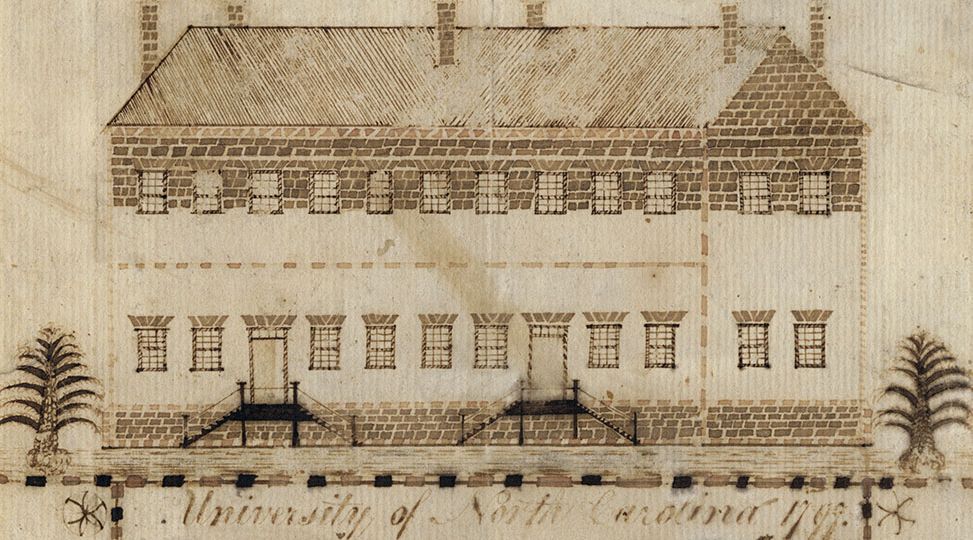
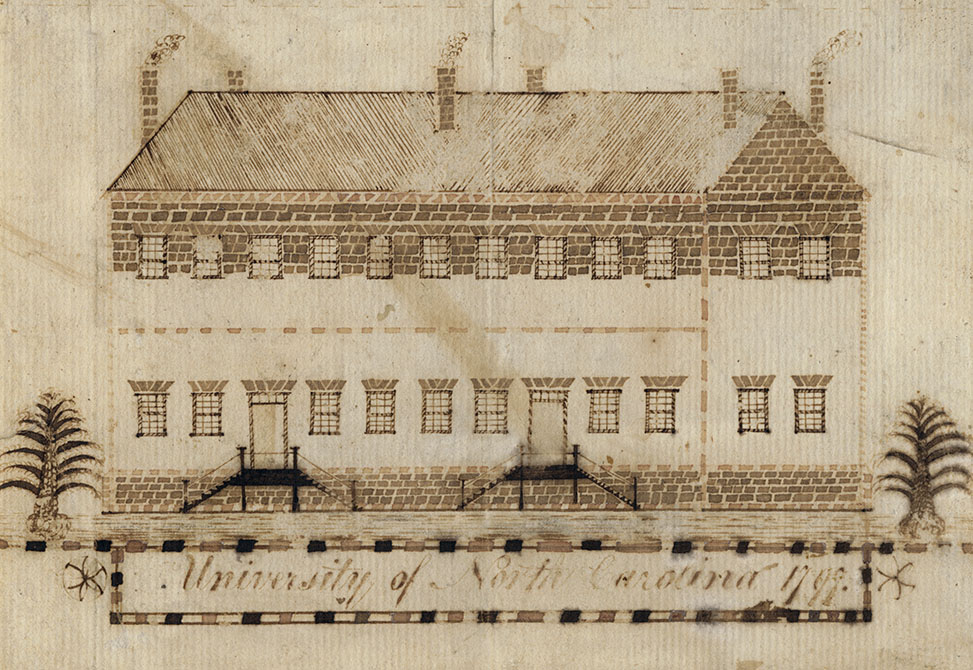
Old East is the first building at the university and is listed on the National Register of Historic Places as the first building on a public university campus in the United States. The original structure, located just to the east of the Old Well, was designed to be the north wing of a larger building. It was built by James Patterson and remodeled in 1822 by William Nichols, adding a third floor, and in 1848 by Alexander Jackson Davis, all of whom used enslaved laborers. Known as simply as the College, later East, and then Old East as the campus grew, the structure has been in continuous occupation since beginning as a dormitory.

Old East and Old West have undergone multiple repairs and renovations over the years. A major restoration project in the mid-1990s removed virtually all of the interiors and restored the exteriors to resemble their 1848 appearance. This effort included recreating the Philanthropic Society library space on the third floor of Old East.

Date Established: 1795

Date Range: 1795 – Present

This 1797 drawing of Old East by student John Pettigrew is one of the earliest known images of the UNC campus and a rare glimpse of Old East before its third story was added. Pettigrew Family Papers, Southern Historical Collection, Wilson Library.


16 Apr: Old Chapel Hill Cemetery

Old Chapel Hill Cemetery

Old Chapel Hill Cemetery, located at the corner of South and Country Club Roads, is as old as UNC itself. The first recorded burial was a white student, George Clarke of Bertie County, who died unexpectedly in 1798. He was buried in the woods at the top of a knoll that was then well east of campus and town. The earliest known African American person buried there was Ellington Burnett in 1853. A low rock wall near the center of the cemetery historically separated the graves of black and white persons. For many years it was known as the College Graveyard or Village Cemetery, and both university and town cared for it. Now officially owned by the town, the cemetery is on the National Register of Historic Places as a burial site of formerly enslaved people and of noteworthy faculty and university leaders. In 2004 the Black Student Movement erected a plaque on South Road to honor those buried in the African American section. In 2005 Carolina officials dedicated Memorial Grove, a space for the scattering and interment of ashes. Perhaps the best-known epitaph in the cemetery belongs to Jane Tenney Gilbert: "I was a Tar Heel born and a Tar Heel bred / and here I lie a Tar Heel dead. / BORN JAN. 1896 AND STILL HERE 1980."


Privacy Preferences
When you visit our website, it may store information through your browser from specific services, usually in form of cookies. Here you can change your privacy preferences. Please note that blocking some types of cookies may impact your experience on our website and the services we offer.