Skip to main content Scroll Top

Entries

16 Apr: Odum Village

Odum Village

In 1960 the university opened new housing for married students in order to replace the ramshackle Victory Village units. The new community, eventually named Odum Village after UNC faculty member Howard W. Odum, included brick buildings (a big improvement from the prefabricated metal Victory Village units) and modern amenities, including a large television antenna. The two complexes continued side by side on South Campus for several years before demolition began on the Victory Village buildings. Odum Village served as the primary housing for married students until Baity Hill Graduate and Family Housing opened in 2005. In 2016 the UNC—Chapel Hill Board of Trustees approved demolition of the Odum Village buildings to make way for future projects.

Date Established: 1960

Date Range: 1960 – Present
16 Apr: Odum Institute for Research in Social Science

Odum Institute for Research in Social Science

The Institute for Social Sciences was established in 1924 with funding from the Rockefeller Foundation and encouragement from university president Harry Woodburn Chase. It was the first program of its kind in the country. Led by sociologist Howard Odum, the institute focused most of its research on social and economic problems facing the American South, including poverty and race relations. The early work of the institute helped raise the academic reputation of the university, especially among other regional schools, but it also drew criticism and accusations of a liberal or even Communist influence at the university. The institute evolved throughout the twentieth century, adding equipment and staff to adapt to the increasingly complex data-processing needs of social scientists. In 1999 the name was changed to the Howard W. Odum Institute for Research in Social Science in honor of the institute's founding director.

Date Established: 1924

Date Range: 1924 – Present

16 Apr: Nursing, School of

Nursing, School of

The School of Nursing was founded in 1950 as the first four-year school of nursing in the state to offer a bachelor's degree. (Duke University already had a three-year degree program.) UNC had offered summer extension classes for nurses beginning in the mid-1930s and a bachelor's degree in public health nursing in the School of Public Health starting in 1941. A nursing program was part of a major effort by the state legislature in the late 1940s to improve health care statewide. The effort included expanding UNC's medical program to four years from two years, building a state hospital, and adding dental and nursing schools to the existing pharmacy and public health programs.

The first class of twenty-seven white women that started the program in fall 1951 were the first full class of freshmen women to enroll at the university, as female enrollment was still limited elsewhere in the university. Their first dormitory was Smith Building. Residence halls, offices, and classrooms of the School of Nursing occupied space in a number of buildings over the years, including the hospital, until Carrington Hall opened in 1969.

The School of Nursing now offers bachelor of science and master of science degrees in nursing, a doctor of philosophy, and a doctor of nursing practice. Its focus remains on practice, research, teaching, and administration.

16 Apr: North Carolina Collection

North Carolina Collection

The North Carolina Collection, part of the Wilson Special Collections Library, traces its origins back to 1844, when university president David Lowry Swain created the North Carolina Historical Society and began collecting books and other materials about North Carolina history. Mary Lindsay Thornton was hired as the first curator of the collection in 1917 and remained in the job for more than forty years, helping grow the collection into one of the largest state historical libraries in the country. In 1935 alumnus John Sprunt Hill, who was already a dedicated supporter of the collection, donated the Carolina Inn to the university with the direction that profits from the inn would be used to support the North Carolina Collection. In addition to its printed materials about North Carolina, the collection also supports a gallery in Wilson Library and a large photographic archive and hosts the North Carolina Digital Heritage Center, which provides digital library services for cultural heritage organizations across the state.

16 Apr: North Carolina Botanical Garden

North Carolina Botanical Garden

The UNC Board of Trustees first approved the use of university-owned land for a botanical garden in 1952. The original land was supplemented by private gifts, and the North Carolina Botanical Garden now manages more than 1,000 acres. The garden, overseen by the university's botany department, first opened to the public in 1966. It was designed as a conservation garden, cultivating and maintaining thousands of different native plant species. The garden supports both education and research, attracting a large number of visitors each year and serving as a resource for faculty and students in the botany department. One of the many specialized collections in the garden is devoted to carnivorous plants, including pitcher plants and Venus flytraps. In addition to the main gardens located southwest of campus, the North Carolina Botanical Garden also oversees the Coker Arboretum, Battle Park, the Mason Farm Biological Reserve (a natural area preserved for research and education), and the UNC Herbarium, a collection of natural history specimens founded in 1908 that has grown into one of the largest collections of its kind in the country.

Date Established: 1952

Date Range: 1952 – Present

16 Apr: Nobel Prize

Nobel Prize

Two UNC—Chapel Hill faculty members have been awarded a Nobel Prize: Oliver Smithies, who won the Nobel Prize for Physiology or Medicine in 2007 for his work on gene modifications using embryonic stem cells, and Aziz Sancar, who won the 2015 Nobel in Chemistry for his work on DNA repair. Smithies used part of his award to establish the Oliver Smithies Nobel Symposium to bring a Nobel laureate to campus each year for a visit and lecture. Carolina alumnus Robert Furchgott, class of 1937, earned a Nobel Prize in Physiology or Medicine in 1998, for discoveries concerning nitric oxide as a signaling molecule in the cardiovascular system.

Date Established: 2015

Date Range: 2015 –
2015

16 Apr: Nike

Nike

Nike has provided shoes, uniforms, and other items for Tar Heel athletic teams since 1993. The switch to Nike was a big change for UNC's basketball teams, which had worn Converse shoes since 1962. The university's relationship with Nike has not been without controversy. When UNC—Chapel Hill was negotiating a renewal of the contract in 1996, a group of students protested, citing allegations of low wages and poor working conditions for Nike's factory workers in Asia. Student objections continued through the next couple of years and were investigated in detail in a spring 1998 class called Economics, Ethics, and Impacts of the Global Economy: The Nike Example. The course drew national attention, including coverage on ESPN, and had a surprise visitor at the end of the semester when Nike CEO Phil Knight came to campus and sat in on the students' final presentations, which contained multiple recommendations for the company. Nike promised to take a closer look at its labor practices, and the athletic department continued to renew its Nike contracts, with the most recent extension announced in 2018.

16 Apr: New West

New West

New West was built in the late 1850s as a dorm to house the expanding population of students. It was designed by architect William Percival to match New East, except that it is one story shorter. In what was an innovation at the time, the building did not include fireplaces in each room. Instead, they would be heated by a basement furnace and a system of pipes. It didn't work —the rooms on the bottom floor were much too hot while the top floors stayed cold. When the Dialectic and Philanthropic Societies combined in 1959, they agreed to hold their meetings in New West. The building has had many different uses over the years. In the 1890s New West was home to university printing and a pharmaceutical lab. Departmental occupants have included music, psychology, computer science, and, most recently, Asian studies.

Date Established: 1861

Date Range: 1861 – Present

»


16 Apr: New East

New East

With enrollment increasing in the 1850s, the university built two new dorms to house the additional students. They were placed on either side of the east and west buildings and were called New East and New West. As New East was on a downhill slope, architect William Percival designed it with an additional story to balance the height of the buildings on the landscape. New East was not without its critics. The supposedly modern heating system failed to work as designed. When a committee surveyed the campus in the 1870s in preparation to reopen the university, New East was called "the most ill[-l]y constructed of all the buildings." In addition to dorm rooms, New East also housed the debating hall and library of the Philanthropic Society. Students lived in the building until the 1890s, when it was converted to serve as office space and classrooms for academic departments. Several departments have used the building at different times, including biology, geology, and most recently, city and regional planning. The Philanthropic Society continued to meet in the building for many years, and at one point New East hosted meetings of the student legislature.

Date Established: 1861

Date Range: 1861 – Present

«


NCLogo_973

16 Apr: NC logo

NC logo

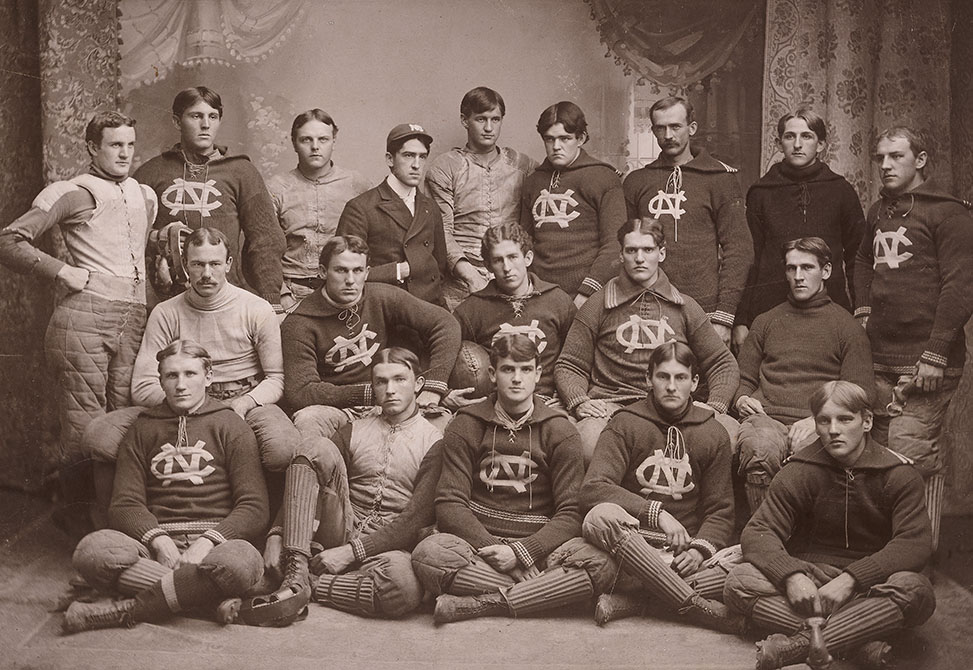
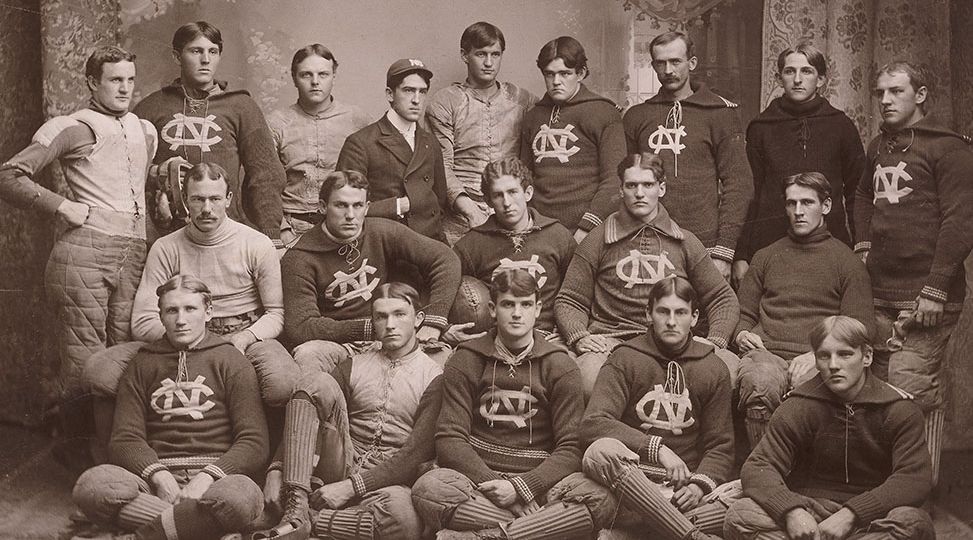
The interlocking "NC" logo has been associated with the university since at least the 1890s. It was used on uniforms worn by the early baseball and football teams and appears on sweaters worn by students in the late nineteenth and early twentieth centuries. When UNC—Chapel Hill entered its first trademark and licensing agreement in 1982, the "NC" logo was one of the symbols registered by the university.

Date Established: 1900

Date Range: 1900 – Present

The interlocking “NC” design has been a fixture on UNC athletic uniforms since the early days of organized sports on campus. This photo shows the 1898 football team. UNC Image Collection, North Carolina Collection Photo Archives, Wilson Library.


Privacy Preferences
When you visit our website, it may store information through your browser from specific services, usually in form of cookies. Here you can change your privacy preferences. Please note that blocking some types of cookies may impact your experience on our website and the services we offer.