Skip to main content Scroll Top

Entries

16 Apr: Granville Towers

Granville Towers

Granville Towers opened in 1966 as an experiment in a new type of campus housing. The two high-rise buildings on Franklin Street, built on the site of the old Chapel Hill High School, would house more than 1,000 students in the country's first example of a private dorm. Granville Towers was built by a private company in cooperation with the university. While students enjoyed more amenities than those in traditional dorms, they still had to follow university rules about drinking and hours, and there were graduate counselors on every floor. More expensive than campus housing options, Granville Towers offered a more luxurious and more independent living experience, with furnished rooms, private bathrooms, a cafeteria, parking, and, perhaps most coveted by students, air conditioning in every room.

The towers were originally divided by gender: men in the west building, women in the east. In 2009 UNC—Chapel Hill purchased Granville Towers and the adjacent shopping center, but the towers continued to be run by a private company in cooperation with the university.

Date Established: 1964

Date Range: 1964 – Present
16 Apr: Graham Student Union

Graham Student Union

Carolina students began advocating for a new student union as early as the 1950s. The Graham Memorial Building, dedicated in 1931, was ill-suited for the needs of the post–World War II generation of students. The new union was part of an effort to expand and modernize student services at the university, built at the same time as the new Student Stores building and House Undergraduate Library. The modern architectural style of the new buildings was not popular with everyone, as seen in debates in the Daily Tar Heel at the time, but the increase in space was definitely welcomed. The Graham Student Union opened for students in 1969. The new building featured expanded office space, meeting rooms, lounges, snack bar, and a bowling alley. It was expanded in 1981 and again in the early 2000s.

The building is named for Frank Porter Graham, one of the most beloved figures in UNC–Chapel Hill history. A 1909 graduate of Carolina, Graham was a popular history professor at UNC before being elected as president of the university in 1930. In 1931 he was appointed president of the consolidated University of North Carolina. Graham oversaw the university system through the difficult years of the Great Depression and the subsequent boom in enrollment and building during and after World War II. He is usually remembered best for his concern for students and for his progressive politics.

Graham was widely popular with students, especially in Chapel Hill. Future university and state leaders, such as UNC System president William C. Friday and state governor Terry Sanford, cited Graham as a formative influence on their careers. Graham was often less popular around the state and was criticized for his support of organized labor and civil rights. His willingness to speak out on social and political issues was tempered by his reluctance to do anything that he felt would harm the university. When Pauli Murray applied to attend graduate school at UNC in 1939, Graham responded that it was too soon for him to publicly advocate for admitting African Americans to the university, fearful that doing so would “cause a throwback to a darker time.”

In 1949 Graham was appointed to serve out the remainder of a vacant term in the U.S. Senate. Widely expected to win reelection in 1950, he was defeated in the primary by Willis Smith, whose campaign focused heavily on Graham’s support of civil rights and integration. The loss was a blow not just to Graham but to his many devoted supporters among students and alumni. Graham would spend the remainder of his career working at the United Nations but was a frequent presence in Chapel Hill until his death in 1972.

Date Established: 1964

Date Range: 1964 – Present
16 Apr: Graham Residence Hall

Graham Residence Hall

Graham Residence Hall opened in 1924, alongside two other new dorms (Aycock and Lewis). It was named in 1928 for John Washington Graham, the son of former governor and U.S. senator William A. Graham. After graduating from UNC in 1857 and serving in the Confederate army, where he was wounded twice, he had a successful career as a lawyer. Graham was an active member of the conservative party that sought to overturn Reconstruction-era reforms in the state. As a member of the state senate in the early 1870s, he was active in the ultimately successful effort to impeach Governor William Holden. During the trial Graham suggested that the crimes committed by robed Ku Klux Klan members in the late 1860s were actually done by disguised African Americans. Graham was a member of the UNC Board of Trustees for more than fifty years.

Date Established: 1924

Date Range: 1924 – Present

16 Apr: Graham Memorial Hall

Graham Memorial Hall

Not long after the death of beloved university president Edward Kidder Graham in 1918, alumni announced a plan to raise money to build a student union, which would be named in honor of Graham. The Campus Y had served as the center of student activities since 1907 and was running out of space. Construction on the union began in 1922 but took nearly a decade, delayed in part by lack of funds. Students eventually decided to pay for the finishing touches themselves, voting in 1931 to pay a union fee of one dollar each academic quarter for furnishings and maintenance.

The Graham Memorial Student Union opened in the fall of 1931. It featured a large, wood-paneled lounge, game rooms with billiards and table tennis, a bowling alley, and a barber shop. It also housed student organizations and publications, including the Daily Tar Heel and the Yackety Yack. It would remain the center of student life until the new Frank Porter Graham Student Union was built in the late 1960s.

Graham Memorial is named for Edward Kidder Graham. A native of Charlotte, he graduated from UNC in 1898 and was hired the following year as a librarian. He soon joined the English department as an instructor and was frequently promoted, serving as department chair and later dean of the College of Liberal Arts. He was appointed acting president of UNC in 1913 and was elected to succeed Francis Venable in 1914. He served until his death from influenza in 1918. Despite his short tenure as president, Graham has had a lasting influence on the university. He continued the work begun by Venable to develop UNC into a research university. Graham was also especially interested in expanding the university's role in North Carolina. He helped establish the Bureau of Extension, which brought lectures and lent books to communities across the state.

When the student union moved to its new home in 1968, the Department of Dramatic Art took over Graham Memorial. In 2000, following renovations, the building became the home of the honors program and other campus offices.

Date Established: 1914

Date Range: 1914 – Present

16 Apr: Governors

Governors

When Roy Cooper was sworn in on January 1, 2017, he became the 32nd governor of North Carolina to have attended Carolina. The first was William Miller, who attended UNC during the 1802 school year, left without graduating, and was elected governor in 1814. Miller's story is not unusual —many early governors left the university before graduating, a sign that possession of a college degree was not seen as a prerequisite for many professions in the nineteenth century. Twenty-one governors (including Cooper) earned degrees from the university.

16 Apr: Government, School of

Government, School of

Now located in the Knapp-Sanders Building on the eastern edge of campus, the School of Government is the oldest program of its kind in the nation. It was created to train and support local officials at all levels of government in North Carolina. Since its inception it has been the destination for generations of new mayors, legislators, city managers, county attorneys, judges, budget directors, tax supervisors, planning and zoning personnel, and more. More than 12,000 public officials participate annually in a training program. The school also has a residential and online master of public administration degree program.

Law professor Albert Coates began to offer classes for elected officials who needed to learn the laws they were expected to enforce. He soon realized there was a constant flow of new officials who needed this training. In 1931, with the help of his wife, Gladys Hall Coates, he created the Institute of Government as a private enterprise. It became part of the university in 1942 and was the foundation for the School of Government, established in 2001.

16 Apr: Gore Cogeneration Facility

Gore Cogeneration Facility

Located near the intersection of West Cameron Avenue and Merritt Mill Road, the so-called Cogen Facility is the fourth power plant at UNC—Chapel Hill, completed in 1992. The plant, which is coal powered, provides about 20 percent of campus electricity needs, including the hospitals. It also generates steam as a by-product, which is used for heating and other uses, thus the term "cogeneration." While the facility is recognized as efficient and clean for this type of energy production, it is responsible for 50 percent of the greenhouse gases that the university emits every year. The university is in the process of modifying it to also use natural gas, which will reduce coal burning, and instituting further measures to reduce emission and improve air quality.

The facility is named in memory of professor Joshua W. Gore, who came to UNC in 1882 to teach physics and engineering and lead the School of Mines, which became the Department of Applied Science. Gore installed the first electrical systems on campus in 1890 and helped design and build the first telephone system. He also helped design the first power plant in 1895, which he oversaw until his death in 1908.

16 Apr: Golden Fleece

Golden Fleece

The Order of the Golden Fleece was founded in 1904 at the suggestion of philosophy professor Horace Williams, who was worried that the university was becoming too factional. Williams, along with faculty members Edward Kidder Graham and Eben Alexander, wanted to promote service to the university. The order was open to all students, faculty, and alumni, though new members were primarily rising seniors. Women began to be admitted starting in 1972. The name comes from the story of Jason and the Golden Fleece. The president of the club is known as the Jason, while the members are called Argonauts.

The induction or "tapping" ceremonies are now private but used to be held in a dramatic public ceremony. In the 1930s students would gather in Memorial Hall to hear a lecture on the subject of character, followed by a ritual in which current members of the Golden Fleece, wearing black hooded robes, would walk among the audience and select the students to be inducted into the order. The Order of the Golden Fleece continues to add new members every year. The Golden Fleece typically works in a quiet way through individuals and other organizations to promote unity and address timely issues. On rare occasions, the order has worked publicly on campus issues such as hazing and the student honor code. The organization remains private, but the names of members are not kept secret and have included many well-known UNC—Chapel Hill administrators and alumni.

Date Established: 1904

Date Range: 1904 – Present

16 Apr: Glee Club

Glee Club

One of the university's oldest student clubs, the UNC Glee Club was founded in 1848 at the suggestion of math instructor Charles Phillips. The club soon became a fixture at celebrations and official events and helped introduce at least a couple of notable songs. In 1878 the Glee Club was the first group to perform "The Old North State," which would later become the state song of North Carolina. At the club's 1897 commencement performance they introduced a new piece, "Hark the Sound," which was soon adopted as the university's alma mater. In 1934 women students at the university organized a Women's Glee Club. The men's club often performed outside of Chapel Hill, traveling around the state and country for concerts and going on extended tours of Europe in 1927 and 1966. In June 1966, the Men's Glee Club performed before a national audience in an appearance on the Ed Sullivan Show. The Men's and Women's Glee Clubs remain active on campus and are now overseen by the Department of Music.

Gimghoul_973

16 Apr: Gimghoul

Gimghoul

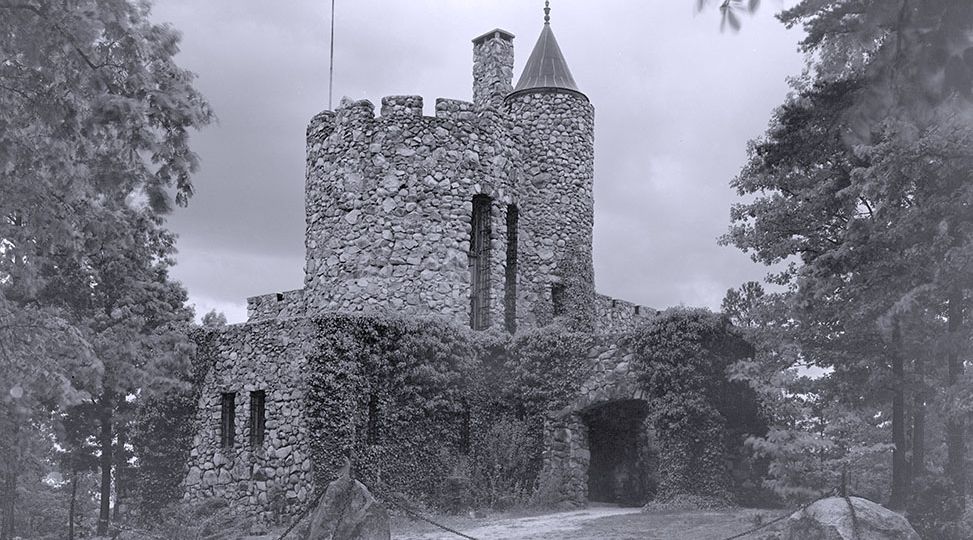
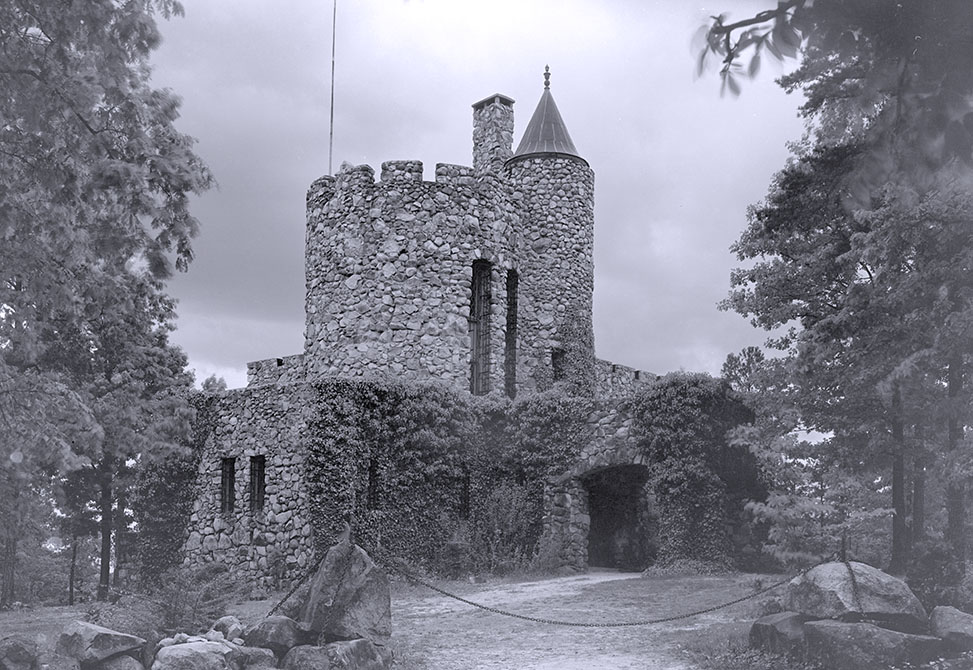
In 1889 a small group of UNC students founded a club called the Order of Dromgoole. They were likely inspired by the example of secret societies at other colleges, such as the well-known Skull and Bones at Yale. The name came from a former student named Peter Dromgoole, who disappeared from campus mysteriously in the 1830s and was never heard from again. The name was soon changed to the Order of the Gimghoul, "in accord with midnight and graves and weirdness," according to one of the founders. The club was open only to male students, junior class or higher, and to faculty. In its early years the names of the club members were published in the yearbooks; the names of members are now kept secret. There are other long-running private societies on campus, including the Gorgon's Head, another secret society, and the Golden Fleece, an honorary organization. But the Order of the Gimghoul is the only one with a castle.

In 1915 the Order of the Gimghoul purchased a large tract of land east of campus. They sold part of it, gave part of it to the university to be used as Battle Park, and kept the remainder to build a home for the order. Completed in 1926 using designs by architect and UNC alumnus Nathaniel Cortlandt Curtis, the large stone building, known as Hippol Castle, is located at the end of a residential street on the east side of campus called Gimghoul Road. The Order of the Gimghoul still exists, with new members added regularly, but its activities and traditions remain a mystery to the majority of UNC—Chapel Hill students.

Date Established: 1924

Date Range: 1924 – Present

Hippol Castle, home of the Order of the Gimghoul, ca. 1930s. Photo by Bayard Wootten. Bayard Wootten Photo Collection, North Carolina Collection, Wilson Library.


Privacy Preferences
When you visit our website, it may store information through your browser from specific services, usually in form of cookies. Here you can change your privacy preferences. Please note that blocking some types of cookies may impact your experience on our website and the services we offer.