Skip to main content Scroll Top

Entries

16 Apr: Gillings, Joan H., Center for Dramatic Art.

Gillings, Joan H., Center for Dramatic Art.

This facility, located on Country Club Road adjacent to the Old Chapel Hill Cemetery, is the home of the Department of Dramatic Art and PlayMakers Repertory Company. The building has offices, classrooms, rehearsal spaces, production shops, and two theaters. The Paul Green Theatre, which seats 500, is named in memory of Paul Green, the Pulitzer Prize—winning playwright and human rights activist who was a UNC alumnus and professor. The theater features an innovative thrust stage designed by renowned scenic artist Desmond Heeley. The Elizabeth Price Kenan Theatre, a performance space with flexible seating, hosts student productions, the PRC2 series, as well as guest shows. The space's name recognizes the support of local philanthropist Betty Kenan for the performing arts at UNC. The opening of the center in 1998 meant that for the first time all of the UNC Department of Dramatic Art operations were together in one location. The building was named the Joan H. Gillings Center for Dramatic Art in 2017 in recognition of Gilling's support for performing arts programming at UNC—Chapel Hill. A resident of Chapel Hill and Wilmington, North Carolina, Gillings has been a committed supporter of programs both at Carolina and at the University of North Carolina—Wilmington.

16 Apr: Gillings School of Global Public Health

Gillings School of Global Public Health

Public health programs at UNC began in the 1920s as part of the university's efforts to address the needs of the state. It set up training programs for county health officers and public health nurses in collaboration with the State Board of Health. These programs were part of the School of Medicine, eventually becoming a separate school and awarding its first degrees in 1940. Graduate and research programs helped the school grow exponentially in the decades after World War II. It developed international research endeavors such as the Carolina Population Center, and multi-institutional efforts to address cancer, HIV/AIDS, aging, and environmental pollutants.

In 2008 the school became the Gillings School of Global Public Health in recognition of a transformational gift from local business owners and philanthropists Dennis Gillings and Joan Gillings. Adding the word "global" to the school's name illustrated its reach. Its faculty and students work in all 100 counties of the state and in more than 60 countries worldwide. Consistently ranked as one of the top public health programs in the country, the Gillings School has departments in biostatistics, environmental sciences and engineering, epidemiology, health behavior, health policy and management, maternal and child health, and nutrition and a program in public health leadership.

16 Apr: Gerrard Hall (New Chapel)

Gerrard Hall (New Chapel)

This modest building is now little noticed on Cameron Avenue between South Building, the Campus Y, and Memorial Hall. Construction took place between 1822 and 1837, halted by the lack of funds. It was the university's second chapel, replacing Person Hall for that purpose, in an era when students began each day with mandatory religious services. Gerrard was also used for commencement and other official functions. President James K. Polk (UNC class of 1818) spoke there for commencement in 1841, as did President James Buchanan in 1859 and President Andrew Johnson in 1867.

Gerrard, along with Old West and the extant design of the quad around the Old Well, are the work of noted architect William Nichols. Along with the other antebellum buildings, Gerrard was built using an enslaved labor force, including people enslaved by Nichols and by university trustee William Polk.

Gerrard has entrances on two sides, a feature that shows how university plans change over time. Not long after it was completed a portico was added on the south side, as university officials thought to face the entrance toward a planned east-west avenue in that direction. In 1900 the portico came down, as the anticipated avenue had not been built, and two entrances were built into the building's east side. Between the two is a marble dedicatory plaque with the biblical phrase from Micah: "To do justly and to love mercy, and to walk humbly with thy God." In the early 2000s university architects rebuilt the south portico.

The building is named for Charles Gerrard, a Revolutionary War veteran who bequeathed the university nearly 14,000 acres in Tennessee, part of which he received for his service to the state in the Revolutionary War. Funds from the sale of these lands paid to complete the chapel construction in 1837.

Date Established: 1822

Date Range: 1822 – Present

16 Apr: German Club

German Club

This student organization oversaw campus dances for many years. The name comes from a style of formal social dancing in the nineteenth century called a "German cotillion" or simply "German." At Carolina throughout the first half of the twentieth century, the formal dances organized by the club were known as the "Germans."

UNC students were organizing formal dances as early as the 1830s, when they hosted a Commencement Ball. Dances were primarily organized by campus clubs. In 1923, following a dance that was, according to the Tar Heel, "characterized by excessive drinking and other loose conduct," students sought to provide more oversight of campus dances and charged the German Club with their management. At one point open to all students, the club was later composed of representatives from UNC's social fraternities.

The spring and fall Germans were major events in Carolina student life. They often featured prominent national acts, such as Woody Herman, Fats Domino, and Louis Armstrong (who performed on campus at least twice). The entertainment was not limited to musical acts —comedian Woody Allen performed at a German Club dance in 1965. By the late 1960s, as the student body grew larger and more diverse, fewer students attended the formal dances and they eventually ended. There was a brief revival of the German Club dances in the 1980s, but these lasted only for a few years.

16 Apr: George Watts Hill Alumni Center

George Watts Hill Alumni Center

In 1993, after several years of construction, the General Alumni Association dedicated the George Watts Hill Alumni Center, located on Stadium Drive. The center was designed to be used both as a gathering place for alumni and as an event center. It houses the offices for the Alumni Association, including the Alumni Review, and alumni records. The building includes a library, meeting rooms, and the Carolina Club, a private membership club with dining and event spaces established in 1993 for alumni association members and UNC faculty and staff. The center is named for alumnus George Watts Hill (class of 1922), a successful business leader from Durham who donated $3.5 million toward the construction of the center. Hill's father, John Sprunt Hill, had also been a prominent donor to the university, funding the construction of the Carolina Inn and providing support to the university libraries.

16 Apr: Genome Sciences Building

Genome Sciences Building

This building was a major component of a campus-wide effort initiated in 2004 to expand research facilities at UNC—Chapel Hill. Completed in 2012, the building houses the Carolina Center for Genome Sciences, which brings together faculty from across campus working on genomics research. It contains auditoriums, classrooms, and laboratories. Built to be more environmentally friendly than older campus buildings, it includes several innovative features, including rooftop greenhouses used by researchers working on plant genomics.

Date Established: 2008

Date Range: 2008 – Present

16 Apr: Genetic Medicine Building

Genetic Medicine Building

This multidisciplinary research facility opened in 2008 to house scientists and laboratories from the School of Medicine's Departments of Biochemistry and Biophysics, Genetics, and Pharmacology, and from the Eshelman School of Pharmacy's Institute of Pharmacogenomics and Individualized Therapy, the Center for Integrative Chemical Biology and Drug Discovery, and the Center for Nanotechnology in Drug Delivery. At seven stories and some 330,000 square feet, it is one of the largest buildings on campus.

16 Apr: Gardner Hall

Gardner Hall

Opened in 1953, Gardner was one of three new buildings built for the School of Business Administration (Carroll and Hanes were the others). The new buildings were designed to match the older buildings directly across Polk Place (Saunders, Manning, and Murphey). It has served as the home for several academic departments. Since the 1970s the Department of Economics has been based in Gardner Hall. The building is named for former North Carolina governor O. Max Gardner. A native of Shelby, he received his undergraduate degree from North Carolina State College of Agriculture and Engineering (now North Carolina State University) and attended law school at Carolina. He played football for both schools. Serving as governor from 1928 to 1932, during the Great Depression, he sought several cost-saving measures, including consolidation of the state's three public universities: UNC, North Carolina State College, and the North Carolina College for Women (now UNC-Greensboro). After leaving office, Gardner established a law firm in Washington, D.C., where he was a successful lobbyist and an adviser to President Franklin D. Roosevelt.

Date Established: 1950

Date Range: 1950 – Present

16 Apr: Friday Center

Friday Center

The William and Ida Friday Center for Continuing Education opened in 1991 to serve as a conference facility for the university. Located a few miles from campus and convenient to Interstate 40, the site offers an expansive space and plenty of parking, features increasingly hard to find on the crowded main campus. The Friday Center also serves as the home of UNC—Chapel Hill's continuing education efforts, offering programs and classes to anyone interested in learning, regardless of their affiliation with the university.

The center is named for one of UNC's most influential leaders, William C. Friday, and his wife, Ida Friday. William Friday earned his undergraduate degree at North Carolina State College of Agriculture and Engineering and a law degree from UNC. He spent his entire career in higher education, serving first as dean of students at UNC and then as assistant to the president of the UNC System. Friday was appointed president of the consolidated university (later the UNC System) in 1956 and remained in the job until 1986, making him the longest-serving president in the system's history. Ida Howell Friday was a graduate of Meredith College and the UNC School of Public Health. A painter and sculptor, she also supported local historic preservation, civil rights, women's rights, and the arts.

Friday's tenure as president was marked by incredible growth and change. The system grew from three schools to sixteen as the state substantially increased its commitment to public higher education. Friday's time as president also saw multiple controversies. Early in his tenure he had to deal with the Dixie Classic gambling scandal and the state's Speaker Ban Law. For much of the 1970s Friday struggled to refute and then respond to accusations from the federal Department of Housing, Education, and Welfare that the UNC System was not providing equal funding and support for African American students.

Friday remained wary of the influence of college athletics throughout his career. In his retirement he was one of the cofounders of the Knight Commission on Intercollegiate Athletics, which sought to provide analysis and support for universities trying to manage the rapid growth and influence of athletics. For many years Friday hosted the North Carolina People interview program on UNC-TV and was one of the best-known figures in the state.

Date Established: 1988

Date Range: 1988 – Present

FraternitiesAndSororities_973

16 Apr: Fraternities and sororities

Fraternities and sororities

The first fraternity on campus was the Beta chapter of Delta Kappa Epsilon, organized in April 1851. It was soon followed by Phi Gamma Delta, Delta Psi, Chi Psi, and Sigma Alpha Epsilon. They disbanded during the Civil War and university closing, returning to campus soon afterward. Alpha Tau Omega, active since 1879, is the longest consecutively active fraternity at UNC—Chapel Hill. In 1890 the Greek letter fraternities published the first yearbook, The Hellenian, which was replaced in 1901 by the university-wide Yackety Yack. Professional fraternities established chapters at UNC in the 1910s, starting with Alpha Chi Sigma, a chemistry fraternity, in 1912.

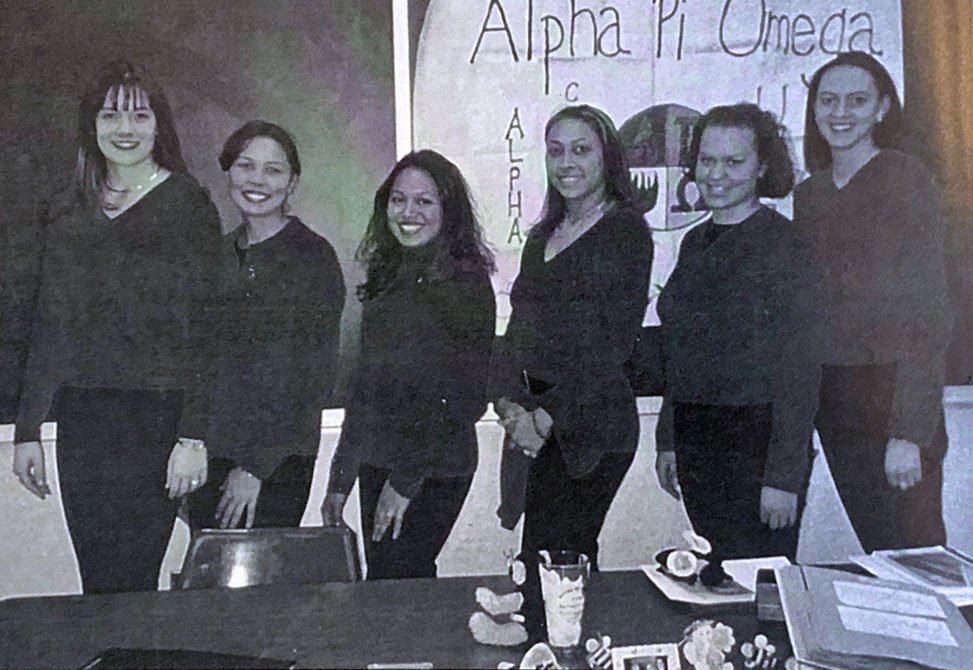
Although women began attending the university in the 1890s, the first sororities did not open until 1923, with Pi Beta Phi and Chi Omega. Their number increased from the 1930s through the 1970s, as women students gained a greater foothold. The first Jewish fraternity at UNC came in 1924, with the Omega chapter of Tau Epsilon Phi. In 1973 the Psi Delta Chapter of Omega Psi Phi became the first historically black Greek fraternity at Carolina; and the Kappa Omicron chapter of Delta Sigma Theta the first African American sorority on campus. In 1994 UNC—Chapel Hill undergraduates organized the nation's first sorority for Native American women, Alpha Pi Omega, which has grown to nineteen chapters across the country.

A number of cultural fraternities and sororities have joined these since the late 1990s, representing students interested in Asian, South Asian, Latinx, and multicultural experiences. All of the Greek fraternities and sororities are official student organizations at Carolina, and in 2018 about 17 percent of the students were affiliated with one.

Fraternity Row originally stretched from the site of Porthole Alley south to Cameron Avenue. A fire in January 1919 destroyed three of the ten houses and nearly burned down the new Carnegie Library (Hill Hall). The trustees decided to deal with the hazards of frame fraternity houses by moving them off-campus. They purchased lots on the west side of Columbia Street and exchanged the fraternities on campus property for new spaces there. The newly dubbed Fraternity Court was completed in 1926. Until recently, only two of the original fraternity houses remained: Hill Hall Annex, located just to the north of Hill Hall, was built in the 1890s as the Delta Kappa Epsilon Fraternity. It served many subsequent functions until it was demolished in 2017. The sole remaining structure is Evergreen House, which was built around 1890 as the Kappa Sigma Fraternity and now houses the Department of Psychology community clinic.

Date Established: 1851

Date Range: 1851 – Present

Members of Alpha Pi Omega, UNC’s (and the nation’s) first Native American sorority. Yackety Yack, 2000, North Carolina Collection, Wilson Library.


Privacy Preferences
When you visit our website, it may store information through your browser from specific services, usually in form of cookies. Here you can change your privacy preferences. Please note that blocking some types of cookies may impact your experience on our website and the services we offer.