Skip to main content Scroll Top

Entries

Cheers_973

16 Apr: Cheers

Cheers

When UNC began participating in intercollegiate sports in the 1890s, students developed a series of school cheers for the games and pep rallies. Unlike the alma mater and other school songs, the "university yells" were not set to music. Among the most popular was the "Yackety Yack," from which the college yearbook took its name, and variations on a cheer involving spelling the word "Carolina." The cheers published in the 1902 handbook were typical of those used early in the twentieth century:

Hackie, Hackie, Hackie,
Sis Boom Bah,
Carolina, Carolina,
Rah Rah Rah.
Boom Ray Ray
Boom Ray Ray
Carolina Varsity
S-s-s- Boom Tar Heel.
Yackety Yack Hooray Hooray
Carolina Varsity
Boom Rah Boom Rah
Car-o-li-na.

School cheers continued to appear in student handbooks for several decades. It appears that by the 1960s they were no longer in regular use.

Date Established: 1900

Date Range: 1900 – Present
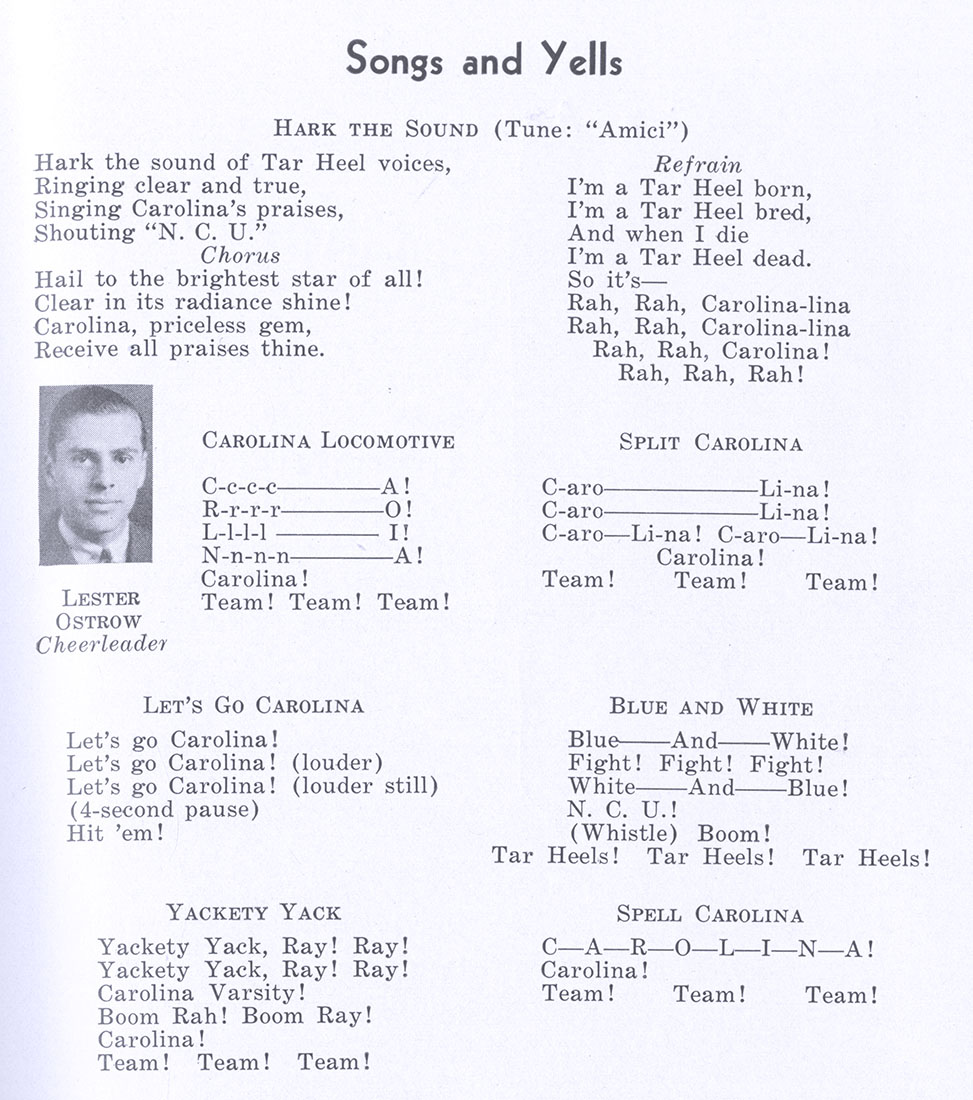
This page of “Songs and Yells” is from the 1935-36 student handbook. North Carolina Collection, Wilson Library.
 

16 Apr: Cheerleading

Cheerleading

Organized cheering was a part of the game day experience since the earliest days of UNC sports. Students in the stands, led by an elected "chief cheerer," chanted or sang from a variety of prepared cheers. The cheerleaders left the stands in the 1920s, led by Vic Huggins. An enthusiastic supporter of university athletics, Huggins is credited with bringing the first group of uniformed cheerleaders to Carolina. One of the most influential cheerleaders in campus history was Norm Sper, who came to Carolina in the late 1940s and helped establish lasting traditions, including the Beat Dook Parade, the Victory Bell, and the Cardboard Club. Some notable alums have served as cheerleaders at UNC, including future president Frank Porter Graham, who was elected chief cheerer in 1909, and bandleader Kay Kyser, who organized a large group of students called the Carolina Cheerios, known for their matching outfits and coordinated cheers. By the 1940s women joined the cheerleading squad and the cheerleaders followed other schools in developing a more modern style of cheerleading, with colorful uniforms, organized cheers, and gymnastic stunts.

Date Established: 1914

Date Range: 1914 – Present

004719_cheek_clark_building004

16 Apr: Cheek/Clark Building (University Laundry)

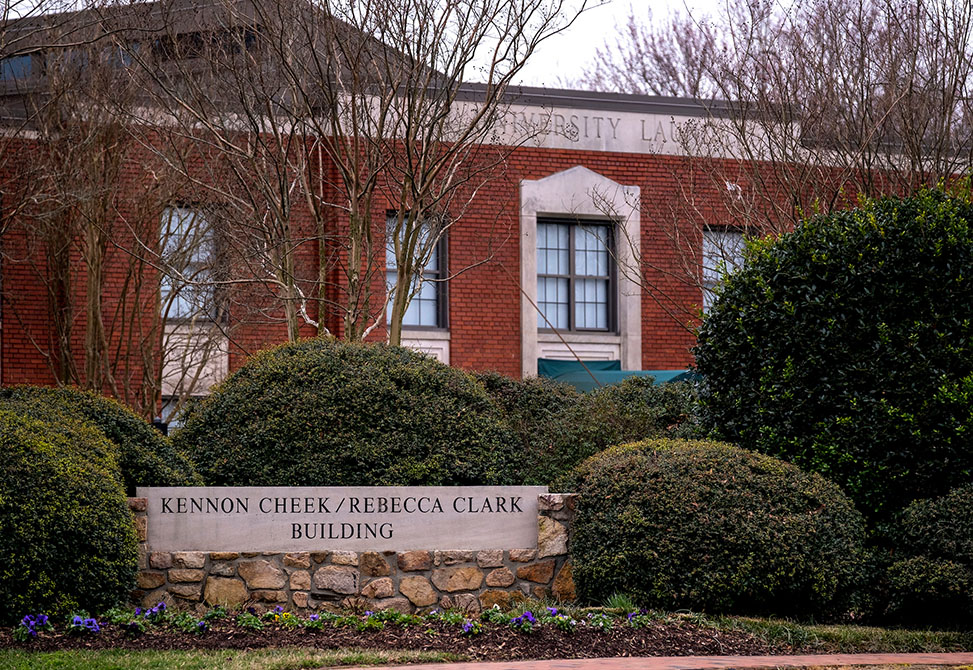
Cheek/Clark Building (University Laundry)

Located on West Cameron Avenue next to the chiller plant, this building currently houses offices and meeting rooms for Carolina's grounds, housekeeping, and building services operations. Employees in these units maintain and operate Carolina's 300-plus academic buildings, research facilities, and residence halls, more than 700 acres of campus grounds and landscapes, and 4,000 total acres throughout Orange County.

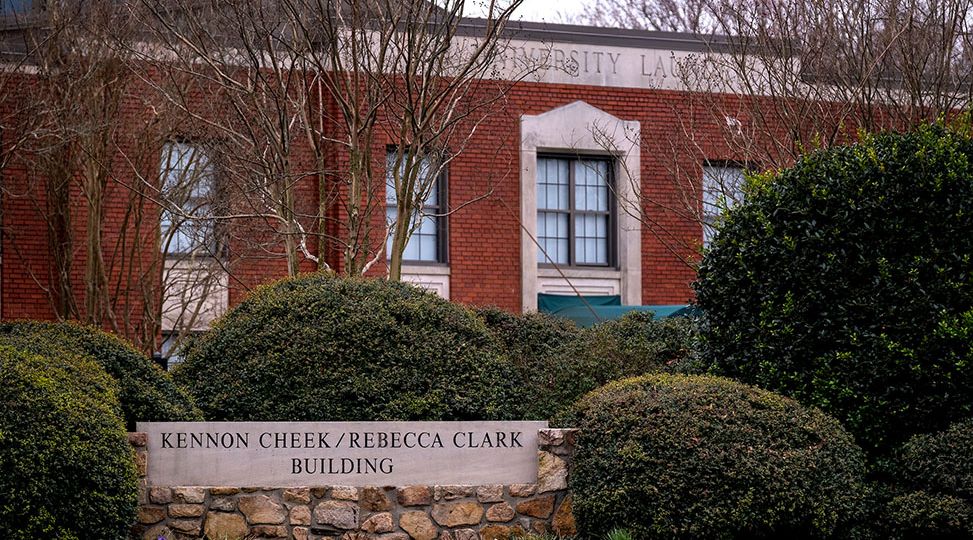
The building's original purpose is illustrated by the name that still adorns the front entrance: University Laundry. The university opened the building in 1925 to operate laundry service for campus and town and hired African American employees to staff it. Carolina offered laundry services —a revenue stream —from 1925 until some time in the late 1970s, when all of the residence halls contained coin-operated machines, and transferred other laundry and dry-cleaning services to outside vendors. Over time the building served as a headquarters for Carolina employees who cared for buildings and grounds and was a center for employee activism over the years, as various people lobbied for better working conditions for the university's lowest-paid workers.

The building was rededicated in September 1998 as the Kennon Cheek/Rebecca Clark Building. The renaming recognized Kennon Cheek and Rebecca Clark, two people who advocated for better working conditions for Carolina's lowest-paid employees and who were also important figures in the Chapel Hill community.

Kennon Cheek was born in Chatham County and came to work at Carolina in 1917. In 1930 he cofounded the Janitors Association to lobby the administration for better working conditions for all of its African American employees. During the early years of the Janitors Association, janitors not only provided cleaning services but also painted, did repair work and carpentry, ran errands, and delivered campus mail. In the Chapel Hill community, Cheek helped move Hackney's Educational and Industrial School from its location on South Merritt Mill Road to the Northside neighborhood west of campus, and helped raise funds for the rebuilding of St. Joseph CME Church on West Rosemary Street after the church burned down.

Rebecca Clark, also from Chatham County, began work at the university as a maid at the Carolina Inn in 1937 and later worked in the laundry building. Clark returned to the university in 1953 as a nurse's aide and became the first licensed practical nurse to work in the campus infirmary. During her time in the university laundry, Clark began to work on labor issues. She met with then president Frank Porter Graham to appeal for better working conditions in the laundry. In 1942 she took over as the shop steward for the State, County, and Municipal Workers of America, a subgroup of the Congress of Industrial Organizations that advocated for the rights of low-wage public workers. Building on the relationships created between the Janitors Association and Graham's administration, Clark was able to win wage increases for the laundry workers, in addition to safer work spaces and more reasonable work schedules.

Date Established: 1925

Date Range: 1925 – Present

Cheek/Clark Building, 2018. Photo by Jon Gardiner, UNC???Chapel Hill.


ChaseHall_973

16 Apr: Chase Hall

Chase Hall

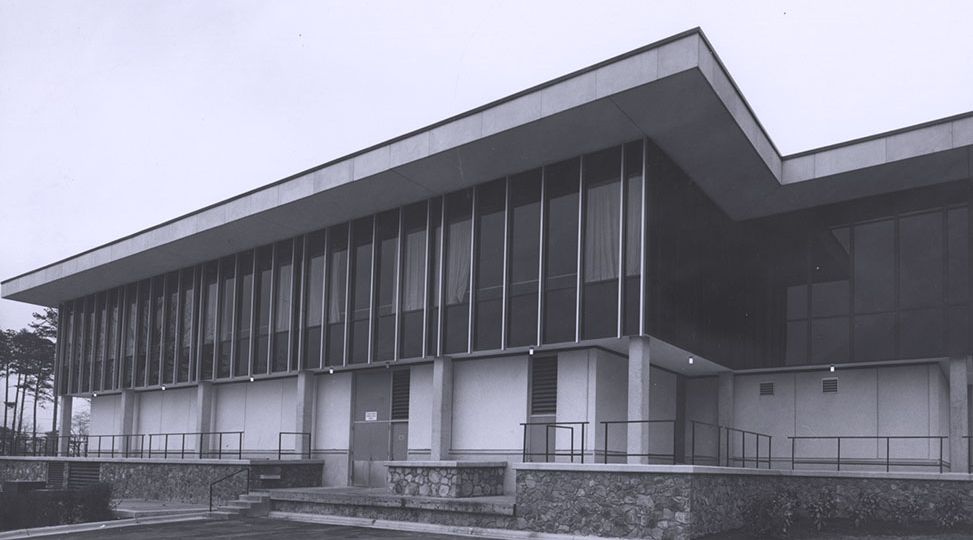
Chase Hall opened in fall 1965 to serve as a dining hall for the growing population of students on South Campus. With a modern design and bright furnishings, the building was impressive, but the cafeteria service was plagued with problems from the start. Despite plans to serve up to 5,000 students per meal, customers complained of long lines and food that was inadequate in both quality and quantity. After the cafeteria received a "C" sanitation rating in 1967, students formed Project RETCH (Refuse to Eat Trash in Chase Hall) to lobby for better food and service. Yet problems persisted —a 2001 Alumni Review article called Chase "a metaphor for nearly everything students dislike about campus food." The original Chase was torn down in 2005 to make room for two new campus buildings. The Chase Hall name moved to Ram's Head Plaza.

The building was named for former UNC president Harry Woodburn Chase. Serving as president from 1919 to 1930, Chase, a native of Massachusetts, presided over a period of significant growth and change at the university. Building on plans started by his predecessor, Edward Kidder Graham, Chase helped develop Carolina into a modern research university. Under his leadership the university expanded graduate education, more than doubled the size of the faculty, and launched an extensive building campaign that would include new dorms, classrooms on Polk Place, and major new buildings, such as Kenan Stadium and Wilson Library. Chase also stood up for the university in the mid-1920s when the North Carolina legislature proposed a bill that would limit the teaching of evolution in state-supported schools. Using language that would inspire university responses to future ideological battles, Chase wrote to the legislature about the importance of academic freedom and the necessity of faculty being able to teach without interference from the state. Chase left Carolina in 1930 to take over as president of the University of Illinois, staying there for just a few years before going to New York University, where he spent a long tenure as president to finish his career.

Date Established: 2004

Date Range: 2004 – Present

Chase Cafeteria, ca. 1965. UNC Image Collection, North Carolina Collection Photo Archives, Wilson Library.


16 Apr: Chapman Hall

Chapman Hall

Dedicated in 2006, Chapman was built as part of the Carolina Physical Science Complex, one of the largest construction projects in the university's history. When it opened, Chapman Hall included classroom and laboratory space for several departments, including physics, astronomy, math, and marine sciences. It also included a rooftop observatory and control room for telescopes operated by UNC—Chapel Hill in Chile and South Africa. The building is named for Max C. Chapman Jr., a 1966 graduate of Carolina who went on to a successful career on Wall Street and who donated $5 million in support of its construction.

16 Apr: Chapel Hill grit

Chapel Hill grit

Chapel Hill grit is the reddish-brown gravel seen throughout the university campus and downtown, including the pathways in the Coker Arboretum and on some of the sidewalks on Rosemary Street. Composed of decomposed granite, the sand-like gravel is unique to the area. Before the majority of the pathways were covered in brick, students often complained about the dust from the gravel walkways covering their shoes. But there were some who looked back on it fondly as a distinctive part of their Carolina experience. Chancellor Robert B. House, in a memoir about his early days as a student at Carolina, wrote, "I think the miracle of falling in love with Chapel Hill comes when you get one of its red grits in your shoe. Chapel Hill then enters your soul to stay."

16 Apr: Chapel Hill

Chapel Hill

In 1792, when trustees selected this site for the university, locals called the area New Hope Chapel hill, for a deserted Anglican chapel that had once stood on a high ridge near a crossroads. In 1793, when university trustees sold lots to create a town, its name became Chapel Hill. It was a small village in its early years and began to grow only in the early 1900s, along with the university. A typical college town that, along with Raleigh and Durham, is also one of the points of the Research Triangle, Chapel Hill has a reputation for being a progressive and liberal outpost in a conservative South.

Despite its reputation, the town was not all it might seem to be. In 1960, when African American high school students challenged segregation laws with sit-ins and picket lines, Chapel Hill business owners resisted change, and the community watched in dismay as their town, too, became the site of violent altercations between citizens. Yet in 1969 residents elected Howard Lee as mayor, the first African American mayor since Reconstruction in any majority-white city in the South.

In the 1990s Chapel Hill was the center of an emerging independent music scene, anchored by groups such as Superchunk, Squirrel Nut Zippers, Ben Folds Five, and the recording company Merge Records. Local musicians have also helped revive traditional music, including the Red Clay Ramblers, Ayr Mountaineers, and the Carolina Chocolate Drops.

Date Established: 1793

Date Range: 1793 – Present

16 Apr: Chancellors

Chancellors

The chancellor is the administrative and executive head of each institution within the UNC System. The president is the leader of the UNC System. This structure came about in 1971, when the North Carolina General Assembly established a single sixteen-university system, with a chancellor and a board of trustees for each institution, and a board of governors for the system. The first step toward this idea came in 1931, when the General Assembly decided to consolidate administrative operations of three public campuses —the University of North Carolina in Chapel Hill, North Carolina College for Women (now UNC-Greensboro), and North Carolina State College of Agriculture and Engineering (now North Carolina State University). Frank Porter Graham, then UNC's president, became president of the newly dubbed Consolidated University. The leader of each institution at first had the title of dean of administration, changed to chancellor in 1945.

Since 1932 there have been eleven chancellors of UNC—Chapel Hill:

Robert Burton House (dean of administration, 1934—45; chancellor, 1945—57)

William B. Aycock: 1957—64

Paul F. Sharp: 1964—66

J. Carlyle Sitterson: 1966—72

Nelson Ferebee Taylor: 1972—80

Christopher C. Fordham III: 1980—88

Paul Hardin: 1988—95

Michael Hooker: 1995—99

William O. McCoy (acting and interim): 1999—2000

James Moeser: 2000—2008

H. Holden Thorp: 2008—13

Carol L. Folt: 2013—19

Kevin Guskiewicz: 2019—

16 Apr: Chancellor's residence

Chancellor's residence

Quail Hill, the current official residence of the university chancellor, is located adjacent to campus, off Raleigh Road. It was built by George Watts Hill (class of 1922), a Durham banker and philanthropist who served on the UNC Board of Trustees and later on the UNC System Board of Governors. The university purchased Quail Hill in 1993 from his widow, Anne Gibson Hill. Before 1993, the chancellor's residence was a house on Country Club Road.

Hill was interested in architecture and oversaw the design and construction of Quail Hill. His architectural influence is also evident on campus. He managed construction of the Carolina Inn, which was built by his father, John Sprunt Hill (class of 1889), in 1924. He also contributed funds and architectural direction for the George Watts Hill Alumni Center, which opened in 1993.

There have been discussions over the years about whether the chancellor and the system president should switch official residences. The President's House, on Franklin Street, is much closer to the campus, while Quail Hill is adjacent to the UNC System offices on Raleigh Road.

Date Established: 1954

Date Range: 1954 – Present

16 Apr: Cellar Door

Cellar Door

Cellar Door is the long-running undergraduate art and literary journal at UNC—Chapel Hill. Published continuously since 1974, Cellar Door contains short stories and poetry, as well as student art and photography. Notable writers who published in Cellar Door as undergraduates include poet and creative writing faculty member Michael McFee, novelist Jill McCorkle, and singer-songwriter Tift Merritt.

Date Established: 1974

Date Range: 1974 – Present

Privacy Preferences
When you visit our website, it may store information through your browser from specific services, usually in form of cookies. Here you can change your privacy preferences. Please note that blocking some types of cookies may impact your experience on our website and the services we offer.