Skip to main content Scroll Top

Entries

16 Apr: Caudill Labs

Caudill Labs

Caudill Labs opened in 2007 next to Wilson Library to provide expanded and improved space for the study of chemistry at UNC—Chapel Hill. The building was part of an effort in the 2000s to build new physical science facilities to replace the long-outdated Venable Hall. The building is named for alums and donors W. Lowry and Susan S. Caudill.
16 Apr: Carroll Hall

Carroll Hall

Carroll Hall opened in the spring of 1953, one of three new buildings to house the university's growing School of Business Administration (along with Hanes and Gardner). The building was named for Dudley Dewitt Carroll, the dean of the school; he took over as dean in 1919, when it was known as the School of Commerce, and stayed in the position for thirty-one years. The building was expanded in 1970, but it wasn't long before the business school began looking for a larger home, eventually moving to a new building on South Campus in 1997. The building was renovated and then occupied by the School of Journalism in 1999.

Date Established: 1953

Date Range: 1953 – Present

16 Apr: Carrington Hall

Carrington Hall

Carrington Hall is home to the School of Nursing, located on Columbia Street and Medical Drive. Before it was completed in 1969, nursing programs were housed in parts of the medical school that have since been demolished. An eight-story addition in 2005 doubled the building's size, adding new classrooms, laboratories, and research spaces, including a human patient simulator laboratory. The addition was the first campus structure to earn LEED (Leadership in Energy and Environmental Design) certification by the U.S. Green Building Council.

The building is named in memory of Elizabeth Scott Carrington, to honor her efforts to establish a four-year school of nursing at Carolina and her work to improve the quality of nursing education in North Carolina. Born in Alamance County, Elizabeth Scott became a nurse, and along with her husband, a physician, she supported the state's Good Health Plan of the 1940s, a campaign to expand medical education and health services. Put in charge of the committee to promote the university's new four-year program, she worked to recruit students, raise funds, and secure scholarships. She persuaded alumnus James M. Johnston to designate part of his bequest to the university for nursing student scholarships. In 1983 UNC—Chapel Hill awarded an honorary degree to Carrington in recognition of her extraordinary public service.

Date Established: 1969

Date Range: 1969 – Present

16 Apr: Carr Building

Carr Building

Opened in 1900 as a dormitory, the Carr Building was funded in its entirety by Julian Shakespeare Carr, an alumnus and frequent donor to the university. The dorm was built with all the modern (for 1900) conveniences, including electricity and indoor plumbing. It housed students through the 1970s and was converted to office space in the 1980s. It currently serves as the home of several departments, including faculty governance and student affairs.

Carr, who attended the university in the 1860s, made his fortune in the tobacco industry with W. T. Blackwell in Durham, the company that made the famous Bull Durham tobacco. Carr was also involved in banking, railroads, and the textile industry. After purchasing the majority of the mills in the town adjacent to Chapel Hill, then known as Venable, he asked that it be renamed to Carrboro.

Carr, a Confederate veteran, was active in politics, campaigning on behalf of the Democratic Party and championing the cause of white supremacy. He spoke out against allowing African Americans to vote and endorsed racial violence when it served his political goals. In his retirement, Carr helped organize and lead reunions of Confederate veterans throughout the country. He frequently spoke at these and other events, his speeches often featuring racist depictions of African Americans and a defense of the Confederacy. In a widely quoted speech at the dedication of UNC—Chapel Hill's Confederate Monument in 1913, Carr spoke of the period after the Civil War when Confederate veterans "saved the very life of the Anglo Saxon race in the South."

Date Established: 1900

Date Range: 1900 – Present

16 Apr: Carolina Women's Center

Carolina Women's Center

Established in 1997, the Women's Center is the home for information and programs related to women and gender equity at Carolina. Center staff work with the campus and community to educate and advocate for gender equity and women's empowerment. The proposal for such a center came from a recommendation made by a student organization called the Women's Issues Network, which was further supported by a Task Force on Women at Carolina, convened in 1995. Regular programs sponsored by the Women's Center include HAVEN (Helping Advocates for Violence Ending Now) workshops to train allies for survivors of sexual assault and relationship violence, an informational program for expectant mothers called What to Expect When You're Expecting @ UNC, and Women's/Gender Week. The center is currently housed in the Stone Center and serves students, faculty, and staff.

16 Apr: Carolina Quarterly

Carolina Quarterly

Established in 1948 as the successor to the Carolina Magazine, the Carolina Quarterly is a student-run literary journal. Originally limited to the work of students, the journal soon opened its pages to other writers, becoming a publication of national significance in the process. Renowned authors such as Don DeLillo, Annie Dillard, and Joyce Carol Oates have published in the Carolina Quarterly. In an interview in 2008, novelist Robert Morgan, who had edited the Quarterly as a student at UNC in the 1960s, referred to it as a "venerable institution" at Carolina, putting the university on the map in the world of creative writing.

16 Apr: Carolina Population Center

Carolina Population Center

With a worldwide population boom in the decades following World War II, UNC, along with other universities, was interested in starting a program to study population growth and change. With support from the Ford Foundation and federal grants, the Carolina Population Center was established in 1966. The research projects and programs offered by the center involved organizations and communities in North Carolina and around the world and have included such topics as family planning, adolescent sexual behavior, and health and nutrition. The research efforts of the center are led by faculty fellows from a variety of UNC—Chapel Hill schools and departments.

Date Established: 1966

Date Range: 1966 – Present

16 Apr: Carolina Political Union

Carolina Political Union

Organized in 1936 by students in E. J. Woodhouse's political science class, the Carolina Political Union sought to share information and promote debate about current affairs. The group invited speakers to campus and succeeded in bringing many prominent politicians to Chapel Hill, including President Franklin D. Roosevelt (1938), Speaker of the House Sam Rayburn (1941), and Congressman John F. Kennedy (1947). The group also invited controversial speakers to campus, most notably Ku Klux Klan leader Hiram Wesley Evans (1937) and Communist Party leader Earl Browder (1938). The club was discontinued in the mid-1950s and then revived for a few years in the late 1960s.

CarolinaPlaymakers_973

16 Apr: Carolina Playmakers

Carolina Playmakers

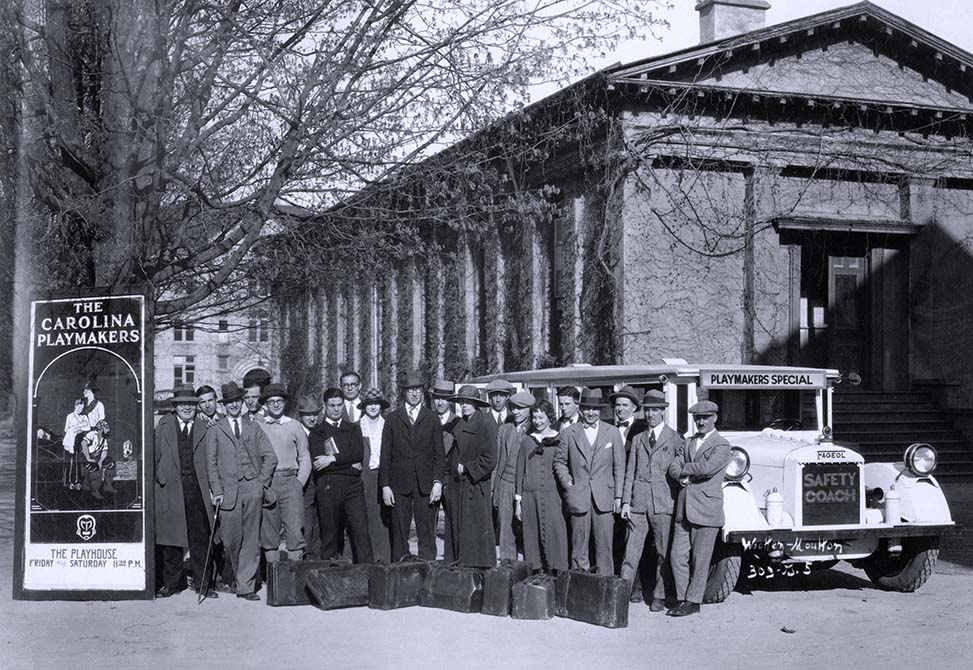
The Carolina Playmakers was the name for the drama program and the faculty, staff, students, and community members who staged plays at the university. The Playmakers started in 1918 with the arrival of Frederick Henry Koch, a professor from the University of North Dakota. Koch had developed a type of playwriting he called "folk drama" that focused on local themes and ordinary people. The Carolina Playmakers staged original plays on campus and on tour, traveling as far as New York and visiting the White House. The Playmakers published four books of student folk plays in the 1920s, as well as a theater journal, the Carolina Play-Book, from 1922 to 1944.

A number of well-known North Carolina writer and theater artists came from the Carolina Playmakers, including Bernice Kelly Harris, Thomas Wolfe, Paul Green, his wife Elizabeth Lay Green, Andy Griffith, and Louise Fletcher. Smith Hall was renamed Playmakers Theatre in the 1920s when it became the new home for the program, and in the 1970s PlayMakers Repertory Company adopted a variation of the name as a tribute to the earlier group.

Date Established: 1919

Date Range: 1919 – Present

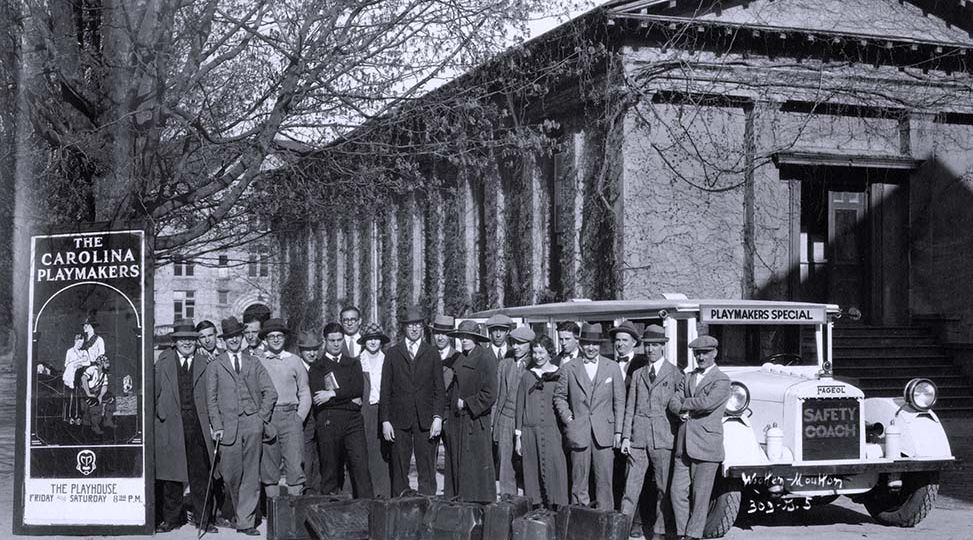
The Carolina Playmakers about to embark on a statewide tour in 1925. Department of Dramatic Art Photos, North Carolina Collection Photo Archives, Wilson Library.


16 Apr: Carolina North

Carolina North

Carolina North is a planned research and mixed-use academic campus on 250 acres on land the university owns that includes the Horace Williams Airport. The satellite campus has been discussed for more than twenty years and is modeled in part on similar expansions at other schools, such as the Centennial Campus at North Carolina State University. In 2009 the university completed a development agreement with the town of Chapel Hill that will guide development of the site and began plans for a new law school building there. The economic recession of 2009—10 delayed building construction indefinitely. The university continues to work on infrastructure projects and maintain the forest and trails for recreational use.

Date Established: 2020

Date Range: 2020 – Present

Privacy Preferences
When you visit our website, it may store information through your browser from specific services, usually in form of cookies. Here you can change your privacy preferences. Please note that blocking some types of cookies may impact your experience on our website and the services we offer.