Skip to main content Scroll Top

Entries

16 Apr: College of Arts and Sciences

College of Arts and Sciences

The heart of the academic experience and home to most of UNC—Chapel Hill's students, the College of Arts and Sciences is where all undergraduates begin their Carolina education. The current unit structure was created in 1935 with the merger of the College of Liberal Arts and the School of Applied Science. The General College, which is the program for the first-year and second-year students, was a separate entity until 1961, when it was merged in the College of Arts and Sciences. In addition to the 16,000 plus undergraduates, the college has the largest group of graduate students —more than 2,500 —on campus. Within the college are forty-three departments, divided among fine arts and humanities, natural sciences and mathematics, social sciences, and global programs. In addition, it has multiple research institutes, centers, and interdisciplinary programs. It also houses Honors Carolina, undergraduate research, first-year seminars, academic advising, the Writing Center, and other offices that support undergraduate education.
»


16 Apr: Coker Hall

Coker Hall

Coker Hall opened in 1963 as classroom and laboratory space for the Department of Botany. After the Departments of Botany and Zoology combined to create the new Department of Biology, Coker Hall was the departmental home. It is named for William C. Coker, professor of botany at the university for more than four decades. A South Carolina native, Coker came to Chapel Hill to teach in 1902 and remained until his retirement in 1945. He was a prolific author and a popular teacher, known for the frequent field trips he led so that students could study plant specimens in their natural environments. Coker's most lasting legacy at UNC—Chapel Hill is the Coker Arboretum, also named in his honor, making him one of only a few people to have been the namesake for multiple places on campus.

Date Established: 1963

Date Range: 1963 – Present

16 Apr: Coker Arboretum

Coker Arboretum

In 1903 William C. Coker, a professor of botany at the university, proposed turning a large area on the east edge of campus into an arboretum. The five-acre space once housed university president David Lowry Swain's cattle. By the time Coker started work, it was described as an "uninviting crayfish bog." Coker supervised the draining of the area, the laying of walkways, and the planting of hundreds of different species. Some of the plants in the arboretum had a practical use early in its history. Working with a former student, Coker developed a "drug garden" that contained plants used for medicinal purposes. Intended to serve as a sort of outdoor classroom for the study of native plants, Coker later added many East Asian trees and shrubs. Housing more than 400 different plants, it is known for its ornamental trees and flowers and a large wisteria arbor that runs along Cameron Avenue.

One of the more notable events in the history of the arboretum came in the 1930s when a student named Kemp Nye, inspired by the popular Tarzan movies then in the theaters, bet another student that he could cross the entire arboretum by swinging on trees. As onlookers watched, Nye succeeded in making it all the way across without touching the ground. The narrow, unlit walkways and secluded gardens in the arboretum were often rumored as the sites of romantic liaisons between students, but for many the arboretum was a place to be avoided. In 1965 a UNC—Chapel Hill student was murdered in the middle of the day in the arboretum. In the 1970s, after several sexual assaults were reported, the perception that the arboretum was unsafe was reinforced and students were told to avoid the area after dark. Some students and administrators urged that lights be added to the arboretum walkways, but they remain unlit. The arboretum is currently managed by the North Carolina Botanical Garden.

Date Established: 1903

Date Range: 1903 – Present

16 Apr: Cobb Residential Hall

Cobb Residential Hall

When it opened in 1952, Cobb was the university's largest dorm, constructed at a cost of nearly $1 million and housing more than 400 students. The building is named for Collier Cobb, professor of geology for more than forty years. Cobb joined the faculty in 1892 and taught until shortly before his death in the 1934. When the building was named, Cobb's son, Collier Cobb Jr., was on the Board of Trustees Building Committee.

Date Established: 1952

Date Range: 1952 – Present

16 Apr: Coates Building

Coates Building

The Coates Building, located on Franklin Street across from McCorkle Place, was built to house the Institute of Government in 1939. After the institute moved to a new building on the other side of campus, the space was used for academic offices and centers, including the Center for International Studies and the Department of Geography. In 1997 it was renamed in honor of Albert and Gladys Coates. Albert Coates was the founder and first director of the Institute of Government. He and his wife, Gladys Coates, were active in university life for more than a half century. Both wrote about university history, including a book they coauthored on the history of student government at the university.

16 Apr: Class gifts

Class gifts

Senior class gifts are a long-standing tradition at UNC—Chapel Hill and other colleges and universities. The outgoing class typically selects a project and raises money from class members and others. The statues of Venus de Milo, Minerva, and Apollo in Murphey Hall were gifts from the classes of 1900, 1901, and 1902. As electricity came to the campus, the class of 1903 purchased electric lights for Gerrard Hall. The class of 1988 raised money to create Fordham Court, the fountain and seating area between Carr Building, Bynum Hall, and historic Playmakers Theatre. The class of 2001 may be unique in that its gift included living creatures —the aquarium in the Graham Student Union. The class of 2002 provided funding for the Unsung Founders Memorial on McCorkle Place. Perhaps the most notorious class gift to date was the Student Body sculpture from the class of 1985. Other classes have donated benches, bronze plaques, campus gateways, trees, and more.

A class gift may also be a fund. Classes have given to the library, for teaching awards and other faculty recognition, and for scholarships and student support. The class of 1969 may have been the first to endow a student scholarship, and some subsequent classes have chosen to add their gift to the fund. Since the early 2000s senior classes have encouraged its members to pledge an annual gift to any university need. Stone markers at the base of the bell tower recognize each class's total participation.

16 Apr: Civil War

Civil War

When North Carolina joined other southern states and seceded from the United States in May 1861, university president David Lowry Swain kept the school open. Students circulated a petition calling for a temporary closure until fall term, reasoning that the conflict would be short. Swain and the board instead argued for the need to protect students from the war and their own inexperience. Most students and faculty did leave, however. As the war continued, Swain successfully argued for an exemption from the Confederate government's conscription order for younger students, maintaining that the small number would do little for the army and wreak permanent damage to the institution. Carolina managed to remain open throughout the conflict, despite dwindling numbers of faculty and students and fierce political criticism.

In the closing days of the war in spring 1865, Chapel Hill found itself in the middle of the action. Confederate forces moved through the town on their flight from General William Sherman's Union troops, who entered the village the next day. President Swain was part of a team sent by the governor to negotiate a surrender and protection for Raleigh and the university. Sherman agreed to the terms and thus spared both the capital and the university buildings. Swain's role in this earned him further political enmity, only intensified months later by his daughter's marriage to the leader of the Union brigade that occupied Chapel Hill.

Approximately 1,000 alumni and students (about 40 percent) served in the Confederate forces, and 287 died in service. Of the fourteen faculty at UNC in 1861, six also joined the war. Three of them died in service, as did four of the five university tutors. At least five alumni served the Union.

Date Established: 1861

Date Range: 1861 –
1865

CircusRoom_973

16 Apr: Circus Room

Circus Room

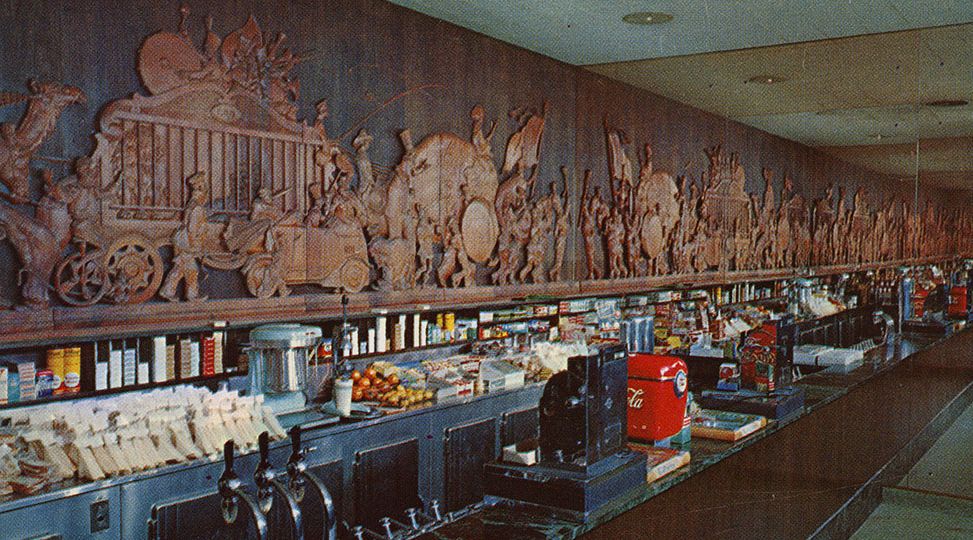
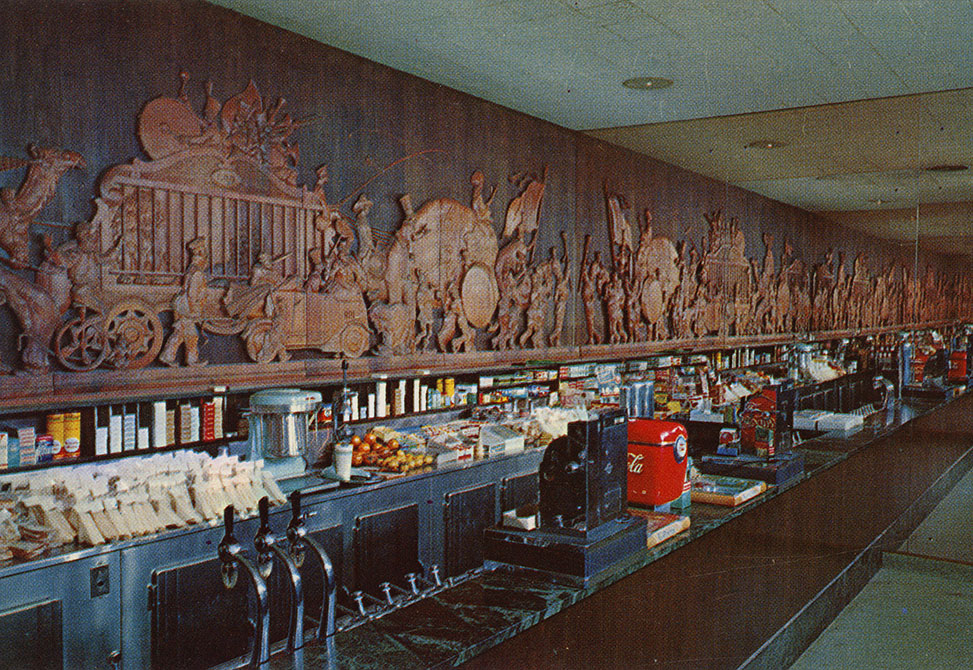
Located in the Monogram Club building (now Jackson Hall), the Circus Room was a popular soda fountain and snack bar. The Circus Room opened following World War II. It was decorated with dark wood paneling and a twenty-five-foot-long wooden carving of circus animals. The Circus Parade was carved by hand by university employee Carl Boettcher, based on drawings by illustrator William Meade Prince. After renovations in the 1970s the Circus Parade moved to the Carolina Inn cafeteria. It now hangs in the George Watts Hill Alumni Center. The Circus Room remained open as a snack bar and convenience store and was popular with students for decades: when the Office of Undergraduate Admissions was planning an expansion in the 1980s, students circulated a petition asking that the Circus Room not be closed. It remained in place until the mid-2000s.

Date Established: 1946

Date Range: 1946 –
2005

Interior of the Circus Room showing Circus Parade carving, ca. 1960s. Durwood Barbour Postcard Collection, North Carolina Collection Photo Archives, Wilson Library.


16 Apr: Cherry trees

Cherry trees

A feature of McCorkle Place that is especially evident in early spring is the cherry trees that line the east and west sides of the quad. The original trees were the senior gift of the class of 1929. A sandstone tablet set into the stone wall on Franklin Street recognizes that fact. Because the average lifespan of flowering cherry trees is only about twenty to thirty years, none of the original trees are still there. But because students, alumni, and visitors love seeing the cherry blossoms in the spring, the university's grounds staff continues to replace the trees as they die. An endowed fund, given in memory of alumnus and former dean Martha Decker Deberry, helps continue this practice. A stone marker beneath a cherry tree near Franklin Street and Graham Memorial Hall recognizes this gift.

16 Apr: Chemistry, Department of

Chemistry, Department of

Part of the College of Arts and Sciences, the chemistry department is one of the oldest on campus and has produced a number of academic leaders and major donors to the university in addition to distinguished graduates in the discipline. Chemistry dates its founding to 1818, when UNC hired Denison Olmsted (1791—1859) from Yale to teach the subject. A formal department was organized around 1890 under Francis P. Venable (1856—1934), first department chair and the university's first faculty member to hold an earned PhD. He led the department, and the university as president from 1900 to 1914, as both developed more rigorous academic and research programs.

An earlier chemistry professor was at the center of a major controversy. Benjamin S. Hedrick, an alumnus and professor of agricultural chemistry, supported the Republican Party antislavery candidate in the 1856 presidential election. In a university comprising mostly slave-owning students, faculty, and trustees, Hedrick was attacked on campus and in the press for this position. He was fired for engaging in political conflicts.

Chemistry has had various homes over the years. It was first housed in South Building from the early 1820s until the 1850s. With the need for a laboratory space to conduct experiments, the department took over basement space in Smith Hall (now Playmakers Theatre) in the 1850s. When the university reopened in 1875, chemistry moved into Person Hall, where it stayed until 1906. That year, the legislature made the first ever appropriation for a university building —for chemistry, which was later named Howell Hall. In 1925 the department moved into Venable Hall. In 1971 and 1985, respectively, the department added Kenan and Morehead Laboratories. They are named for two chemistry graduates, John Motley Morehead and William Rand Kenan Jr., who would become two of the university's most consistent and generous donors. The old Venable Hall was replaced in 2010 by the new Venable and Murray Halls.

Privacy Preferences
When you visit our website, it may store information through your browser from specific services, usually in form of cookies. Here you can change your privacy preferences. Please note that blocking some types of cookies may impact your experience on our website and the services we offer.