Skip to main content Scroll Top

Entries

16 Apr: Building names

Building names

Most campus buildings, along with some schools, units, and physical spaces, have a namesake. While the mechanism for selecting people to honor in this way has changed over time, the reasons for doing so remain much the same. In general, the university has honored donors, past presidents and chancellors, deans, faculty members, and other employees who are considered important to the life of the institution. In another category are buildings named for governors and illustrious alumni.

Naming buildings for donors was an early practice. The first was the second building to be constructed in the 1790s, Person Hall, named to recognize Thomas Person's financial gift that enabled the first trustees to finish construction of Old East and Person. The only other antebellum building to be named for a donor was Smith Hall, now historic Playmakers Theatre. Benjamin Smith, who like Person was a trustee, donated 20,000 acres of land in Tennessee that he received for service in the Revolutionary War.

Examples of buildings named for governors, trustees, and other notable alumni are the first set of classroom buildings completed in 1922, Manning, Murphey, and Saunders (now Carolina Hall), and the 1924-era upper quad of dormitories, Mangum, Manly, Grimes and Ruffin. In this case, a committee of the trustees selected the namesakes. In 1928 the trustees adopted a policy to name academic buildings for influential professors and dormitories for important figures in the state.

Today's campus reflects this mix of donor appreciation and historical commemoration. Approximately 38 percent of campus names reflect a donation, while 62 percent derive from some mix of faculty and trustee designation for remembrance. Of note are more recent namings that reflect the community's desire to recognize those left out of such commemorations. In 1967 trustees chose to name a new residence hall for Hinton James, the university's first student. In 1998 UNC—Chapel Hill recognized campus employees by renaming the University Laundry for Kennon Cheek and Rebecca Clark, both of whom worked for better conditions for staff. In 2007 another residence hall was named for George Moses Horton, an enslaved poet who worked on campus and sold his poetry to students.
16 Apr: Brooks Hall

Brooks Hall

The home of the University of North Carolina Press since 1980, Brooks Hall is a two-story building at the corner of Boundary Street and Hooper Lane. The building is named for North Carolina attorney, politician, and author Aubrey Lee Brooks and his sons Thornton H. Brooks and James T. Brooks. The elder Brooks, an 1893 graduate of the UNC School of Law, established the Brooks Scholarship Fund at Carolina and an endowment for UNC Press.

UNC—Chapel Hill first proposed this building site in 1977, a controversial choice given its location in a historic neighborhood and the necessity to demolish three vacant houses that had been part of the university's 1920s-era faculty row. The town's historic district committee denied the university's request. After months of debate among the university, neighbors, the Chapel Hill Preservation Society, and the town, the North Carolina legislature passed a law that exempted state and university lands from local historic district oversight, thus clearing the way for construction. A grant from the W. K. Kresge Foundation and other gifts funded the building, along with a warehouse for the press off of Airport Road.

In 1990 an electrical fire destroyed most of Brooks Hall. While the sole occupant of the building at the time escaped injury, the fire demolished the archival copy of each of the more than 4,000 books published by UNC Press, along with manuscripts and most of its office records. Using insurance funds, the university rebuilt and expanded the building, which reopened in 1993.

16 Apr: Brooks Computer Science Building

Brooks Computer Science Building

The Frederick R. Brooks Jr. Computer Science Building was dedicated in 2008. It adjoins Sitterson Hall and is home to UNC—Chapel Hill's Department of Computer Science. Brooks, a North Carolina native, was working at IBM in 1963 when he came to campus to deliver a lecture on computer science. He caught the attention of campus administrators, who hired Brooks the following year to begin a computer science department at the university, only the second in the country. Already renowned for his software development at IBM, Brooks was an influential writer, teacher, and administrator. His book The Mythical Man-Month: Essays on Software Engineering (1975) is an important contribution to the teaching of software project management. Brooks led collaborations with academic departments and with other universities, helping develop real-world applications for the research at Carolina. Brooks's recent personal research explores 3D graphics and virtual reality.

16 Apr: Brinkhous-Bullitt Building

Brinkhous-Bullitt Building

The towering Brinkhous-Bullitt Building was completed in 1973 to house research facilities for the School of Medicine. Originally known as the Preclinical Education Building, it received its current name in 1983 in honor of two former faculty members and chairs of the Department of Pathology: James B. Bullitt and his successor, Kenneth M. Brinkhous. For many years, the Caduceus, the health sciences bookstore, was located in Brinkhous-Bullitt.

Bricks_973

16 Apr: Bricks

Bricks

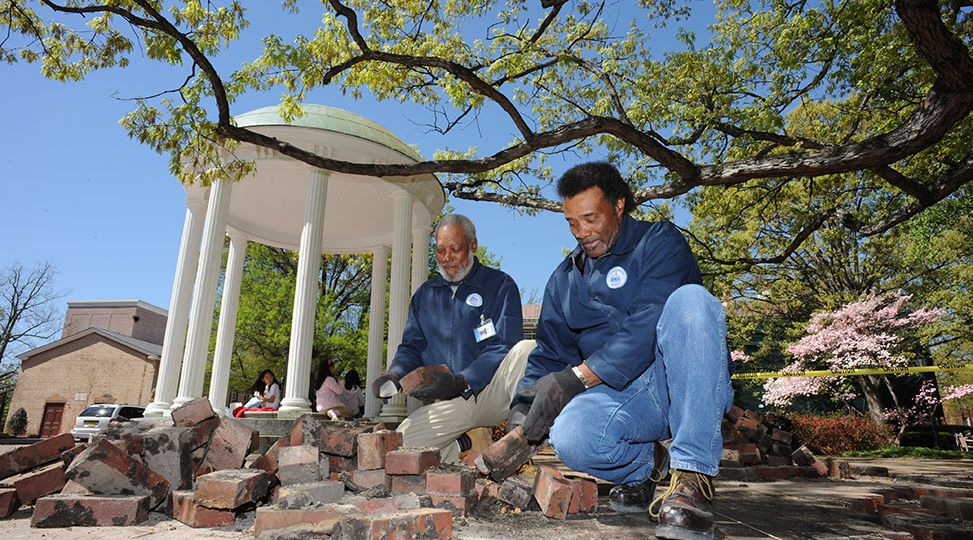
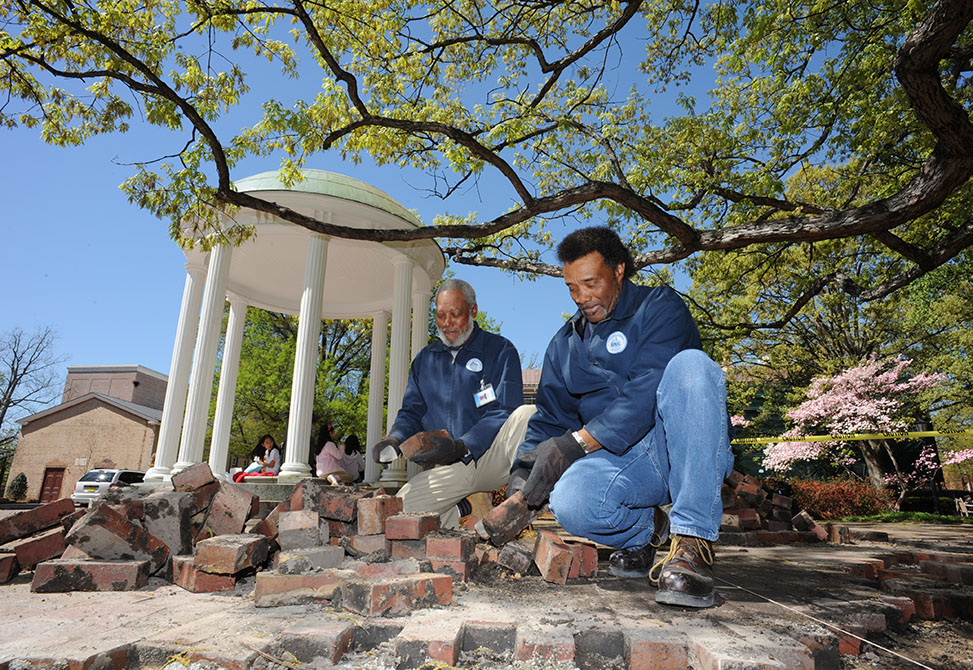
Throughout the nineteenth and early twentieth centuries all of the walkways on campus were covered in gravel (or, to be more precise, Chapel Hill grit). In the mid-1940s, inspired by the brick walkways at Colonial Williamsburg, the university announced a plan to create Williamsburg-style brick walks. While some alums lamented the loss of the old, dusty paths, the plan was recognized as an improvement over the unpaved walkways, which frequently covered shoes in dust or mud, depending on the weather. The bricks brought a new challenge in the regular maintenance they required. Stray tree roots and construction projects result in frequent repairs to the paths, as do souvenir-seeking students —a 2015 Daily Tar Heel article described the common practice of removing bricks as mementos of the campus. A facilities staff member estimated that in an average week more than 100 bricks had to be replaced.

Date Established: 1940

Date Range: 1940 – Present

UNC Facilities staff members Clifton Jones (left) and Claiborne Baker work on repairing the brick walkways around the Old Well, 2009. News Services Photo Collection, University Archives, Wilson Library.


BrauerHall_973

16 Apr: Brauer Hall

Brauer Hall

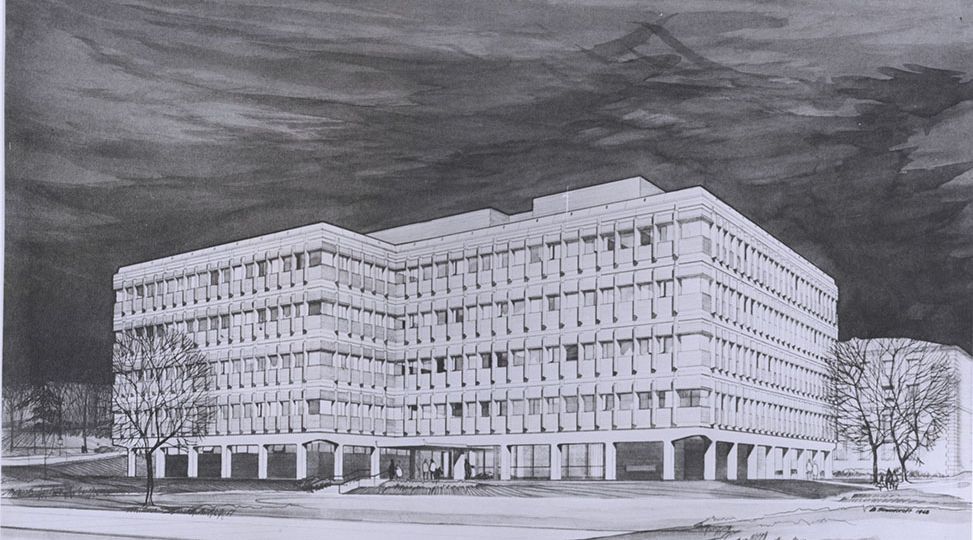
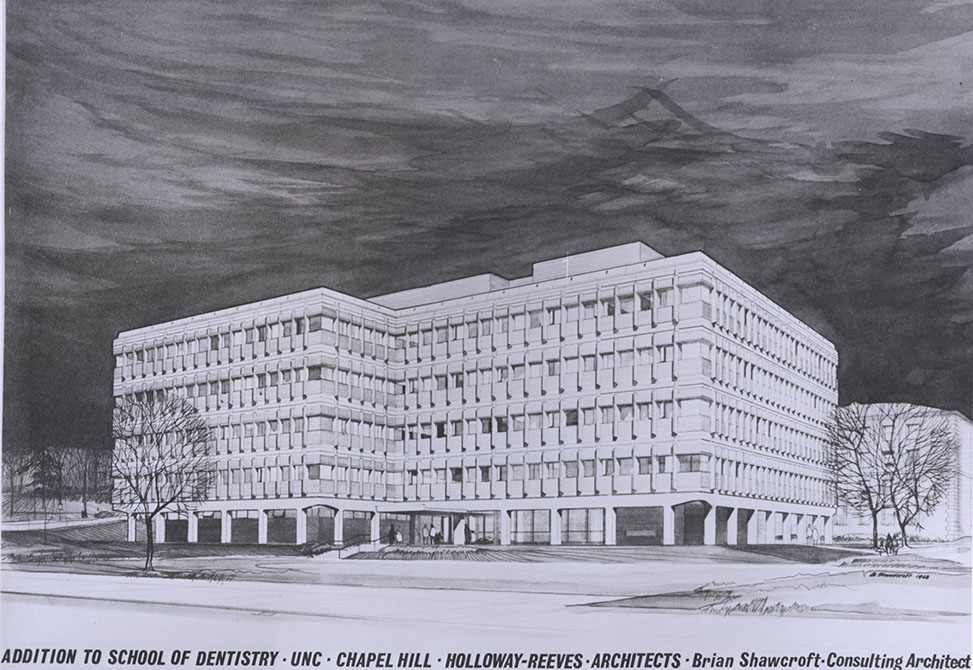
Brauer Hall has been the home of the School of Dentistry since it opened in 1969. Originally known simply as the Dental Education Building, it was renamed in 1972 for John C. Brauer, the founding dean of the School of Dentistry. Brauer was dean of the dental school at the University of Southern California when he was hired in 1950 to start the program at UNC. He designed the curriculum, hired staff, and welcomed the first students within a year. Brauer was an innovator in dental education. His plan to have faculty also serve as practicing dentists has inspired similar programs around the country. He also helped further dental education in the state by installing closed-circuit television, enabling far-flung dentists to observe complicated procedures at the school. Anticipating the need for private support for the school, he helped start the Dental Foundation of North Carolina, which now provides more than $2 million a year to fund scholarships, research, and faculty support. When Brauer retired in 1966, the School of Dentistry was recognized as one of the top dental schools in the country.

Architectural drawing for Brauer Hall, 1967. UNC Image Collection, North Carolina Collection Photo Archives, Wilson Library.


«
»


Boxing_973

16 Apr: Boxing

Boxing

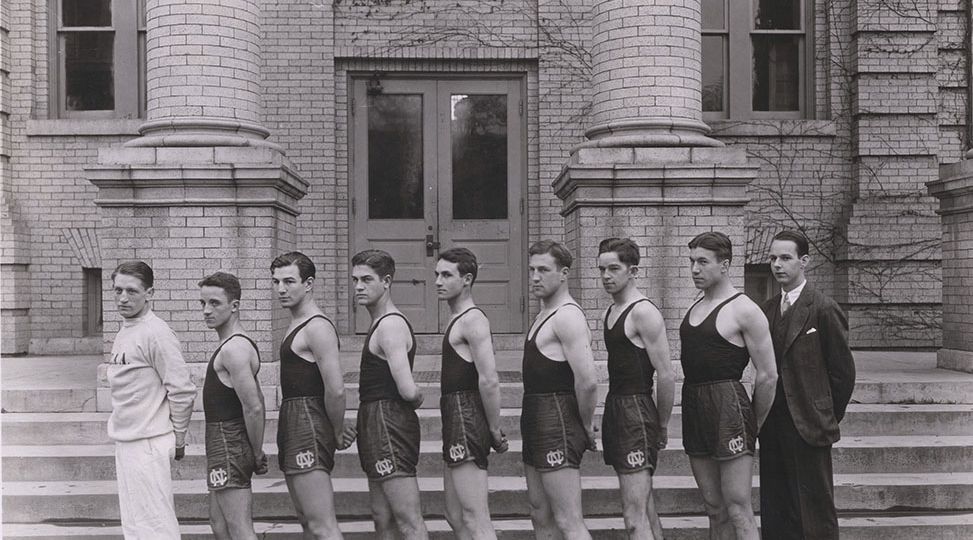
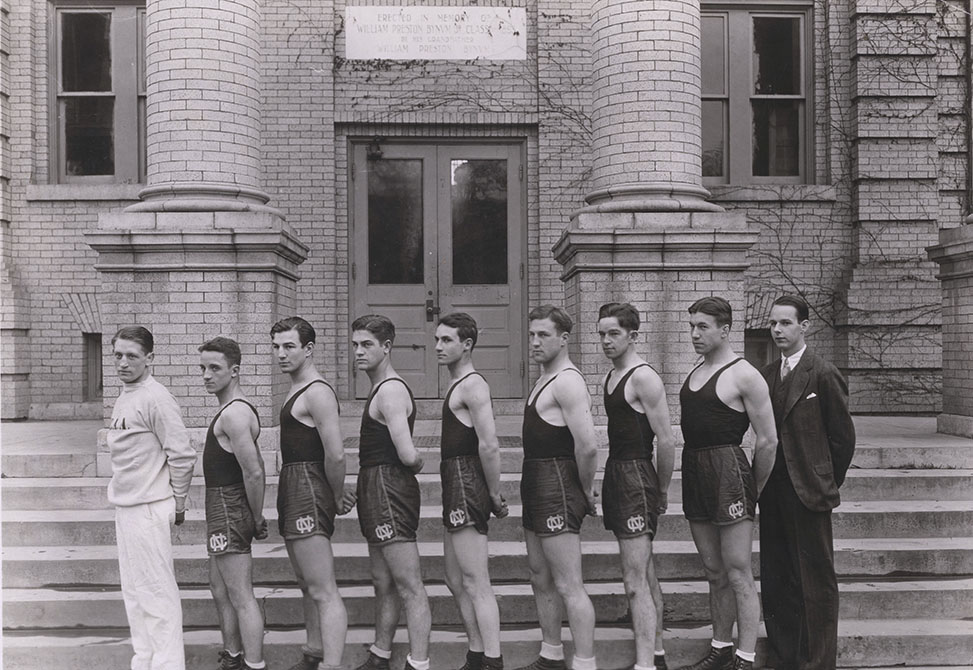
Boxing was a popular varsity and intramural sport for a few decades in the early twentieth century. It began informally in 1924 with a match between UNC student boxers and soldiers from Fort Bragg. The university hired a boxing coach the following year, and it was soon established as a varsity sport. By the 1940s campus administrators began to consider dropping varsity boxing. Attendance was waning, there were continued concerns about student safety, and UNC was having a hard time scheduling matches because few nearby schools had boxing teams. Varsity boxing was discontinued in 1948.

UNC Boxing team, 1927. UNC Image Collection, North Carolina Collection Photo Archives, Wilson Library.


BowmanGrayMemorialPool_973

16 Apr: Bowman Gray Memorial Pool

Bowman Gray Memorial Pool

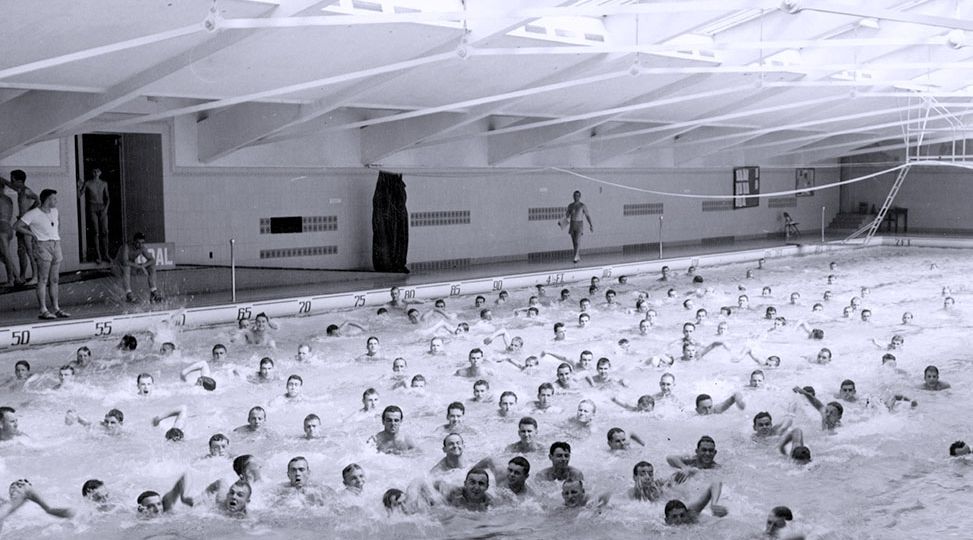
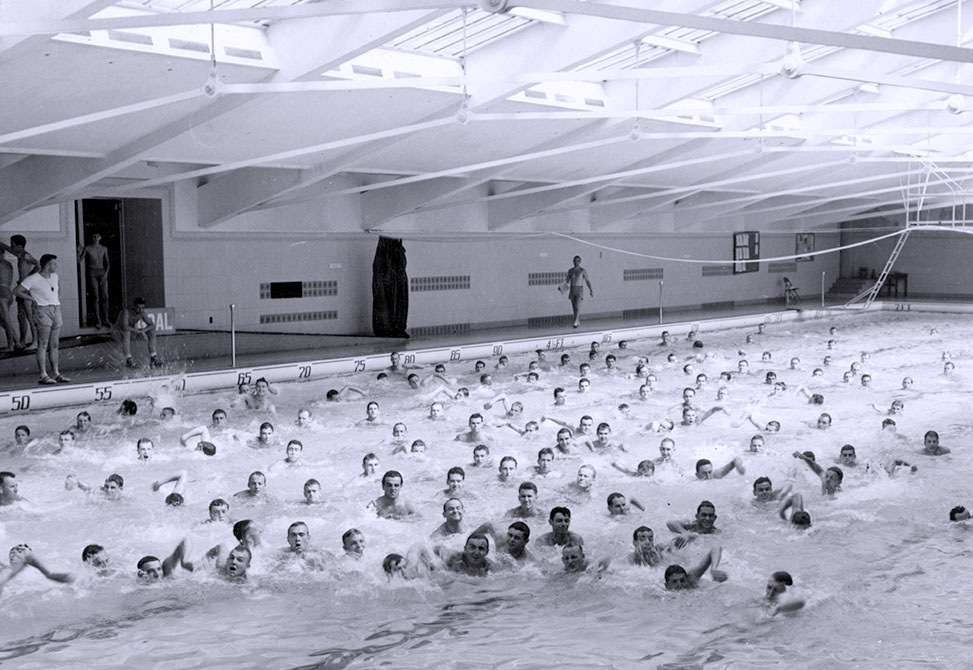
Carolina students were excited when the Bowman Gray Memorial Pool opened on April 15, 1938. There had been no pool on campus since the closing of the pool in Bynum Gymnasium in 1924. The new pool was built as part of Woollen Gym. When it opened, the Daily Tar Heel proclaimed it to be the "largest indoor swimming pool south of Philadelphia." While primarily built for recreational swimming, the pool was also used by the UNC swimming teams. While the U.S. Navy pre-flight school was on campus during World War II, it was used for training exercises by navy cadets. The pool was one of many contested sites on campus when the first African American students enrolled in 1951. Harvey Beech, who entered the UNC School of Law that year, recalled receiving a swimming card when he first enrolled, only to have it taken away, told that it was given to him "by mistake."
The pool is named for alumnus Bowman Gray Sr., who had a successful career at R. J. Reynolds Tobacco Company. After Gray's death in 1935 his family gave money for the construction of the university pool and supported multiple institutions in Winston-Salem, especially Wake Forest University.

Students in the Bowman Gray Memorial Pool, ca. 1930s. UNC Image Collection, North Carolina Collection Photo Archives, Wilson Library.


BoshamerStadium_973

16 Apr: Boshamer Stadium

Boshamer Stadium

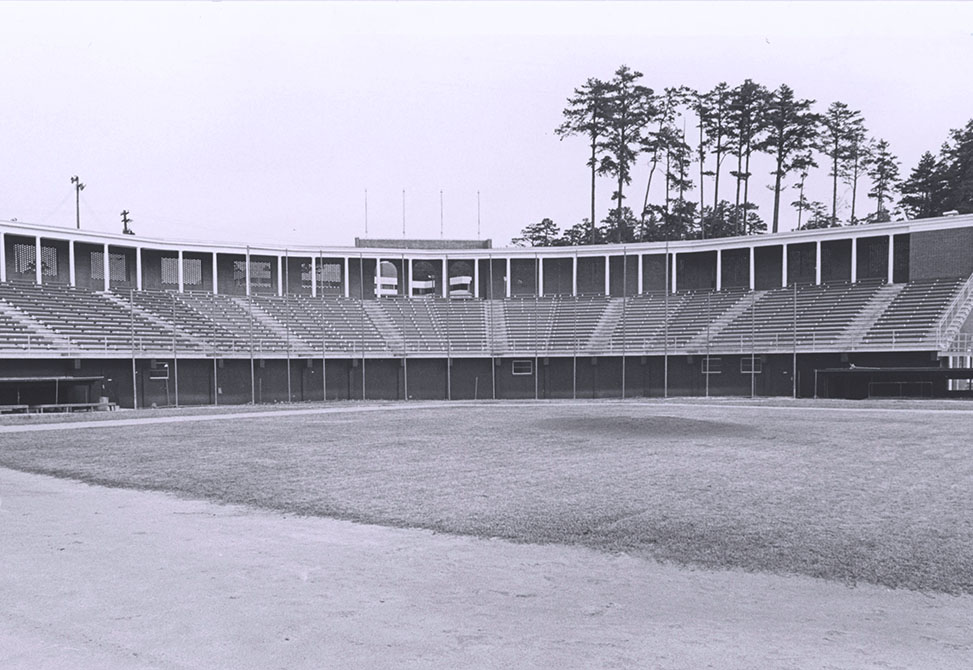
Boshamer Stadium is the home of the Carolina baseball team. Opened in 1972, Boshamer replaced Emerson Field, the longtime home of Tar Heel baseball and other sports. The stadium is named for Cary C. Boshamer, an alumnus and former football player who had a successful career in the textile industry in Gastonia, North Carolina. He was an active supporter of the university, funding an endowed professorship in his name and a scholarship. The UNC baseball team moved to the site of Boshamer Stadium in 1966, playing games at the new field in front of a few fans on temporary stands. When the new stadium opened in time for the 1972 season, it included seats for more than 2,000 fans. The stadium underwent a significant renovation following the 2007 season, expanding seating to 4,100 and adding modern amenities. When it reopened in 2009 the playing field was named for supporter and former player Vaughn Bryson and his wife, Nancy, and the expanded courtyard area was named for the family of New York Yankees owner George Steinbrenner, who donated money to support the renovation.

Date Established: 2007

Date Range: 2007 – Present

Boshamer Stadium, ca. 1970s. UNC Image Collection, North Carolina Collection Photo Archives, Wilson Library.


16 Apr: Book Exchange

Book Exchange

The Book Exchange was a university-operated campus store that opened in 1915 after students and faculty complained about textbook prices in local stores. Housed in the Campus Y building, the store focused primarily on textbooks but also sold school supplies. Store offerings and services changed over the years. In the 1930s the Book Exchange offered typewriter cleaning and repair services. The fact that the store was run by the university appeared to do little to alleviate complaints over prices. Stories and editorials frequently appeared in the Daily Tar Heel complaining about prices and overcrowding at the "Book-Ex." The bookstore was located in the basement of Steele Building in the 1950s and 1960s before moving to much more spacious quarters in the new Daniels Building when it opened in 1968.

Privacy Preferences
When you visit our website, it may store information through your browser from specific services, usually in form of cookies. Here you can change your privacy preferences. Please note that blocking some types of cookies may impact your experience on our website and the services we offer.