Skip to main content Scroll Top

Entries

NavyPreflightSchool_973

16 Apr: Navy pre-flight school

Navy pre-flight school

During World War II, the university served as a major training center for the U.S. Navy. President Frank Porter Graham successfully lobbied the Roosevelt administration to select Chapel Hill to host one of the navy's pilot training centers. First announced in 1942, the UNC pre-flight school led to the construction of several new buildings to host the cadets and the renovation of many older ones. By the end of the war more than 20,000 people had received military training in Chapel Hill. Many notable people spent time on campus at the navy pre-flight school, including future presidents Gerald Ford and George H. W. Bush. When pressed for staff to support the cadets, the navy brought in German and Italian prisoners of war from Camp Butner to serve as dining hall attendants.

In addition to the many ways that the navy transformed the campus during the war years, the pre-flight school was especially notable for its baseball team and its band. Nicknamed the "Cloudbusters," the school's baseball team had several professionals who were preparing to serve in the navy, including Ted Williams. The navy program also included the B-1 Band, an African American band containing musicians from North Carolina, many of whom were students at North Carolina A&T. The band members were the first African Americans to serve in the U.S. Navy above the rank of dining hall workers and porters. When university officials refused to house them on campus, the band was welcomed into the community center in the Northside neighborhood west of campus. Each morning they would march to campus to play at the raising of the colors.

Date Established: 1942

Date Range: 1942 – Present
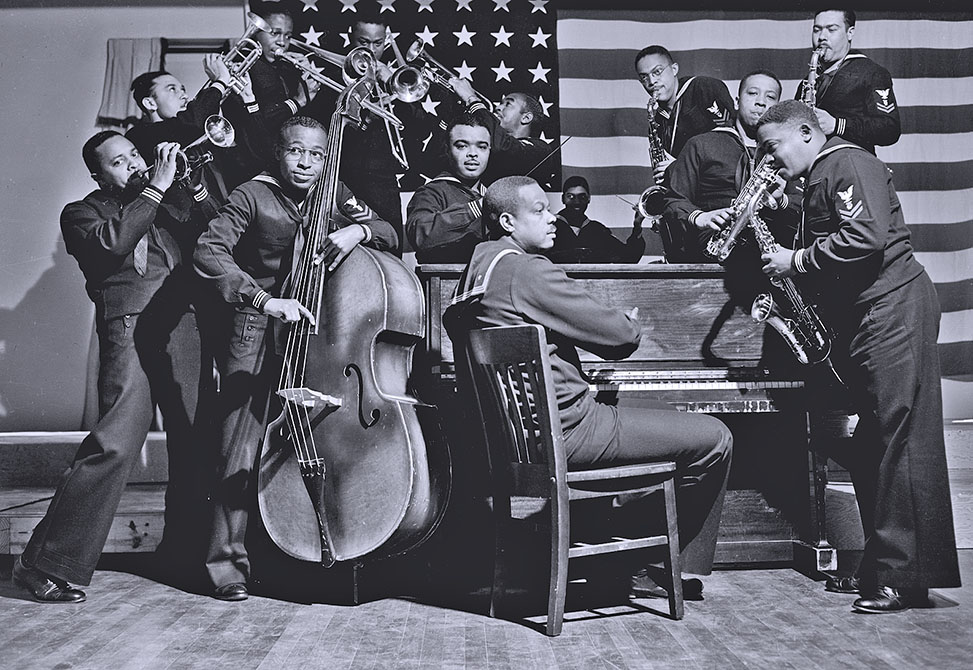
The B-1 Band at the U.S. Navy pre-flight school on campus, ca. 1944. U.S. Navy Pre-Flight School Photo Collection, North Carolina Collection Photo Archives, Wilson Library.


16 Apr: Navy Field

Navy Field

Navy Field was located along Ridge Road behind Fetzer Field and across from Boshamer Stadium. It was originally used for military exercises when the U.S. Navy pre-flight school was on campus during World War II. The field was later adapted for use by UNC athletics, serving as a practice field for the football team and hosting home games for the field hockey and lacrosse teams for many years. Use of the field was discontinued in the 2010s to make way for the new indoor football practice facility.

16 Apr: Naval Armory

Naval Armory

As the campus ramped up military training facilities during World War II, the U.S. Navy funded the construction of an armory. Initially used by the navy for the campus pre-flight school, the building has housed the campus Navy ROTC since 1943. It was built to support the training needs of navy cadets and included classrooms, a drill floor, and an indoor rifle range. The armory currently houses UNC—Chapel Hill Navy, Air Force, and Army ROTC programs. Beginning in the early 2000s, the university has discussed razing the armory to make way for new construction (other nearby buildings built during the World War II expansion have suffered a similar fate). In 2002 navy cadets successfully lobbied to keep the building, but its future on campus continues to be discussed.

16 Apr: Native Americans

Native Americans

North Carolina has the largest native population east of the Mississippi River, including eight sovereign American Indian tribes. The site of the University of North Carolina and the Town of Chapel Hill in the central Piedmont was home to indigenous peoples for thousands of years before Europeans and Africans arrived here. The campus is located on land that Europeans took from local tribes —the Enos, Occaneechis, Shakoris, and Sissipahaws —through war and treaty. As the forces of colonization disrupted lives through disease, enslavement, and displacement, some of the Piedmont indigenous peoples moved to join the Catawba Nation south and west of here, while the Occaneechis moved north to join the Saponi Confederation. Others remained, sought ways to accommodate European settlement, and built new communities. In its early years, the university also benefited from the sale of vast tracts of land in western North Carolina and Tennessee that had once belonged to the Cherokees and Chickasaws.

Legal segregation barred American Indians from attending the university. There is mention of a Chickasaw man who attended in the 1880s, but little is known about his time here. Henry Owl, a member of the Eastern Band of Cherokee Indians, was the first American Indian man to earn a UNC degree. Owl received a master of arts in history in 1929. The following year Owl presented his master's thesis as proof of his literacy when he registered to vote. Continuing attempts to disfranchise him eventually led to his testifying in Congress and to a state law that reaffirmed the right to vote for Cherokees. Owl's determination is honored on campus with the Henry Owl Fund, established in 2011 to support graduate students studying the Cherokee language.

Genevieve Lowry Cole (Lumbee) was the first American Indian woman to earn a degree from Carolina. She graduated from UNC's medical technology program in 1954. Cole went on to work in health care in North Carolina in various capacities, including as the UNC hospital supervisor of clinical hematology, the senior technologist in Duke Hospital's Microbiology Laboratory, and the branch head of three laboratories at the North Carolina State Laboratory of Public Health in Raleigh. She currently is a member of the UNC—Chapel Hill Board of Visitors and an advocate for Carolina's Native American students.

16 Apr: National Pan-Hellenic Council

National Pan-Hellenic Council

The National Pan-Hellenic Council is composed of the nine historically African American Greek lettered fraternities and sororities. The organizations are popularly known as the Divine Nine. Established when the United States was racially segregated, the organizations no longer restrict membership but continue to commemorate and celebrate their origins in African American history and culture. Planning is currently underway for an NPHC Garden, in the courtyard of the Student and Academic Service Building. The Garden, intended to evoke traditional fraternity and sorority "plots" at historically-black universities, will be a gathering space for members as well as the entire campus community. The NPHC organizations with chapters at Carolina are listed below with charter date:

Alpha Kappa Alpha Sorority, Inc. (1974)

Alpha Phi Alpha Fraternity, Inc. (1976)

Delta Sigma Theta Sorority, Inc. (1973)

Kappa Alpha Psi Fraternity, Inc. (1976)

Omega Psi Phi Fraternity, Inc. (1973)

Phi Beta Sigma Fraternity, Inc. (1982)

Sigma Gamma Rho Sorority, Inc. (1990)

Zeta Phi Beta Sorority, Inc. (1978)

16 Apr: Nash Hall

Nash Hall

Nash Hall opened in 1942, one of several new buildings used for the U.S. Navy's pre-flight school on campus during World War II. Located near the corner of McCauley and Pittsboro Streets across from the Carolina Inn, it housed cadets and later students before being converted to office and lab space in the early 1950s. The building was demolished in 2006 to facilitate work on underground steam pipes and the space was converted to a parking lot. Nash Hall was named for the Nash family of Hillsborough, including Frederick Nash, a lawyer, judge, University Trustee, and, in the 1850s, Chief Justice of the North Carolina Supreme Court.

16 Apr: Muslim Students Association

Muslim Students Association

The UNC—Chapel Hill Muslim Students Association was founded in 1975 with the goals of fostering community, providing opportunities for fellowship and prayer, and promoting understanding of Islam on campus and in the community. In 1989 the association announced plans to build a mosque and Islamic center near downtown Chapel Hill. The plans were approved by the town planning board, but the mosque supporters were ultimately unable to raise enough money to purchase the property. Throughout the history of the organization its members have worked to counteract hate speech and violence directed at Muslims through education and outreach. The organization has also worked with and cosponsored educational and cultural events with numerous campus organizations, including Hillel, the Black Student Movement, the Stone Center, and others.

Date Established: 1975

Date Range: 1975 – Present

16 Apr: Murphey Hall

Murphey Hall

Murphey Hall was completed in 1923 for use as classrooms and offices. The building originally housed the Departments of English, German, Greek, Latin, and Romance Languages. As the academic departments grew, most eventually moved to new homes: languages to Dey Hall and English to Greenlaw Hall. The Department of Classics, which has been in the building since the 1930s, has been the primary resident of Murphey since the 1970s.

The building is named for Archibald DeBow Murphey, an early graduate of UNC (class of 1799) and a member of the UNC Board of Trustees for several decades. Murphey has been called the father of public education in North Carolina for his strong advocacy for public schools when he was in the state legislature. In this aspect he was ahead of his time: the state would not pass its first public school act until seven years after Murphey's death.

Date Established: 1922

Date Range: 1922 – Present

16 Apr: Morrison Residence Hall

Morrison Residence Hall

Completed in 1965, Morrison continued the expansion of the campus to the south. It was built in the style of nearby Craige and Ehringhaus dorms, which opened a few years earlier. Morehead is a little larger than these other two dorms, housing around 900 students. In 1970 Morrison became the first permanent coed dorm on campus, and the first in which men and women lived on the same floor.

The dorm is named after former governor and U.S. senator Cameron Morrison. A native of Richmond County and longtime resident of Charlotte, Morrison never attended college but was awarded an honorary degree from UNC in 1922. Morrison was governor of North Carolina from 1921 to 1925, a period of rapid growth for both the state and the university. Known as the Good Roads Governor, he supported heavy investment in infrastructure and education, and he supported UNC's ambitious expansion plans. Morrison's political career touched on many of the most controversial issues of his time. He was active in the bitter 1898 and 1900 elections, known as the white supremacy campaigns. Morrison was one of the leaders of the Red Shirts, a terrorist organization devoted to the intimidation of African American voters and their political allies. When he was governor Morrison weighed in on the controversy that erupted when the state textbook commission was considering adopting a textbook that taught evolution. Morrison said, "I don't want my daughter or anybody's daughter to have to study a book that prints pictures of a monkey and a man on the same page."

Date Established: 1963

Date Range: 1963 – Present

16 Apr: Morehead-Cain Scholarship

Morehead-Cain Scholarship

In 1951 the Morehead Foundation, which was created by alumnus and donor John Motley Morehead, announced a $2 million endowment to support student scholarships. The Morehead Scholarships were modeled after the Rhodes Scholarships at Oxford University. The initial criteria for the scholarships, as established by John Motley Morehead, included "qualities of manhood," "evidence of moral force of character," and "physical vigor," along with exceptional scholastic ability. In the early years of the program, around forty to fifty scholarships were awarded annually. As the endowment grew with additional gifts, the number of scholarships increased, topping 100 in some years. Initially limited to men only, the scholarship was first awarded to a woman student in 1971. In 2007 the Morehead Foundation announced a $100 million gift from the Gordon and Mary Cain Foundation and changed the name of both the foundation and scholarships to Morehead-Cain. The Cain Foundation gift was unusual in that neither Gordon nor Mary Cain had a direct connection to the university. Like Morehead, Cain was a chemist who went on to a successful business career. He and his wife learned about and came to admire the Morehead Scholarships through Carolina alumni they knew in Texas and when spending their summers in Linville, North Carolina.

Date Established: 1951

Date Range: 1951 – Present

Privacy Preferences
When you visit our website, it may store information through your browser from specific services, usually in form of cookies. Here you can change your privacy preferences. Please note that blocking some types of cookies may impact your experience on our website and the services we offer.