Skip to main content Scroll Top

Entries

16 Apr: Koury Residence Hall

Koury Residence Hall

Koury Residence Hall was completed in 2002, one of four new dorms finished around the same time (Craige North, Hardin, and Horton are the others). The new dorms, in high demand with students, featured modern technology, single-sex suites, and coed floors. Originally named Ehringhaus South for its proximity to the nearby larger dorm, the building was renamed in 2008 for alumnus Maurice J. Koury. A 1949 graduate of UNC, Koury was president of Carolina Hosiery Mills. He was active in alumni groups and a successful fund-raiser, helping lead the campaign to raise money for the Dean Smith Center in the 1980s and the adjacent natatorium, which is also named for Koury.

Date Established: 2000

Date Range: 2000 – Present
16 Apr: Koury Oral Health Sciences Building

Koury Oral Health Sciences Building

Koury Oral Health Sciences Building opened in 2012 as a teaching and research facility for the School of Dentistry. The building is one of several spaces on campus named for alumnus Maurice J. Koury. A successful business leader in the textile industry, Koury first became involved with the School of Dentistry as a patient. Built with a number of environmentally friendly features, the Koury building has earned Leadership in Energy and Environmental Design (LEED) gold certification.

16 Apr: Koury Natatorium

Koury Natatorium

The Maurice J. Koury Natatorium is the home of the Tar Heel swimming and diving teams. Located on South Campus, adjacent to the Dean Smith Center, the natatorium hosted its first competition on October 31, 1986. The modern facility was a significant improvement for the Tar Heel swim teams over Bowman Gray Memorial Pool, which was built in the 1930s. The state-of-the-art natatorium featured a 1,700-seat grandstand and held over a million gallons of water. The new pool received national attention when it hosted swimming and water polo during the 1987 Olympic Festival. It is named for Maurice J. Koury, an alumnus, major donor, and successful fund-raiser for the university. Koury's ongoing support for the university is marked by the many places his name appears on campus: a residence hall, an auditorium at the Kenan-Flagler Business School, a library in the alumni center, and a building at the UNC School of Dentistry.

16 Apr: Knapp-Sanders Building

Knapp-Sanders Building

Located on the eastern edge of campus at Country Club and Raleigh Roads, Knapp-Sanders the home of the School of Government. The building was completed in 1956, funded through a gift from the Knapp Foundation and from a legislative appropriation.

The building is home to a series of large historic murals by artist Frances Vandeveer Kughle. Painted in the style of earlier WPA (Works Progress Administration) murals, the fourteen works, installed in 1960, depict scenes from North Carolina history. After many years of hearing criticisms that the murals overlooked or misinterpreted significant aspects of state history, the School of Government removed many of the murals and arranged to have a new mural painted that would recognize major figures and events from North Carolina African American history. This new mural was installed in 2010.

Joseph Palmer Knapp was a publisher, financier, philanthropist, and conservationist who came to know the state through a vacation home in Currituck County along the North Carolina coast. He became involved in helping local government leaders on improvement projects, which led him to extend his philanthropy to the government and schools of the county. His recognition that public officials needed training just as other professionals did led him to correspond with Albert Coates, founder and first director of the Institute of Government, which later evolved into the School of Government. Knapp died before he could do more, but his wife, Margaret Rutledge Knapp, saw to it that the family foundation funded the institute's new building. The Knapp Foundation has continued its support of the School of Government, also contributing to the 1998 addition, which added the name Sanders.

John Lassiter Sanders was the institute's second director, taking over from Coates in 1962. Over the years Sanders served as an adviser to state government on reapportionment, the creation of the community college system, and the rewriting of the state's constitution. He worked for the UNC System from 1973 to 1978, where he helped complete its first long-range plan. In 1979 Sanders became institute director again and retired in 1992.

Date Established: 1956

Date Range: 1956 – Present

16 Apr: Kessing Pool

Kessing Pool

Kessing Pool is the university's outdoor swimming pool. It was originally built for use by navy cadets attending the pre-flight school at UNC, one of five U.S. Navy pre-flight schools established across the country during World War II. The pool is named for Oliver Owen Kessing, who was the first commanding officer of the campus pre-flight school. The swimming pools on campus were among many spaces on campus that remained segregated when the first African American students enrolled in the early 1950s.

Floyd McKissick, one of the first African American students to attend UNC when he entered the law school in 1951, remembered the swimming pools in an oral history interview: "There were some incidents of some of the kids went to the swimming pool to swim and they wouldn't let them in, and I told them this pool was going to get integrated today, and I just went on and jumped into the pool. After I jumped into the pool, I walked on out and nobody said anything to me and I said nothing to anybody else. I said, ‘It's integrated now.'"

16 Apr: Kerr Hall

Kerr Hall

Kerr Hall was dedicated in 2002 as a teaching and research building at the School of Pharmacy. The building is named for School of Pharmacy alumnus Banks Kerr, who donated $2 million toward its construction. After graduating from UNC, Kerr opened a drugstore in Raleigh, the beginning of a successful statewide chain of stores. At its peak, there were ninety-seven Kerr Drug stores.

16 Apr: Kenan-Flagler Business School

Kenan-Flagler Business School

UNC first established a School of Commerce in 1919 to train students to "meet the more complex and changing conditions of modern commercial and industrial life," according to the Tar Heel. Housed originally in Alumni Hall, the school held classes Saunders and then Bingham Hall. The early 1950s was a period of growth and change for the school: the name was changed to the School of Business Administration, the program moved into larger facilities in the newly built Carroll Hall, and the school launched a master's of business administration program. In 1991, following gifts from the W. R. Kenan Jr. Charitable Trust and the Kenan family, the school name became the Kenan-Flagler Business School. The name recognizes Mary Lily Kenan Flagler Bingham, sister of William R. Kenan Jr., who established the Kenan Professorships with a bequest, and her husband, oil and railroad magnate Henry Morrison Flagler. With the completion of the McColl Building on a hill near the Dean Smith Center, the school moved to South Campus in 1997.

KenanStadium_973

16 Apr: Kenan Stadium

Kenan Stadium

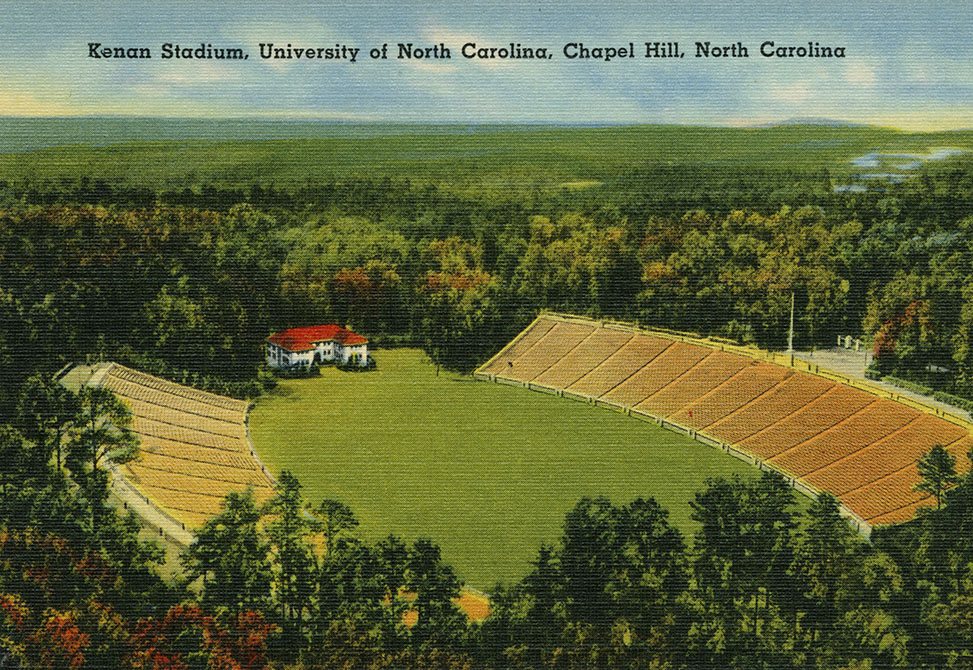
As college football grew rapidly in popularity in the early twentieth century, the Tar Heels soon began attracting more fans than could fit in Emerson Field, which could hold only around 3,000 people. A group of alumni led an effort to build a new stadium and began raising money. The fund-raising effort reached William Rand Kenan Jr., a graduate of the class of 1894 and a member of one of Carolina's earliest football teams. Kenan initially gave $1,000 and eventually agreed to donate the entire amount required for the stadium, around $275,000. It was to be named Kenan Stadium in memory of his parents, William R. Kenan Sr. and Mary Hargrave Kenan.

In 2018 a faculty committee and some journalists —including from the Daily Tar Heel, which ran a front-page story on the stadium —criticized the university for honoring Kenan Sr., one of the leaders of the 1898 Wilmington coup that overturned a multiracial government and murdered numerous African American citizens. Following public discussion and criticism, the university announced that the plaque honoring William Kenan Sr. would be changed to focus instead on William Kenan Jr. in recognition of his substantial financial support of the university.

The stadium was built south of campus in a natural valley over Meeting of the Waters Creek. It was designed by Atwood and Nash, a prominent North Carolina firm that had worked on many significant buildings around the state and on campus. The new stadium was so well received that it attracted the attention of other universities. Atwood and Nash were later hired to provide designs for new stadiums at the University of Georgia and the University of Alabama. Kenan Stadium hosted its first football game, a UNC victory over Davidson, on November 12, 1927. It was formally dedicated a few weeks later, on Thanksgiving Day, during the UNC-Virginia game.

The stadium has undergone several additions and renovations. In 1963 upper decks were added, increasing the seating capacity to 43,000. More seats were added in each of the following three decades, with a major renovation and expansion taking place in 2010—11. This renovation resulted in the demolition of the original field house to make way for the Loudermilk Center for Excellence, an academic support program for UNC student athletes.

The university's annual spring commencement has been held in Kenan Stadium since the 1930s. It has hosted speeches by U.S. presidents (John F. Kennedy in 1963 and Bill Clinton in 1993) and major concerts, including U2 in 1983 and Bruce Springsteen in 2003.

Date Established: 1926

Date Range: 1926 – Present

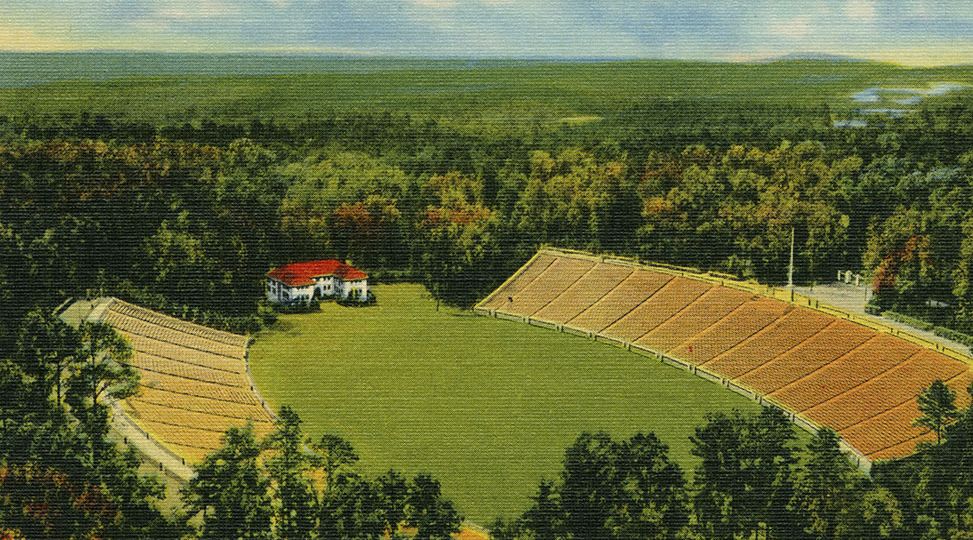
Kenan Stadium, ca. 1930s. Durwood Barbour Postcard Collection, North Carolina Collection Photo Archives, Wilson Library.


16 Apr: Kenan Residence Hall

Kenan Residence Hall

Kenan Residence Hall was completed in 1939, at the same time as McIver Residence Hall, both of which would serve as women's dormitories for the rapidly expanding population of female students at Carolina. The building is named in honor of Mary Lily Kenan Flagler Bingham, whose bequest to the university in 1917 helped establish the Kenan Professorships.

Date Established: 1936

Date Range: 1936 – Present

16 Apr: Kenan Professors

Kenan Professors

Kenan family members have supported the University of North Carolina since its beginning. The family and its related philanthropies are the among the largest donors to the university. Arguably this support has had its greatest influence in the endowed professorships that bear the surname. The first of these, the Kenan Professorships, was established in 1917 through the bequest of Mary Lily Kenan Flagler Bingham. One of the first endowments to UNC and the largest gift to a state university at its time, her gift enabled the university to pay higher faculty salaries to attract and keep outstanding professors. The William R. Kenan Jr. Professorships, created by the namesake's bequest in 1965, added another twenty-five faculty positions. The Graham Kenan Professorship was established in the School of Law in 1965, and the Sarah Graham Kenan Professorships, created in 1968, benefit the law, medical, and business schools. The most recent addition to this aspect of Kenan family philanthropy are the Kenan Eminent Professorships, set up in 2003 to create five faculty appointments and to match gifts from other donors who also contributed to such an endowment.

Date Established: 1918

Date Range: 1918 – Present

Privacy Preferences
When you visit our website, it may store information through your browser from specific services, usually in form of cookies. Here you can change your privacy preferences. Please note that blocking some types of cookies may impact your experience on our website and the services we offer.