Skip to main content Scroll Top

Entries

16 Apr: Kenan Music Building

Kenan Music Building

Opened in 2008, the Kenan Music Building was a part of the Arts Commons envisioned under Chancellor James Moeser, who led efforts to expand and upgrade facilities for the arts at UNC—Chapel Hill. The effort received substantial support from the Kenan Charitable Trust, which earned naming rights to the new building. The trust also provided funding for sixteen full scholarships for students studying music. According to Moeser, the facility provided students and faculty with first-class teaching and rehearsal spaces for the first time since 1930.
16 Apr: Kenan Laboratory

Kenan Laboratory

Kenan Laboratory was completed in 1971 as laboratory and office space for the Department of Chemistry. It was funded by legislative appropriation and named in honor of William Rand Kenan Jr., UNC class of 1894. As a student Kenan assisted in experiments that helped identify calcium carbide and acetylene, work that helped lead to the development of the Union Carbide Company. Kenan worked on the development of acetylene production and later became business partners with oil executive Henry Morrison Flagler. Kenan supported many projects at UNC, most notably the football stadium, which he asked to be named in memory of his parents.

When it opened, Kenan Laboratory was the largest example yet of "modern architecture" on a campus that had largely built in the colonial revival style. Its gray concrete utilitarian appearance struck many people as ugly, although it and the later-built Morehead Laboratory are now considered valuable examples of midcentury modern architecture.

16 Apr: Julian's

Julian's

In 1942 alumnus Maurice Julian opened a men's clothing store on Franklin Street to cater to the cadets in the U.S. Navy pre-flight school on campus. After the war Julian's College Shop catered to students and faculty in an era when most of the people on the still predominantly male campus wore a suit and tie every day. At the time, the 100 block of Franklin Street had nine men's stores, including Varley's, Town and Campus, and Milton's Clothing Cupboard, owned by Maurice Julian's brother, Milton. As times and fashion changed, the other stores gradually closed, leaving Julian's as the last of the old-school menswear stores on Franklin Street. After Maurice Julian's death in 1993, the business was inherited by his children. Originally located at 140 East Franklin Street, near the Carolina Coffee Shop, the business moved across the street to 135 East Franklin in 2007.

The influence of Julian's has extended well beyond the store largely through the work of Maurice Julian's son, Alexander, who went on to become a successful fashion designer and was known as a master colorist. The university has called on Alexander Julian, also an alumnus, at least twice to help revitalize the UNC style: in 1993, by redesigning the men's basketball team uniforms (he added the signature argyle to the uniforms), and in 2010, when he redesigned the university's graduation gowns. After many years of lamenting that the gowns were more turquoise than true Carolina blue, Julian was given the task of redesigning them. The new, "true blue" gowns were first worn at the 2011 commencement. One of the most prominent of Julian's regular customers is probably UNC—Chapel Hill basketball coach Roy Williams. After the Tar Heels won the national championship in 2005, Coach Williams joked, "I owe it all to my lucky Alexander Julian suit and tie."

Date Established: 1942

Date Range: 1942 – Present

Jubilee_973

16 Apr: Jubilee

Jubilee

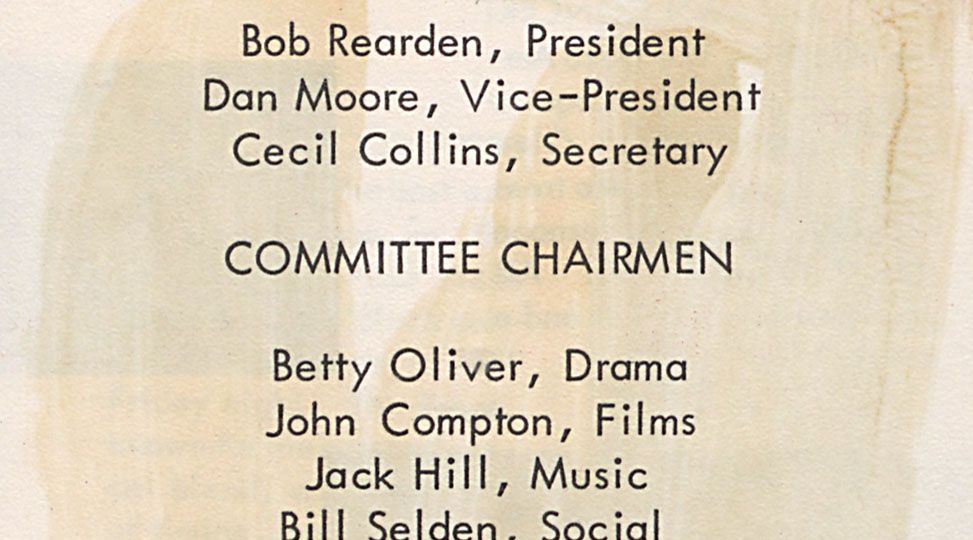
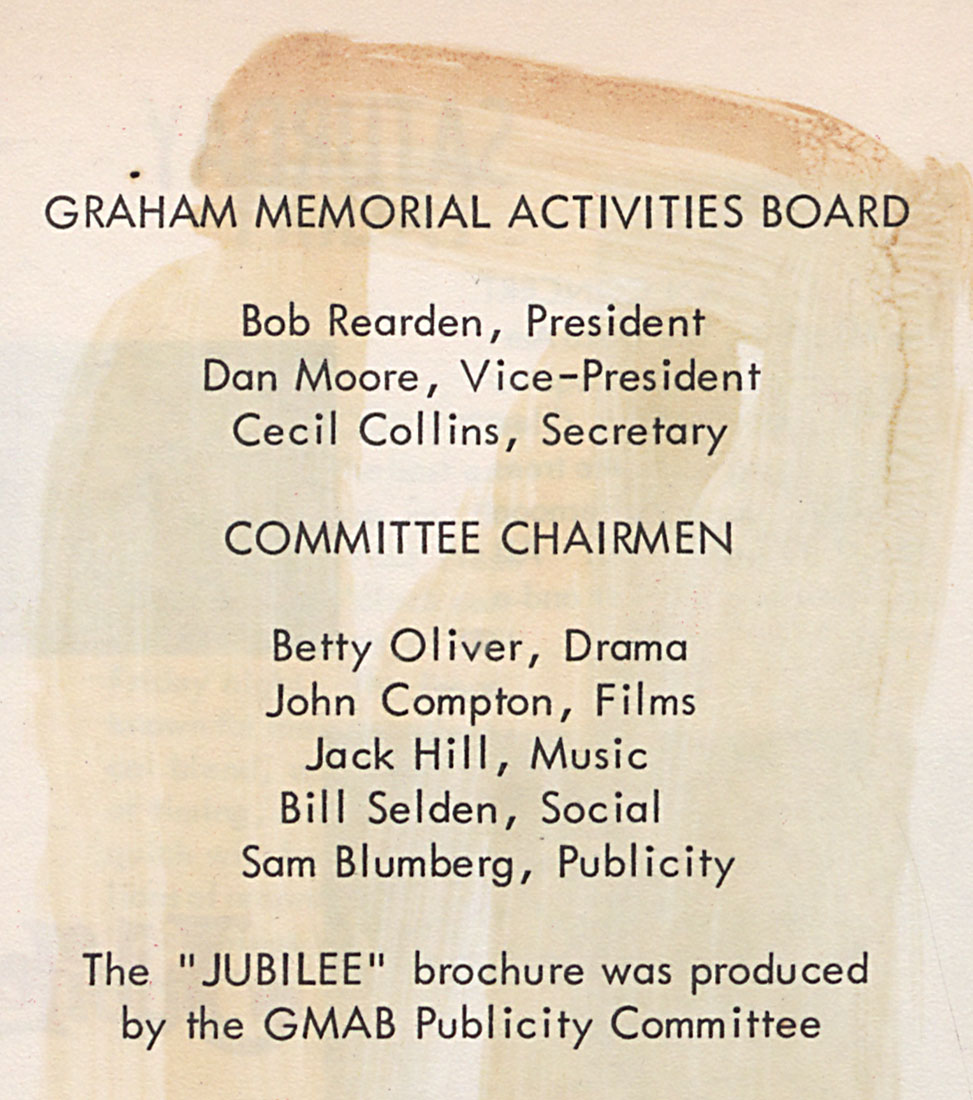
Jubilee was an annual music festival held at the end of the spring semester from 1963 to 1971. It was popular from the beginning. The headliners of the first Jubilee, the Four Preps, drew around 5,000 people to their performance on the lawn in front of Graham Memorial Hall. The concerts grew in popularity as they continued to bring in national acts, including Flatt and Scruggs, Neil Diamond, Johnny Cash and June Carter, and B.B. King. The 1970 festival, held in Kenan Stadium, was a three-day affair that included not just concerts but carnival rides, poetry readings, fireworks, and a 3:00 A.M. showing of Rocky and Bullwinkle cartoons. By 1971 the event got a little too big. An estimated 23,000 people attended the concert on Navy Field featuring Chuck Berry, Muddy Waters, and the Allman Brothers. The crowd included many people without tickets who rushed past the security barriers. Citing increasing costs and concerns over safety, the university discontinued Jubilee.

Date Established: 1963

Date Range: 1963 –
1971

Brochure from the first Jubilee festival, held in 1963. Carolina Union Records, University Archives, Wilson Library.


16 Apr: Joyner Residence Hall

Joyner Residence Hall

Completed in 1948, Joyner was one of several new dorms built in response to the post—World War II increase in enrollment. Originally housing only men, the building was converted to a women's dorm in the early 1960s. It is named for James Y. Joyner, UNC class of 1881. Joyner had a long career in education, first as a school teacher and then as a faculty member and administrator at the North Carolina College for Women (now UNC-Greensboro). He was a classmate and friend of future governor Charles B. Aycock, who appointed Joyner to be superintendent of public education in North Carolina, a position he held until 1919. Joyner was a prominent supporter of public education throughout his life.

16 Apr: Jackson Hall

Jackson Hall

The building now known as Blyden and Roberta H. Jackson Hall was originally built in 1942 to house the campus's U.S. Navy pre-flight school. After World War II a kitchen and dining room were added and it housed the Monogram Club, an organization of current and former varsity athletes. The building became known as the Monogram Club and contained the popular Circus Room soda fountain and snack bar. After a brief stint as a faculty club, the Monogram Club building was renovated again and became the home of the Office for Undergraduate Admissions. In 1992 it was renamed in honor of Blyden and Roberta Jackson. Blyden Jackson, hired in 1969 in the English department, was the first African American full professor at Carolina. When his wife, Roberta Jackson, was hired in 1970 by the School of Education, she was the first tenure-track African American woman in the Division of Academic Affairs.

Date Established: 1942

Date Range: 1942 – Present

16 Apr: Invisible University of North Carolina

Invisible University of North Carolina

In the fall of 1970 graduate student Nyle Frank started the Invisible University of North Carolina. The (very) informal "invisible university" offered alternative classes in the style of 1960s teach-ins. Anyone interested could sign up to take a class, or to teach one. The first course, taught by campus police chief Arthur Beaumont, was called Cooperation between the Fuzz and the Fuzzies. Other courses included graffiti interpretation and pumpkin carving. Frank, a native of Los Angeles, was a well-known figure on campus in the early 1970s. He was easily recognizable, wearing elaborate, colorful clothing and his distinctive "goastache" (half mustache, half goatee). Not satisfied with just an invisible university, in December 1970 Frank was crowned King of the Invisible Universe in a three-and-a-half hour ceremony in the Pit, attended by more than 2,000 students.

Date Established: 1970

Date Range: 1970 –
1972

IntramuralSports_973

16 Apr: Intramural Sports

Intramural Sports

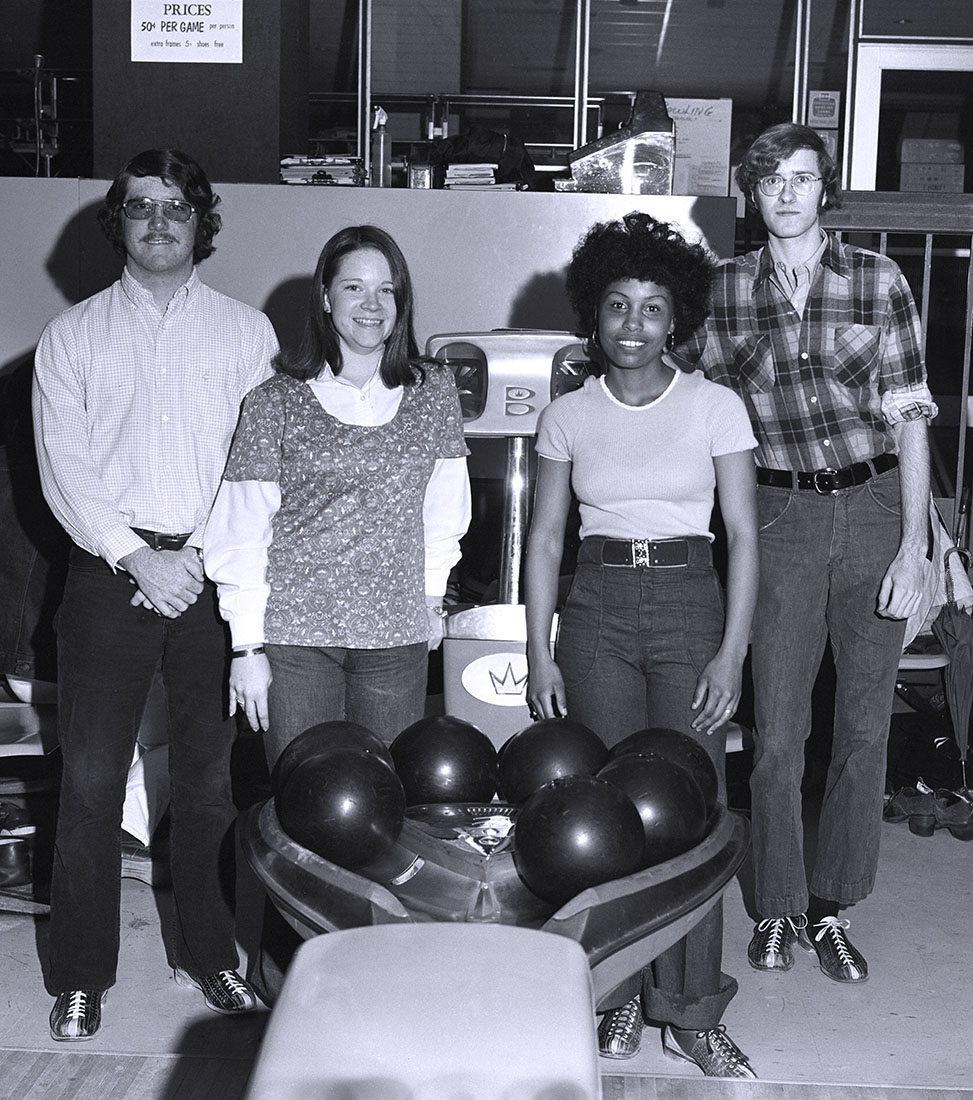
UNC students began participating in organized intramural sports in the 1920s. These casual but competitive activities have been popular with students ever since, though the games have changed over the years. Some sports, like tennis, basketball, and softball, have been popular for decades, but other sports have come and gone depending on the interests of the students. In the 1920s and 1930s indoor track, water polo, boxing, and horseshoes were among the sports offered. Whiffle ball and ultimate Frisbee were popular in the 1970s. More recent intramural sports have included inner tube water basketball, kickball, and street hockey. Dorms and fraternities have traditionally been the most active in fielding teams, though the programs at UNC—Chapel Hill have drawn interest from a wide variety of campus organizations. In 2018 UNC Campus Recreation reported that on average two out of three students participate in intramural sports during their time at Carolina.

Date Established: 1920

Date Range: 1920 – Present

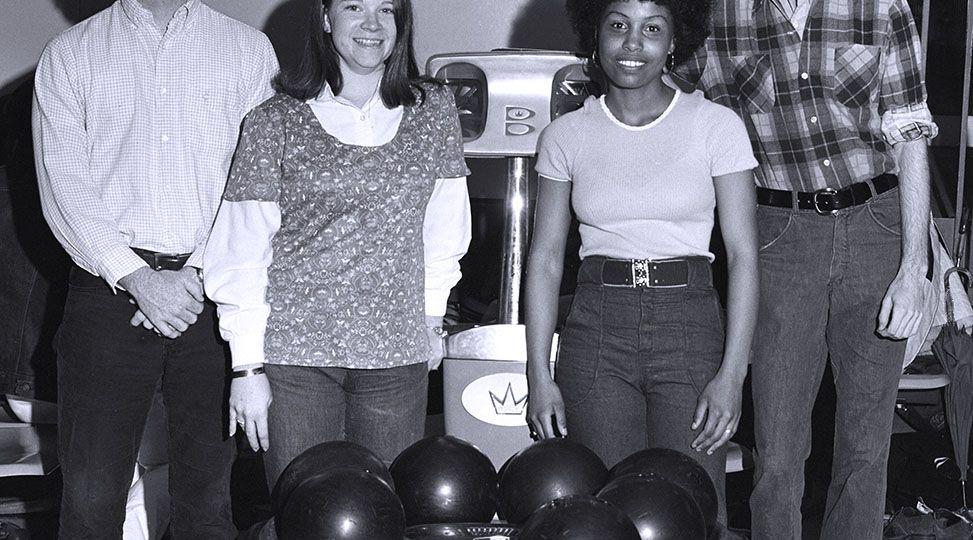
Team from the coed intramural bowling league, 1973. The campus bowling alley was on the ground floor of the Frank Porter Graham Student Union. UNC Photo Lab Collection, North Carolina Collection Photo Archives, Wilson Library.


16 Apr: Intimate Bookshop

Intimate Bookshop

Although it no longer exists, the Intimate Bookshop lives on in Chapel Hill's reputation for creative writing and independent thinking, both of which were nurtured throughout the twentieth century at the Intimate by Carolina faculty and students. The bookshop began in 1931 when Carolina student Milton "Ab" Abernethy set up shop in his boarding house room and invited people to explore the world of books and literature. Abernethy had also just started a literary magazine called Contempo with his fellow student and friend Anthony Buttitta. That endeavor survived only three years but introduced the work of a number of influential writers and thinkers to the small college town.

The bookshop, however, continued. In 1933 it moved into its first Franklin Street location The store quickly became the center for radical activity and gatherings, in part because of the printing press in the back, where Abernethy printed Contempo and materials for radical campus organizations.

In 1964 Wallace Kuralt and his wife, Brenda, bought the store. During their tenure the Franklin Street store thrived, competing with the campus textbook store and expanding its selections to better serve a general audience. The Kuralts eventually opened nine more stores around the state and in Atlanta. A fire decimated the Chapel Hill store in 1992. The Kuralts rebuilt, adding space and special touches such as squeaky floorboards so that it seemed like the old familiar store. The growth of chain bookstores in the 1990s eventually forced Kuralt to close all of the Intimate stores, including the Franklin Street location in 1998.

Date Established: 1930

Date Range: 1930 –
1998

16 Apr: Internet

Internet

The university entered the age of networked computing as early as 1966 as a partner in the Triangle University Computation Center in Research Triangle Park, which linked computers at UNC—Chapel Hill, N.C. State, and Duke. In 1984 the university joined a computer network sponsored by the Association of American University Students to facilitate communication between member universities. By 1991 the university was offering e-mail as a service to campus users. To get access, students and faculty had to go to Phillips Hall and sign up. They received a thirty-eight-page manual explaining how to use e-mail. For faculty and staff who wanted to stay in touch but were dubious about the new service, the university provided "Papermail," which would print e-mails and send them through the campus mail. By 1993 over 1,000 students signed up for e-mail in a single month. UNC—Chapel Hill launched its first website in the mid-1990s and began the processing of moving more and more information and services online.

Privacy Preferences
When you visit our website, it may store information through your browser from specific services, usually in form of cookies. Here you can change your privacy preferences. Please note that blocking some types of cookies may impact your experience on our website and the services we offer.