Skip to main content Scroll Top

Entries

Integration_973

16 Apr: Integration

Integration

Under Jim Crow laws from 1900 to 1951, North Carolina's public schools at all levels were segregated institutions with separate schools for whites, African Americans, and Native Americans. In the 1930s university administrators successfully fought the entry of African Americans to graduate programs by helping open a law school and other graduate programs at the North Carolina College for Negroes in Durham (now North Carolina Central University). In 1951, however, in McKissick v. Carmichael, the courts ruled that the two law schools were not equal and ordered UNC to admit the African American plaintiffs to its law school. Following their legal victory, Harvey Beech, James Lassiter, J. Kenneth Lee, and Floyd McKissick enrolled in the summer of 1951. The same year Carolina admitted Dudley Diggs, an African American student, to the medical school because there were no comparable schools in the state, and Gwendolyn Harrison, a teacher, to summer school graduate courses.

Native Americans who sought entrance to UNC had a more arbitrary experience, as admittance sometimes depended on individual administrators. While there had been one or two American Indians in UNC programs in the 1920s, the 1950s court rulings also opened the doors to them. Cecil B. Lowry (Lumbee) entered as a junior in 1951, and the following year Genevieve Lowry (Lumbee) transferred to UNC as a junior and Otis M. Lowry (Lumbee) entered the medical school.

UNC continued to have a reluctant approach to integration. The first African American students were restricted to their own floor in Steele Dormitory (now Steele Building) and denied seating in the student section of the football stadium. Once the Supreme Court outlawed all forms of segregation in Brown v. Board of Education in 1954, the university had no further legal recourse. In the fall of 1955 the first African American undergraduates entered Carolina: brothers LeRoy and Ralph Frasier and John Lewis Brandon. Enrollment grew slowly; by 1963 only eighteen African American students were at Carolina.

Despite this step toward integration, local businesses continued to maintain racial segregation. In February 1960 nine African American high school students in Chapel Hill staged a sit-in at Colonial Drug Store, setting off years of boycotts, sit-ins, and marches. They were soon joined by university students from Carolina, North Carolina A&T in Greensboro, and other nearby colleges. Many clergy members, faculty, and town residents joined the protests. In March 1964 two African American activists and two white university students staged a weeklong Easter fast in front of the Franklin Street post office. The Ku Klux Klan responded by staging a rally in Chapel Hill. Student government generally supported the protests, and the honor court acquitted all of the student protesters who appeared before it. In contrast, the university administration, by far the largest employer in town, tried to maintain a publicly neutral stance despite its tacit support for segregation. The university's North Carolina Memorial Hospital still maintained segregated facilities, the university television station had refused to air a national program about desegregation, and the athletics program refused to move its weekly press luncheons from a segregated Chapel Hill restaurant. Passage of the Civil Rights Act in the summer of 1964 ended this phase of resistance to integration.

The university's first black athlete, Edwin Okoroma of Nigeria, joined the soccer team in 1963. Charles Scott became the first African American scholarship athlete in 1966 when Coach Dean Smith recruited him to join the basketball team. That same year, the School of Social Work hired Hortense McClinton, the first African American faculty member at Carolina.

Date Established: 1954

Date Range: 1954 – Present
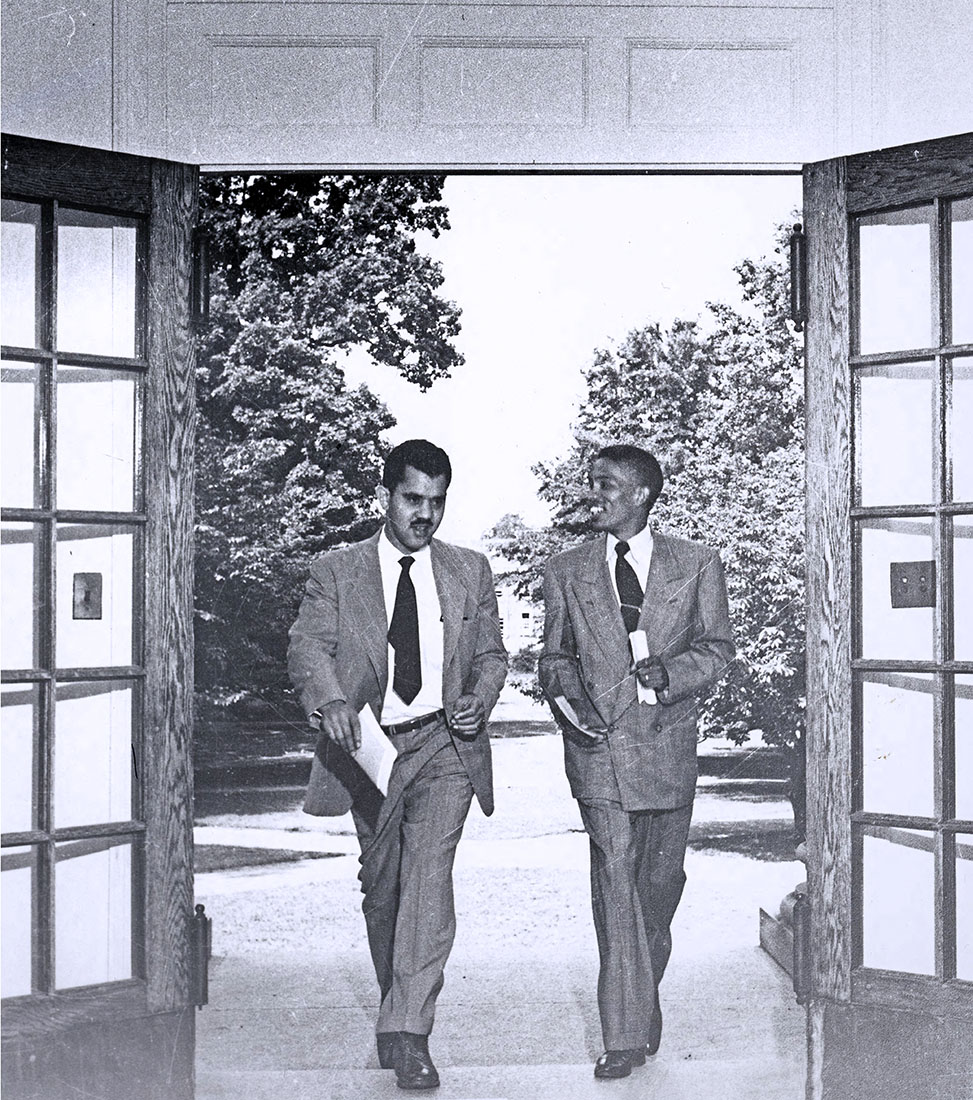
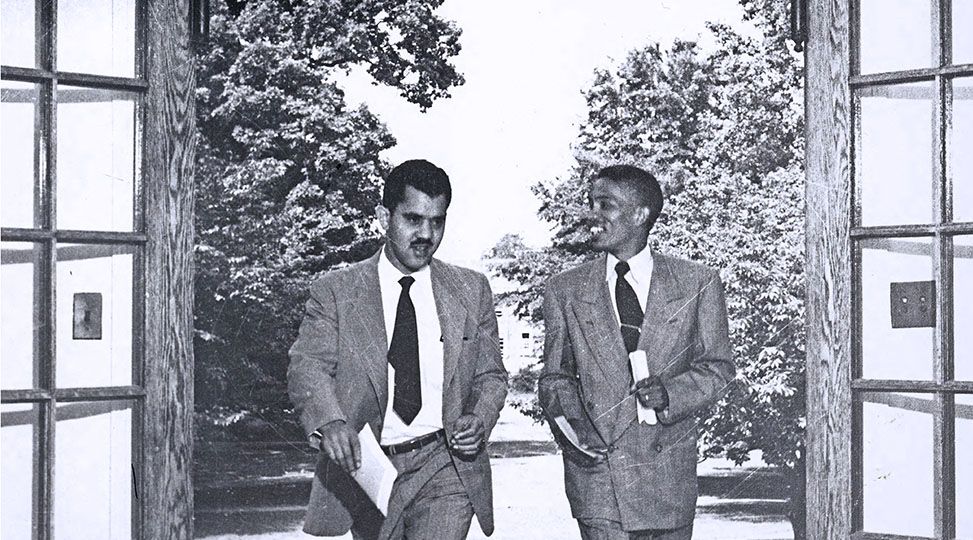
Harvey Beech (left) and J. Kenneth Lee entering Manning Hall on June 11, 1951, their first day as law students at UNC. J. Kenneth Lee Papers, Southern Historical Collection, Wilson Library.
 

16 Apr: Institute of Marine Sciences

Institute of Marine Sciences

Founded in 1947 as the University Institute of Fisheries Research, the institute was established to give Carolina students and faculty an opportunity to learn and conduct hands-on research on coastal issues, and to advise local and state government. Located along the coast near Morehead City, the institute includes research labs and teaching facilities.

16 Apr: Information and Library Science, School of

Information and Library Science, School of

The university began offering courses in library science as early as 1904, as part of the summer school, and added them to the regular curriculum a few years later. Librarian Louis Round Wilson was an early proponent of professional library training and spoke often about the need for a library school on campus. Wilson's advocacy increased in the 1920s, and the university agreed to add the new program. In 1931, supported by a grant from the Carnegie Foundation, UNC began offering classes in the School of Library Science, with Wilson as the director. The school was located in the new University Library (now Wilson Library). Wilson was succeeded after a few years by Susan Grey Akers, one of the original faculty members. When her title was changed to dean in 1941, Akers became the first woman to hold an academic deanship at the university.

The school moved to Manning Hall in 1970 after the building was vacated by the law school. In 1988 the name was changed to the School of Information and Library Science, and in 1999 it was ranked by U.S. News & World Report as the top library and information science graduate program in the country.

16 Apr: Influenza

Influenza

The influenza pandemic that swept the world in 1918 and 1919 had a very visible effect in Chapel Hill, claiming two consecutive university presidents. Edward Kidder Graham, the popular young president who was leading the university's growth and transformation into a modern research university, died from complications from the flu in October 1918. His successor, Marvin Hendrix Stacy, died from influenza just a few months later. Other than the tragic loss of Graham and Stacy, UNC did not suffer great losses during the pandemic, with only a few students dying. Concerned about future outbreaks, in 1919 UNC hired its first physician, Dr. Eric Abernethy, and began the work of modernizing the university infirmary and sanitation practices on campus.

16 Apr: Infirmary

Infirmary

The university did not have a campus infirmary until 1895. The Tar Heel described it as a place where "the indisposed, the drooping, the lame and the halting may retreat." In an era when transportation was slow and unreliable and the nearest hospital was in Durham, the college infirmary often handled serious illnesses, including a case of smallpox in 1900 that had the whole campus on high alert. As student health needs increased, a new infirmary was built in 1900, only to be replaced again in 1907. In 1919 the campus hired its first physician, Dr. Eric Abernethy, who brought modern ideas about sanitation and medical practices to the campus. The infirmary building was later named Abernethy Hall in his honor. In an era with very different ideas about privacy, the names of sick students who were admitted were published in the "Infirmary List," a regular feature of the student newspaper through the early 1960s.

16 Apr: Hyde Hall

Hyde Hall

Hyde Hall is home to the Institute for Arts and Humanities, which provides support and training for faculty through a variety of programs. The decision to place a new building for the institute in McCorkle Place, the oldest part of campus, symbolized the institute's centrality to nurturing the historical commitment to the arts and humanities at Carolina. Completed in 2002, Hyde Hall was funded entirely through private donations. Conversation, a sculpture by North Carolina artist and Carolina alumnus Thomas Sayre, sits in the garden at Hyde Hall. The stone work symbolizes the interdisciplinary dialogues that take place at the institute.

The building is named in honor of Barbara Rosser Hyde (UNC—Chapel Hill class of 1983) and her husband, J. R. "Pitt" Hyde (class of 1965). Both are committed philanthropists for civic and educational programs in their hometown of Memphis and at Carolina.

Date Established: 2003

Date Range: 2003 – Present

16 Apr: Howell Hall

Howell Hall

Completed in 1906 to house the Department of Chemistry (which had been in Person Hall), this building was the first on campus to be funded by a direct appropriation from the state. When the chemistry department moved to Venable Hall in 1925, the building, which had been known as the Chemistry Building, became home to the School of Pharmacy and was renamed for the pharmacy dean. When the pharmacy school moved to a new home in Beard Hall in 1960, Howell Hall was renovated for the School of Journalism, which was there until 1999. The Department of Psychology and Neuroscience moved to the building after the journalism department left. A renovation in 2016 added new laboratories for research in human neurostimulation, physiological monitoring, brain imaging, and behavioral observation.

The building is named in honor of Edward Vernon Howell, Carolina's first pharmacy dean. Born in Raleigh, Howell came to campus in 1897. He headed the pharmacy school for thirty-three years. During his tenure Howell worked to enhance professional standards for the state's pharmacists. At a time when faculty could join the varsity football team, Howell was an outstanding player. He is also believed to have been the first person in Chapel Hill to own an automobile.

Date Established: 1904

Date Range: 1904 – Present

16 Apr: House Undergraduate Library

House Undergraduate Library

As early as 1960, library and university administrators began discussing the need for a library space devoted to the needs of undergraduate students. The Robert B. House Undergraduate Library opened in 1968, around the same time as the new Student Stores and Graham Student Union buildings. The three buildings, designed by the Charlotte architectural firm Cameron Associates, marked a major expansion of the campus and a new commitment to student services. The House Undergraduate Library has focused on the needs of undergraduate students, staying open later than the other campus libraries and offering or hosting support services, including a term paper clinic in the 1970s, one of the university's first computer labs in the 1980s, and, more recently, reserve readings, and spaces and equipment for design and media production.

The library is named for Robert B. House, who served as chancellor from 1945 to 1957. A Halifax County native who graduated from UNC in 1916, House spent the majority of his career at Carolina. He joined the administration in 1926 and was appointed dean of administration for the Chapel Hill campus in 1934, after the creation of the consolidated UNC System. In 1945 the name of his job changed and he became the first person at the university to hold the title of chancellor. House led Carolina through a period of dramatic change, first helping the university endure the Great Depression and then World War II, and then overseeing the subsequent rapid expansion of the campus and student body and the admission of the first African American students in the 1950s.

Date Established: 1964

Date Range: 1964 – Present

Hospitals_973

16 Apr: Hospitals

Hospitals

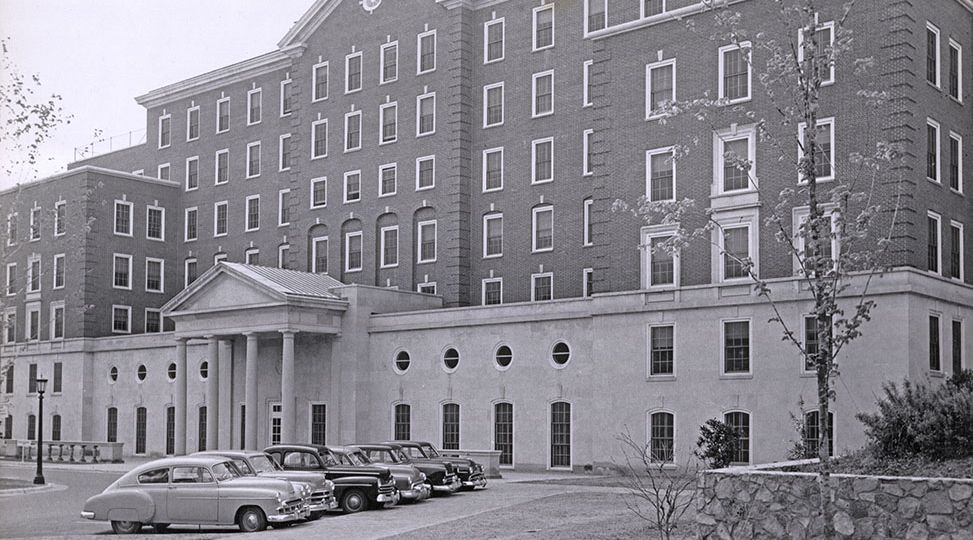
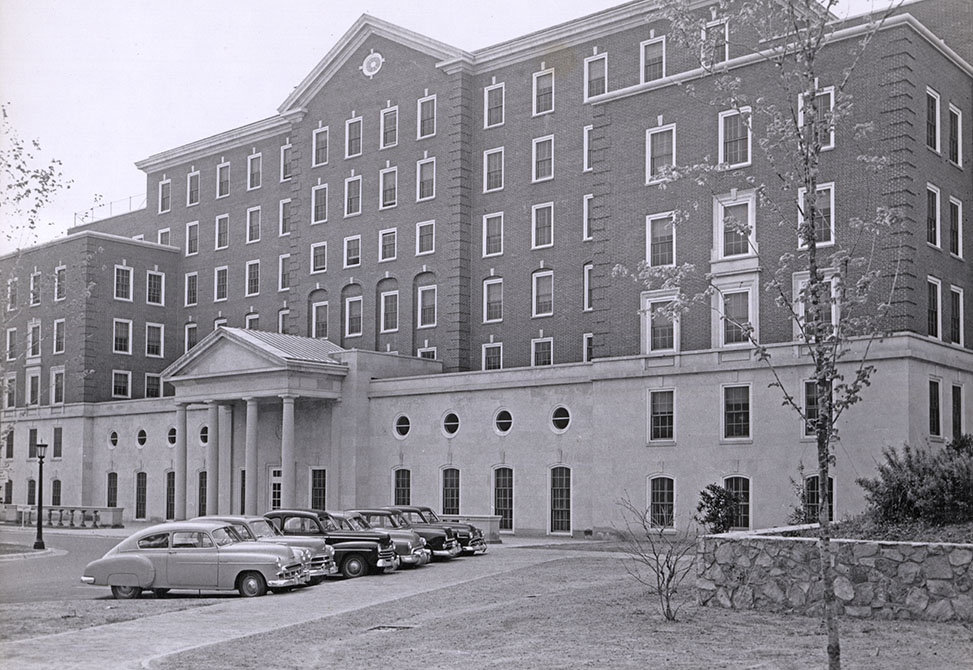
The North Carolina legislature appropriated funds for a teaching hospital at the university as part of the plan to create a four-year school of medicine at UNC. The hospital opened in 1952 and was named North Carolina Memorial Hospital in honor of North Carolinians who had given their lives in military service. The hospital was heavily used, welcoming its 100,000th patient in 1960. It expanded rapidly, adding new programs and expanding the facilities. In 1965 the hospital was the subject of an investigation under the Civil Rights Act. In response, the university announced that it would no longer segregate hospital patients by race.

In 1989 the hospital and its constituent services were organized under the new name UNC Hospitals. In 1998 the North Carolina General Assembly authorized the creation of the UNC Health Care system, which recognized the statewide impact and importance of the UNC hospitals and health care services. The major hospital services in Chapel Hill grew to include the Neurosciences Hospital (opened in 1995), the Women's Hospital (2001), the Children's Hospital (2001), and the Cancer Hospital (2009), home of the Lineberger Comprehensive Cancer Center.

Date Established: 1952

Date Range: 1952 – Present

North Carolina Memorial Hospital shown shortly after its opening in 1952. UNC Photo Lab Collection, North Carolina Collection Photo Archives, Wilson Library.


16 Apr: Horton Residence Hall

Horton Residence Hall

Horton Residence Hall opened in 2002, one of four new dorms completed around the same time (Craige North, Koury, and Hardin were the others). The smaller dorms were an effort to bring more of a traditional campus feel to South Campus, which had been dominated by the high-rise dorms built in the 1960s and 1970s. The dorms, which included seminar rooms to bring residence and academic life closer together, were in high demand among students when they first opened.

Originally named Hinton James North, the building was renamed in 2007 for George Moses Horton. An enslaved African American writer living in Chatham County, just south of Chapel Hill, Horton was a presence on campus for many years in the early to mid-nineteenth century. He initially came to Chapel Hill to sell produce, but students and local residents soon discovered his talent for writing and memorizing poetry. He sold love poems to students, who were said to have passed them off as their own. Assisted by Caroline Hentz, the wife of a faculty member, in 1829 Horton published A Hope for Liberty, a collection of poems, making him the first African American man to publish a book in the South. Horton published another book in 1845 and drew the attention of local residents and UNC administrators. Yet he remained enslaved, finally escaping at the end of the Civil War with a Michigan regiment on its way north. Horton lived the remainder of his life in Philadelphia.

Privacy Preferences
When you visit our website, it may store information through your browser from specific services, usually in form of cookies. Here you can change your privacy preferences. Please note that blocking some types of cookies may impact your experience on our website and the services we offer.