Skip to main content Scroll Top

Entries

16 Apr: Carolina Magazine

Carolina Magazine

The Carolina Magazine was an important part of campus life at Carolina for more than a century. First published in 1844 as a biographical and historical review, the magazine included essays from faculty and local residents. By the 1880s the magazine expanded into a general literary publication, with creative writing by students. Many prominent alumni authors published in the Carolina Magazine as students, including Thomas Wolfe, Paul Green, Walker Percy, and Joseph Mitchell. In the 1920s the magazine occasionally began publishing the work of African American authors. In May 1927 the magazine published its first "Negro Number," which contained creative works by African American authors, including Langston Hughes and Countee Cullen. This special edition was an annual tradition for a few years, and while the issues were usually preceded by condescending commentaries about African American writing, they provided an outlet for African American authors and enabled them to reach new audiences in North Carolina. By the mid-1940s interest in the Carolina Magazine began to wane. The student body was growing, and students were focusing their creative efforts on other publications, including a variety of humor publications such as Tarnation and the Carolina Buccaneer. The last issue of the magazine ran in 1948.
More information about Carolina Magazine

CarolinaInn_973

16 Apr: Carolina Inn

Carolina Inn

In 1921, following an uncomfortable night at a dilapidated Franklin Street boarding house, alumnus John Sprunt Hill decided to build a proper hotel near the university. Hill, already a frequent donor, initially tried to raise money from alumni. When those efforts fell short, he decided to pay for the whole thing himself. Built on land Hill owned near campus, the Carolina Inn opened in late 1924. It was designed by Arthur Nash, the architect responsible for many of the buildings built on campus during the 1920s expansion.

The Carolina Inn quickly became a fixture of campus life, hosting visiting alumni and serving as the de facto site for formal dinners and receptions by campus groups. In 1935 Hill formally transferred ownership to the university with the stipulation that any profits would go to the University Library, in particular the collections devoted to North Carolina (now known as the North Carolina Collection).

While the university began to admit African American students in the 1950s, the Carolina Inn was slower to act. The inn cultivated an "Old South" atmosphere, exemplified by a brochure in use for decades showing on its cover a smiling African American porter ready to open the front door. One of the earliest African Americans to attend a public event at the inn was Martin Luther King Jr., who was a guest at a dinner there during a campus visit in 1960.

Facing growing demand, the inn had significant renovations and additions in the 1940s and 1970s. But it remained a financial headache for the university. By the early 1990s, with the inn losing money, the university decided to lease management to a private company. Another renovation followed, this one bringing the loss of the inn's cafeteria, long a favorite lunchtime spot for local residents and university employees. Even under private management, the inn remained, as UNC System president William C. Friday called it, the "University's living room."

Date Established: 1924

Date Range: 1924 – Present

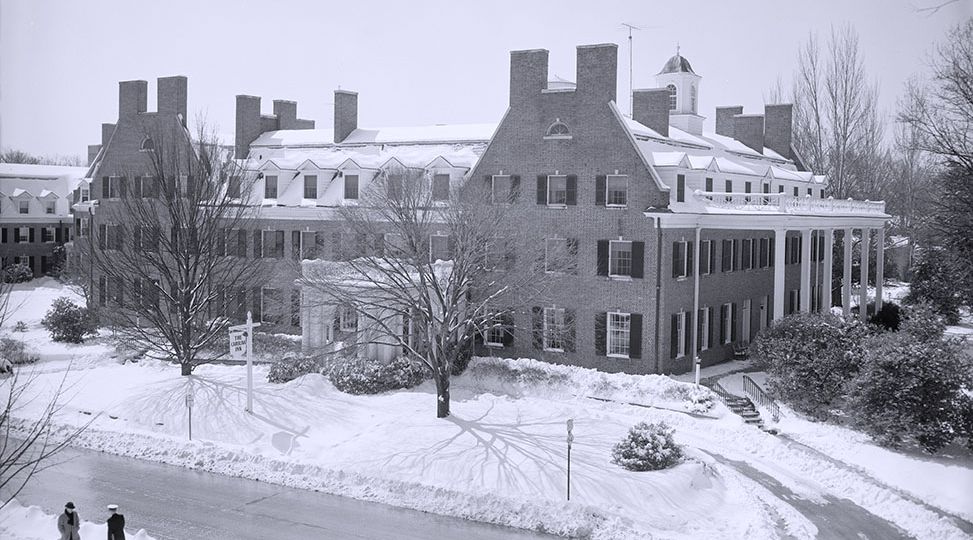
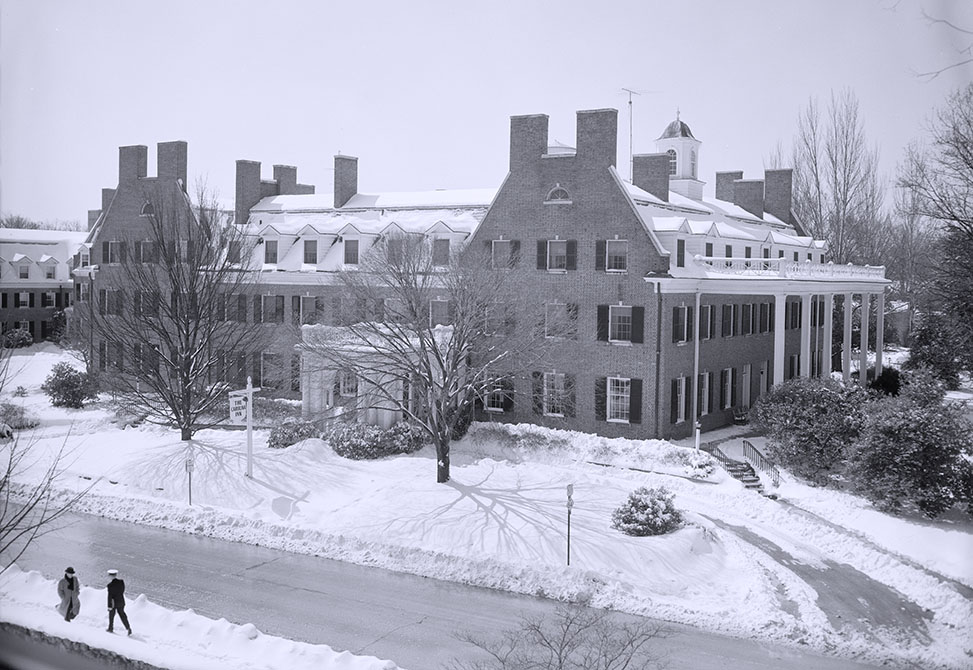
Carolina Inn in the snow, ca. 1960. UNC Photo Lab Collection, North Carolina Collection Photo Archives, Wilson Library.


16 Apr: Carolina Indian Circle

Carolina Indian Circle

Carolina Indian Circle was founded in 1974, when there were only ten Native American students on campus. The circle provides academic and social support for Native American students, helps with recruitment, and sponsors ways for the campus community to learn more about Native American cultures. The group has hosted the annual Carolina Indian Circle Powwow since 1987, the largest powwow held on at any university on the East Coast. The organization also sponsors Unheard Voices, an a cappella group, and hosts Indigenous Peoples Day in October. The First Nations Graduate Circle, founded in 2000, is the graduate and professional student counterpart to the Carolina Indian Circle. It has hosted a Native Leaders Symposium, a day-long program on leadership for Native leaders and academics.

CarolinaHall_973

16 Apr: Carolina Hall

Carolina Hall

The building now known as Carolina Hall was named Saunders Hall from 1922 to 2015. Completed as part of the campus expansion in the early 1920s, Saunders was built as a classroom building, originally housing the Departments of History, Economics, and Commerce. It was named for William L. Saunders, an 1854 graduate of UNC who served in the Confederate army during the Civil War. After the war he worked as a newspaper editor, North Carolina secretary of state, and historian, compiling the ten-volume Colonial Records of North Carolina (1886—90). He was a member of the UNC Board of Trustees from 1878 until his death in 1891. When he was selected as the namesake for the new building on campus, he was called an "ardent friend of the University and one of the master minds of North Carolina." He also led the Ku Klux Klan in North Carolina.

In the late 1860s Saunders and other conservative leaders in North Carolina were angered by the multiracial coalition that had elected a Republican government and approved a new state constitution that, for the first time, gave every man, regardless of race, the right to vote. Saunders helped organize Ku Klux Klan groups throughout the state to intimidate, threaten, and in some cases murder opposing politicians and supporters. Saunders and his allies forced the impeachment of Governor William Holden in 1871 after the governor tried to suppress Klan violence in the state. Saunders's leadership of the Ku Klux Klan was cited by the board of trustees when the building was named in his honor.

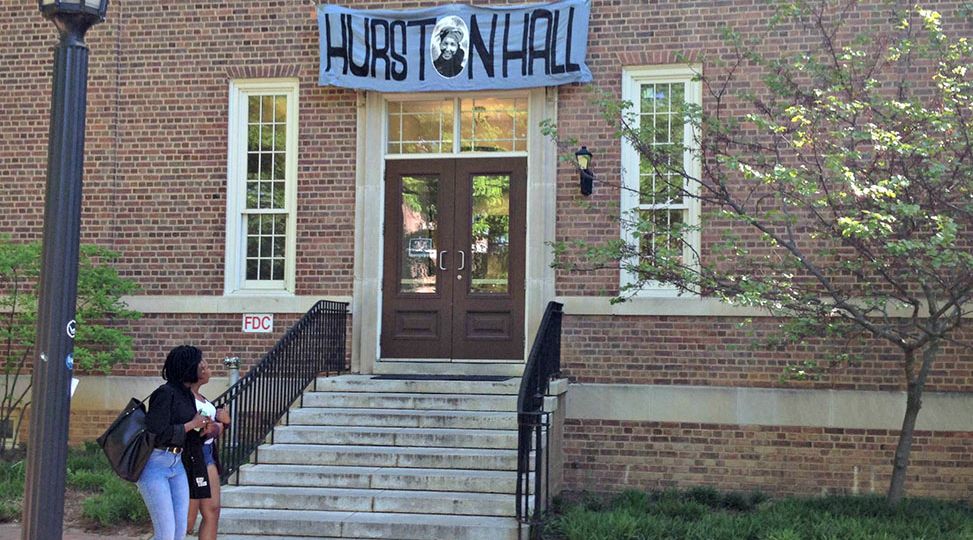
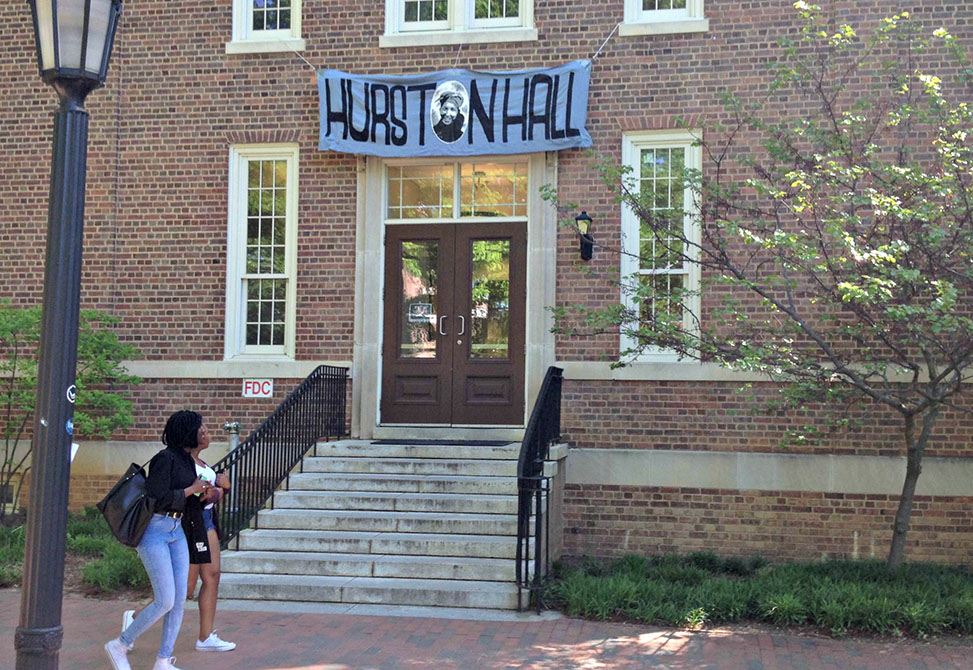
By the late twentieth century students at UNC—Chapel Hill were frequently calling for Saunders's role in the Klan to be acknowledged by the university and the building renamed. In 2014 a coalition of students from the Real Silent Sam Coalition, the Black Student Movement, the Campus Y, and other organizations organized the largest protests yet around Saunders Hall. Students and faculty from the Department of Geography, which was housed in the building, were especially active. The students called for the building to be renamed Hurston Hall in honor of author Zora Neale Hurston, who visited UNC in the late 1930s as a guest of playwright Paul Green.

In a rare acknowledgment of poor judgment by their predecessors, the UNC—Chapel Hill Board of Trustees voted in 2015 to remove Saunders's name from the building. Instead of following the students' requests to name the building for Hurston, the trustees selected Carolina Hall as the new name. Student activists were further frustrated when the trustees immediately followed the action by declaring a sixteen-year moratorium on renaming buildings on campus. In 2016 the university installed an exhibit in the lobby of Carolina Hall that examines the history of Saunders and his allies in the late nineteenth-century white supremacy campaigns in North Carolina.

Date Established: 1922

Date Range: 1922 – Present

“Hurston Hall” banner hung by student activists calling for the renaming of Saunders Hall, April 2015. Photograph by Stephanie Lamm from the Daily Tar Heel.


16 Apr: Carolina Coffee Shop

Carolina Coffee Shop

Carolina Coffee Shop is the oldest continuously operating business in Chapel Hill, operating at 138 East Franklin Street since 1922. It opened as a soda fountain called the Carolina Confectionary. It later added full meals and "Coffee Shop" to the name. By the mid-1930s it was known simply as the Carolina Coffee Shop. The restaurant has long been known for its booths (described as "cozy alcoves" in a 1937 ad), dark wood interior, and classical music.

Date Established: 1922

Date Range: 1922 – Present

16 Apr: Carolina Center for Public Service

Carolina Center for Public Service

Carolina Center for Public Service was established in 1999 to help connect the university's students, faculty, and staff with communities through teaching, research, and service. The idea came from an earlier Public Service Roundtable, a grassroots group of faculty and staff leaders who were interested in building on the university's tradition of public service. The center has programs for students, faculty, and staff to learn more about engagement, to learn new skills, and to connect academic endeavors with communities throughout North Carolina. One of the center's most successful projects was the Tar Heel Bus Tour, created in 1997 to introduce new faculty, staff, and administrators to the state of North Carolina. The weeklong tour traveled around the state to businesses, to historic and cultural sites, and to UNC faculty and students working in the field. The center also houses the APPLES Service-Learning program, Buckley Public Service Scholars, and the Thorp Faculty Engaged Scholars. The center is located at 207 Wilson Street.

16 Apr: Carolina Buccaneer

Carolina Buccaneer

First published in 1924, the Buccaneer was a popular humor magazine on campus. There had been earlier, short-lived humor magazines, but the Buccaneer was one of the longest-lasting ones, published for more than a decade. With its glossy pages and colorful cover illustrations, the Buccaneer had the appearance of a professional magazine. Its content, however, was very much the work of undergraduates. The issues are filled with in-jokes and attempts at bawdy humor. The magazine was known for testing the limits of what could be published on campus. In 1928, as the Buccaneer was preparing a "Girls' Issue," the Tar Heel wrote that the content was so scandalous that it would have to be printed on asbestos paper. In 1939 the editors finally pushed too far. The Buccaneer "Sex Issue," which featured a drawing of a scantily clad woman on the cover, was immediately banned from campus. The student body president said that it would "seriously and permanently damage the reputation and lessen the prestige of the university in general." The Buccaneer didn't survive long after the scandal, publishing its last issue in 1940.

Date Established: 1924

Date Range: 1924 –
1940

16 Apr: Carolina blue

Carolina blue

The university's distinctive school color originated only a few years after the university opened. Not long after the first students arrived, they organized two debating groups: the Dialectic and Philanthropic Societies. The "Di" and "Phi" societies played a large role in campus academic and social life. Early students were required to join one or the other. They proclaimed their membership by wearing ribbons in their society's color. The Phi's color was white, and the Di's color was light blue. The ribbons were also used on diplomas awarded by the society. Examples of these from the early 1800s survive today in Wilson Library.

When UNC began competing in intercollegiate sports in the late 1880s, the students followed the lead of other universities in adopting school colors. There does not appear to have been any debate: the Tar Heel athletic teams used the colors long associated with the debating societies. The light blue soon became a signature color for the university. By the 1930s newspapers were referring to it as "Carolina blue." Used in official publications and on clothing, it was embraced by students and administrators. By the end of the twentieth century the color was an inseparable part of campus life, but there were questions about the "true" Carolina blue. Printers and manufacturers used different versions of the color. The men's basketball uniforms used a darker version that was supposed to look better on television, but campus publications had a much lighter shade.

Alumnus and fashion designer Alexander Julian was particularly offended by the color of the graduate gowns he saw on students walking past his store on Franklin Street. After lobbying for several years to "improve the true blueness" of the robes, Julian was given the job of redesigning the gowns in 2010. Julian's new, "true blue" robes were worn at graduations starting in the spring of 2011. To eliminate further confusion about the proper shade of the color, the university worked with Nike in 2015 to standardize the school's athletic uniforms. In the process, the university established Pantone 542 as the official version of Carolina blue.

16 Apr: Carmichael Residence Hall

Carmichael Residence Hall

When Carmichael Residence Hall opened for the fall 1986 semester, it was the first new dorm on campus since the 1960s. More important for students, it was the first dorm with air conditioning. The coed dorm also included four new "living-learning" programs, giving students from the same major the opportunity to live together. Carmichael now houses students with similar academic interests, as well as a makerspace, a design and fabrication facility operated as part of UNC—Chapel Hill's Innovate Carolina program.

The building is named for Katherine Kennedy Carmichael (1912—1982). A legendary figure both feared and loved by students, Carmichael served as dean of women from 1946 until 1972. The position of dean of women oversaw the academic and social lives of the growing population of women enrolling at Carolina. While men on campus could largely come and go as they pleased, dress how they liked, and socialize wherever and whenever they chose, female students were subject to a strict set of rules, including mandatory study halls and curfews, a ban on drinking, and a dress code. All of these were overseen by Dean Carmichael, whose Women's Handbook was required reading. Raised in Birmingham, Alabama, Carmichael was known for her proper dress and manners and expected the same from her students. At first seen as practical and necessary, the "women's rules," and Carmichael's strict interpretation of them, were challenged by students in the 1960s, leading to gradual changes throughout the late 1960s and early 1970s, until finally women at Carolina were subject to the same rules and restrictions as men. When that happened, the university abolished the position of dean of women, and Carmichael served as an associate dean of UNC Student Affairs. Although she no longer oversaw women students, she continued to advocate for the advancement of women at Carolina.

Date Established: 1986

Date Range: 1986 – Present

16 Apr: Carmichael Arena

Carmichael Arena

With basketball growing in popularity following the 1957 national championship, UNC decided in the early 1960s to build a new arena. Completed in 1965, Carmichael Auditorium, as it was then named, was the home of the Tar Heel basketball team for more than twenty years. Originally seating 8,000 fans (later expanded to more than 10,000), the notoriously loud venue played host to many of Coach Dean Smith's greatest teams, including the 1981—82 national champions. Built along South Road next to Woollen Gym —the previous location of home basketball games —Carmichael was completed in time for the October 12, 1965, University Day celebrations. Lectures and concerts were also held there, including a performance by the Supremes just a month after it opened. In the fall of 1982 Carmichael hosted a week of lectures by evangelist Billy Graham.

The first men's basketball game in Carmichael was played on December 4, 1965, a UNC victory over William and Mary. By the 1980s the men's basketball team was in need of an even larger venue and moved to the Dean Smith Center once it was completed. Carmichael underwent an extensive renovation in 2010 and was renamed Carmichael Arena when it reopened. Carmichael currently hosts Tar Heel volleyball, gymnastics, wrestling, and women's basketball.

The building is named for William D. Carmichael Jr., a university administrator in the 1940s and 1950s. A native of Durham, Carmichael graduated from UNC in 1921 and was a captain of the basketball team. He had a successful career on Wall Street before returning to Chapel Hill in 1939 to serve as controller for the UNC System (coincidentally, he succeeded Charles T. Woollen, namesake of the building Carmichael Auditorium was built to replace). Carmichael, a successful fund-raiser, was named acting head of the university after Frank Porter Graham left in 1949 and was considered a possible successor to Graham. He was later named vice president and finance officer of the UNC System, serving in that role until his death in 1961.

Date Established: 1965

Date Range: 1965 – Present

Privacy Preferences
When you visit our website, it may store information through your browser from specific services, usually in form of cookies. Here you can change your privacy preferences. Please note that blocking some types of cookies may impact your experience on our website and the services we offer.