Skip to main content Scroll Top

Entries

16 Apr: Morehead Planetarium and Science Center

Morehead Planetarium and Science Center

John Motley Morehead III was interested in providing a "silk hat" for the university —a landmark building that was unlikely to be built using taxpayer funds. When a Harvard professor told Morehead, "Your state needs cosmic awakening," Morehead made the decision to build a planetarium. When it opened in 1949, the Morehead Planetarium was the first in the South and one of only six in the United States. From 1959 to 1975 the planetarium hosted training programs for U.S. astronauts, including the members of the Apollo 11 mission to the moon.

The planetarium expanded in 1973 with the addition of an observatory, a banquet hall, and an art gallery. The expansion also including guest quarters, with a large parlor and eight bedrooms. It has been used to host distinguished guests to campus, including Gerald Ford, Andrew Young, Martha Graham, and Princess Anne of Great Britain.

The Morehead Planetarium has always served a dual purpose: as a research laboratory for faculty and students and as a center for education for school children across North Carolina. The planetarium expanded its education and outreach work in the 2000s. In 2002 the name was changed to the Morehead Planetarium and Science Center, and in 2010 the planetarium led the first annual North Carolina Science Festival.

Date Established: 1949

Date Range: 1949 – Present
16 Apr: Morehead Chemistry Labs

Morehead Chemistry Labs

Completed in 1985 as undergraduate lab and classroom space for the Department of Chemistry, the lab was built with a legislative appropriation and named in honor of John Motley Morehead III (UNC class of 1891). He became a chemical engineer, working with a company cofounded by his father. There he helped develop the large-scale manufacture of calcium carbide and acetylene gas. The company eventually became part of Union Carbide. In addition to supporting chemistry and the University of North Carolina Press, Morehead built the Morehead Planetarium and established the Morehead (now Morehead-Cain) Foundation.

Date Established: 1983

Date Range: 1983 – Present

16 Apr: Monogram Club

Monogram Club

In 1908 a group of current and former Carolina varsity athletes organized the "North Carolina Club" as a social organization and to promote sports at the university. The name was changed in the early 1920s to the Monogram Club, a popular name for student-athlete groups used by several other universities. Club members advocated for athletic teams and facilities and for a while oversaw the cheerleading squads. The club also hosted social events that were open to everyone. In the mid-1940s the club moved its offices into the building recently vacated by the campus's navy pre-flight school following World War II. The building housed the popular Circus Room soda fountain and snack bar and became known informally as the Monogram Club until its name was changed to Blyden and Roberta H. Jackson Hall in 1992.

16 Apr: Mitchell Hall

Mitchell Hall

Mitchell Hall opened in 1964 to serve as the home for the Department of Geology and has remained so for more than fifty years. The building is named for Elisha Mitchell, a native of Connecticut and graduate of Yale who was hired in 1818 as chair of mathematics at UNC. Mitchell would remain at Carolina for nearly forty years, serving at various times as bursar, superintendent of property, and acting president. Despite coming from New England, Mitchell joined the practice of enslaving people and, in 1848, published a sermon he gave in defense of slavery, in which he referred to African Americans as a race "of inferior moral and mental endowment." Mitchell was influential in broadly expanding the curriculum in natural sciences at the university. He also made a lasting contribution to the landscape by ordering and supervising the construction of the low stone walls around campus. He is recognized statewide for his efforts to measure the elevation of the mountains in western North Carolina. On one of these visits in 1857, during an attempt to determine the highest peak in the state, Mitchell fell and died. The mountain he was measuring was named Mount Mitchell in his honor.

Date Established: 1964

Date Range: 1964 – Present

MillerHall_973

16 Apr: Miller Hall

Miller Hall

Opened as 1942, Miller was one of several new buildings constructed for the U.S. Navy pre-flight school on campus during World War II. Miller housed navy cadets and later UNC students before being converted to office space in 1950. In 2010 the building was demolished to facilitate repairs to underground steam tunnels. The site was then used to expand the parking lot of the Carolina Inn. Miller Hall was named for William Miller (1783—1825), who was the first North Carolina governor to have attended UNC.

Date Established: 1942

Date Range: 1942 –
2010

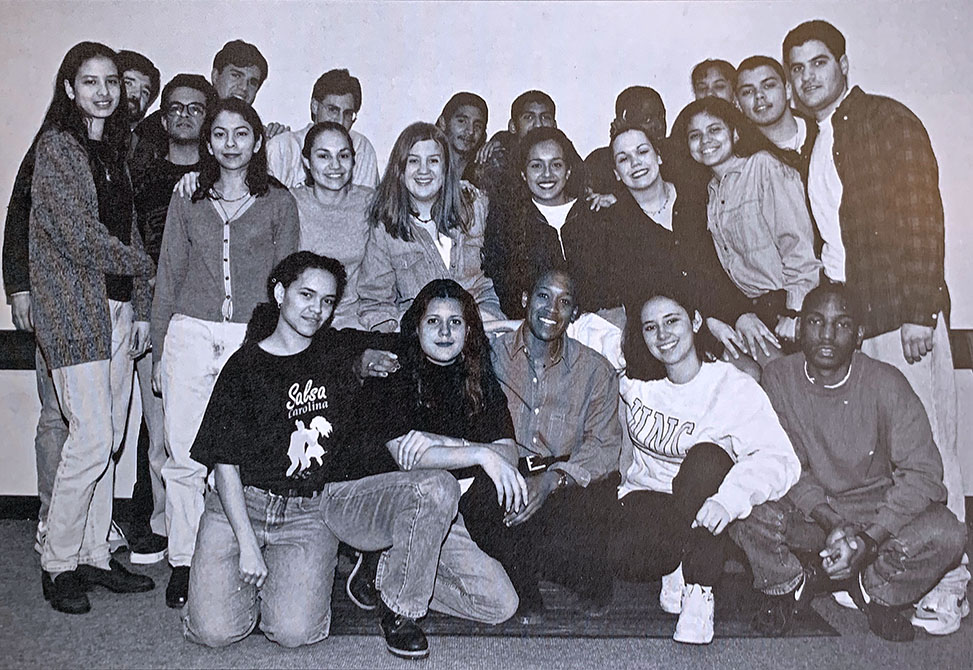
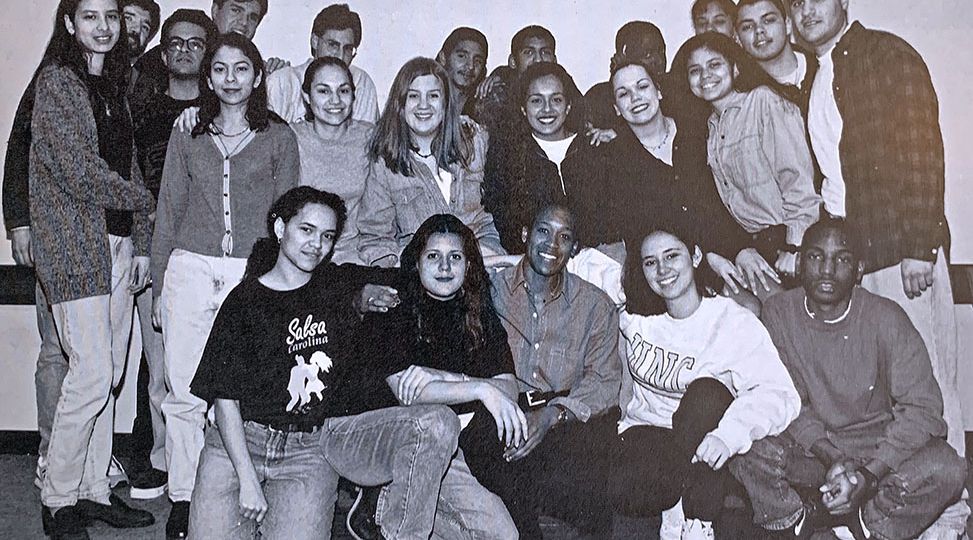
Members of the Carolina Hispanic Association. Yackety Yack, 1995, North Carolina Collection, Wilson Library.


16 Apr: Mi Pueblo

Mi Pueblo

Mi Pueblo was established as the Carolina Hispanic Association (often shortened to CHispA) and was the earliest student organization for Latino/a students at UNC—Chapel Hill. Founded in 1990, the group brought together students for social events and support. Early programs included Latin American dance classes and performances and invited lectures. With the rapid growth of the number of Latinx students at Carolina in the 1990s and 2000s, CHispA expanded to include several subgroups. By then it was one of many student organizations created by and for Latinx students. In 2018 members of the group voted to change the organization's name to Mi Pueblo.

MemorialHall_973

16 Apr: Memorial Hall

Memorial Hall

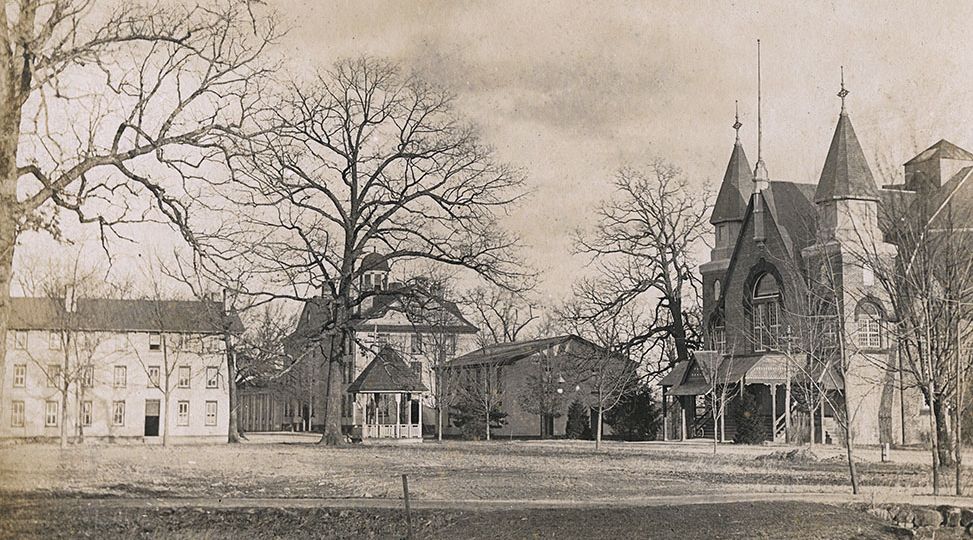
Memorial Hall is Carolina's main performing arts venue and the second building to bear the name and the marble tablets inside. The first Memorial Hall was built in 1885 as a new assembly space for a growing university. It was a combination memorial to the late UNC president David Lowry Swain, alumni who died fighting for the Confederacy, and notable men (and, later, women) of the state. University leaders raised money to build the hall through the sale of marble tablets to commemorate this last group, which they then displayed on its walls. That first building was eventually declared structurally unsound, and in 1930 the university demolished it and erected the present Colonial Revival building. They preserved the marble tablets and placed them into the new building, although not in their original organization. Currently, more than one hundred and sixty marble tablets grace the walls.

Memorial Hall has been the site of commencements, baccalaureates, University Days, speeches, protests, and performances of all kinds. A renovation in 2005 finally gave the hall a fly system, off-stage areas, dressing rooms, and most important, air conditioning. Memorial Hall is the main performance space for Carolina Performing Arts, which brings to campus an array of productions by prominent and popular performing artists from around the world.

Date Established: 1931

Date Range: 1931 – Present

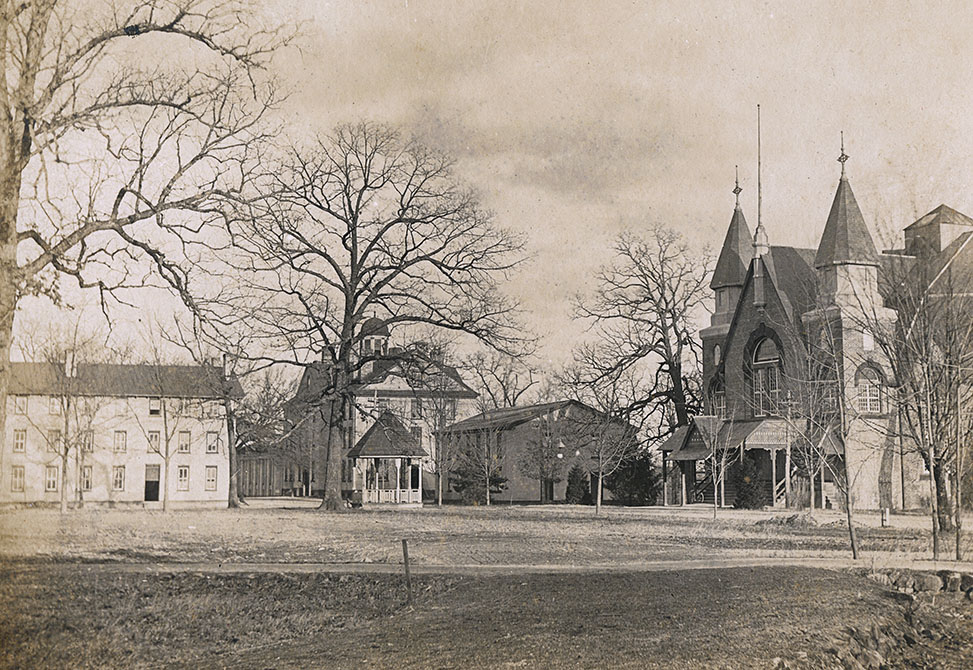
In this photo, taken between 1896 and 1905, the original Memorial Hall is visible on the right, with Old West, South Building, and Gerrard Hall (right to left) in the background. Collier Cobb Photo Collection, North Carolina Collection Photo Archives, Wilson Library.


16 Apr: Meeting of the Waters Creek

Meeting of the Waters Creek

Meeting of the Waters Creek passes through and, in some cases, under the university campus. The creek has been channeled into tunnels passing underneath several campus buildings, including Kenan Stadium. It emerges in the Coker Pinetum, south of Ehringhaus dorm, and flows into the North Carolina Botanical Garden, where it joins Morgan Creek. Coker Pinetum is a twenty-five-acre area that connects the campus with the Botanical Garden. Botany professor William C. Coker gave the property to the university to be used for teaching and as a living laboratory.

16 Apr: Medicine, School of

Medicine, School of

The university first established a School of Medicine in 1879. It was a two-year program, designed to provide students with the fundamentals of medical education, with the understanding that they would continue their education elsewhere. This first effort was short-lived, with the school closing in 1885 after the first dean resigned. It reopened in 1890 as a "special school of medicine and pharmacy."

The School of Medicine moved around campus, housed at different times in New East and Person Hall before moving into the university's first building constructed for medical education, Caldwell Hall, in 1912. The school also used a small wooden building south of campus as a "dissecting hall." Students were required to take a course in dissection as part of their study of anatomy. This introduced the problem common at nineteenth-century medical schools: finding bodies to operate on. The university, not unlike other medical schools at the time, was believed to have employed grave robbers to secure cadavers. The majority of bodies used by the students during that era were African Americans.

In 1902 UNC began a "University of North Carolina Medical Department at Raleigh," offering classes in the state capital. But this closed in 1909, as the university had difficulty funding both programs. As the university advocated to expand to a full four-year medical program, the university system and legislature explored other options, including a rumored proposal from Bowman Gray to fund the school, provided it move to Winston-Salem. In the late 1940s the legislature finally agreed to support a four-year medical program and the establishment of a teaching hospital in Chapel Hill. The North Carolina Memorial Hospital opened in 1952 and the first class of the four-year program graduated in 1954.

Since the establishment of the four-year program, the School of Medicine and related programs in health sciences have seen rapid growth. In 1971 the school significantly expanded its statewide reach with the establishment of Area Health Education Centers. These regional centers provide continuing education opportunities for health professionals across North Carolina.

The school grew throughout the late twentieth and early twenty-first centuries, expanding throughout South Campus and establishing new programs and centers focused on genome sciences, maternal and infant health, infectious disease, cardiovascular biology, cancer research, and many others. By the 2010s the School of Medicine was consistently recognized as one of the nation's leading medical schools.

16 Apr: Media and Journalism, School of

Media and Journalism, School of

The English department began courses in journalism in 1909, and UNC set up a separate Department of Journalism in 1924. Gerald W. Johnson, who went on to a distinguished journalism and writing career, served as the first department chair. The department became a School of Journalism in 1950, expanded to School of Journalism and Mass Communication in 1990, and adopted its current name in 2015. The school's first dean was Oscar J. Coffin, a Daily Tar Heel editor and Carolina alumnus, who led the department and the school for twenty-seven years.

When the department began in 1924, there were seventeen students, including five women. It had space on the second floor of New West, just above the Daily Tar Heel offices. Over the years the department and school have been in Bynum Hall, Howell Hall, and Carroll Hall. Today it has more than 900 students in bachelor's, master's, and doctoral programs, with areas of study in advertising and public relations, journalism, and business journalism. It also offers special programs in environment and science communication, health communication, Latino journalism and media, sports communication, and a joint M.A./J.D. degree with the School of Law.

The School of Media and Journalism has a number of distinguished alumni who have advanced the profession, including twenty-four alumni or faculty who have won or been part of twenty-eight Pulitzer Prizes. Graduates include Emily Steel of the New York Times, Brooke Baldwin of CNN, editorial cartoonist Jeff MacNelly, and Stuart Scott of ESPN, among many more.

Privacy Preferences
When you visit our website, it may store information through your browser from specific services, usually in form of cookies. Here you can change your privacy preferences. Please note that blocking some types of cookies may impact your experience on our website and the services we offer.